
General
Home / Examples / Stress Analysis [Galileo] / Example 13: Resonance of Tuning Fork
The resonance of a tuning fork is analyzed.
The state of deformation and the distributions of the displacement and stress are solved.
Unless specified in the list below, the default conditions will be applied.
Results will vary depending on Femtet version and the PC environment.
Item |
Settings |
Analysis Space |
3D |
Model Unit |
m |
The analysis type is the harmonic analysis.
Item |
Settings |
Solver |
Stress Analysis [Galileo] |
Analysis Type |
Resonant Analysis |
Options |
N/A |
The resonant analysis tab is set up as follows.
Tab |
Setting Item |
Settings |
Resonant analysis |
Number of Modes |
6 |
Approximated Frequency |
0 [Hz] |
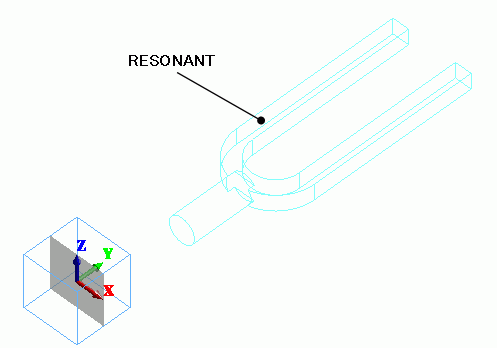
A tuning fork is created by combining cylindrical and rectangular solid bodies with boolean.
Body Number/Type |
Body Attribute Name |
Material Name |
8/Solid |
RESONANT |
001_Al * |
* Available from the material DB
N/A
The following will be output on the output window or the log file.
<<Eigenvalue analysis>> Eigenvalue (resonant frequency):[Hz] Mode[ 0] = 5.06139730e+002 Mode[ 1] = 7.76589632e+002 Mode[ 2] = 1.58726071e+003 Mode[ 3] = 1.92468740e+003 Mode[ 4] = 3.15995476e+003 Mode[ 5] = 4.14822255e+003 |
The resonant frequencies can be checked on Table.
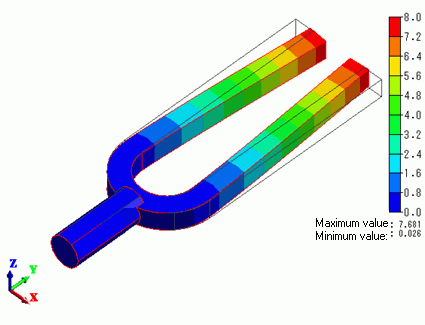
The displacement of the basic resonant mode, Mode[0], is shown below. The contour indicates the magnitude of the displacement.
The displacement of the high-order mode, Mode[1], is shown below. The contour indicates the magnitude of the displacement.
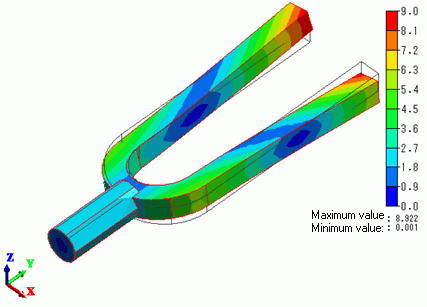
Mode[0] and Mode[1] exhibit completely different resonance.