General
Home / Examples / Stress Analysis [Galileo] / Example 14: Resonance of Cantilever
The resonance of a cantilever is analyzed. One end is set with the fixed displacement boundary condition.
The deformation, the displacement and the stress are solved.
The vibration sensitivity in a certain direction can be examined by the excitation factor and effective mass of the generated modes.
Unless specified in the list below, the default conditions will be applied.
Results will vary depending on Femtet version and the PC environment.
Item |
Settings |
Analysis Space |
3D |
Model Unit |
mm |
The analysis type is the harmonic analysis.
Item |
Settings |
Solver |
Stress Analysis [Galileo] |
Analysis Type |
Resonant Analysis |
Options |
N/A |
The resonant analysis tab is set up as follows.
Tab |
Setting Item |
Settings |
Resonant analysis |
Number of Modes |
3 |
Approximated Frequency |
0 [Hz] |
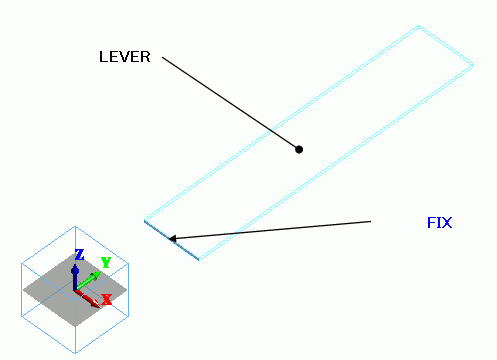
The cantilever is created as a box-shape solid body.
The material is silicon. One end is fixed with the displacement boundary condition.
Body Number/Type |
Body Attribute Name |
Material Name |
0/Solid |
LEVER |
301_Silicon(single-crystal) * |
* Available from the material DB
Boundary Condition Name/Topology |
Tab |
Boundary Condition Type |
Settings |
FIX/Face |
Mechanical |
Displacement |
Select all X/Y/Z components. UX=0, UY=0, UZ=0 |
The following will be output on the output window or the log file.
<<Eigenvalue analysis>> Eigenvalue (resonant frequency):[Hz] Mode[ 0] = 2.50953498e+004 Mode[ 1] = 1.65669006e+005 Mode[ 2] = 3.22935422e+005 |
The resonant frequencies can be checked on Table.
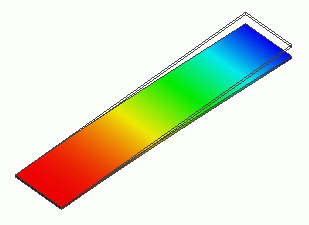
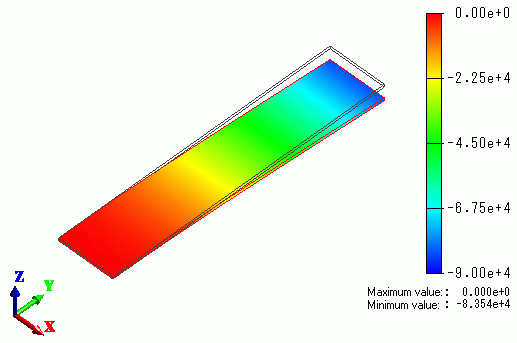
The displacement of the fundamental mode, Mode[0] , is shown below. The contours are the Z displacement.
The displacement of the higher-order mode, Mode[1], is shown below. The contours are the Z displacement.
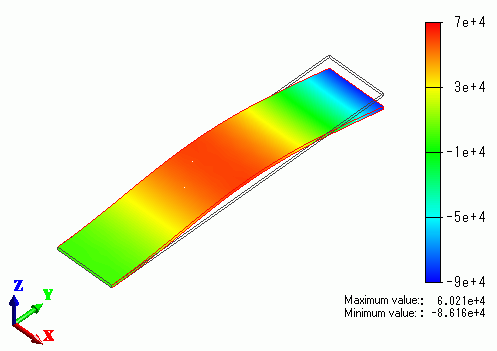
The fundamental mode and the higher-order mode show different displacements.
The effective mass ratio graph can be output from [Table].
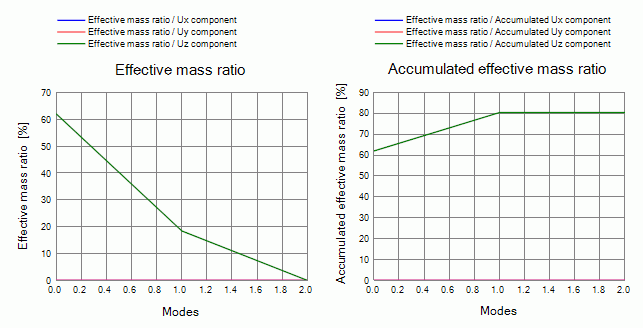
UZ component (the effective mass ratio in Z direction) is 62.0 [%] at Mode 0, 18.4 [%] at Mode 1, and 0 [%] at Mode 2.
Mode 0 is the main mode for the vibration in the Z direction.
The accumulated value up to mode 2 is 80.4 [%].
If more modes are calculated, the accumulated value will approach 100 [%].
UX and UY components are nearly zero. As for vibrations in the X and Y directions, the main modes are not obtained yet.
You need to calculate more modes.