General
Home / Examples / Stress Analysis [Galileo] / Example 16: Harmonic Analysis of Standing Bars
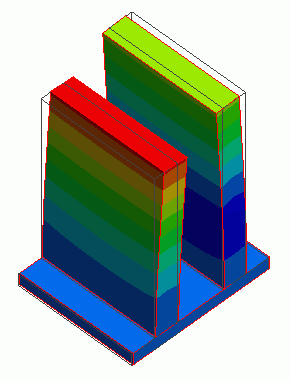
Forced oscillation is applied on two standing bars with different heights. The frequency of the forced oscillation affects the vibration.
The resulting vibrations are analyzed.
Unless specified in the list below, the default conditions will be applied.
The oscillation amplitude near the resonant frequency depends on the mechanical loss. Adjust the mechanical loss if needed. (See Example 50)
Results will vary depending on Femtet version and the PC environment.
Item |
Settings |
Analysis Space |
3D |
Model Unit |
mm |
The analysis type is the harmonic analysis.
Item |
Settings |
Solver |
Stress Analysis [Galileo] |
Analysis Type |
Harmonic Analysis |
Options |
N/A |
The resonant frequencies of each tower are 1250 [Hz] and 1650 [Hz], which are acquired by individual analyses.
Therefore, the sweep range is around those frequencies.
The harmonic analysis is set as follows.
Tab |
Setting Item |
Settings |
Harmonic analysis |
Frequency |
Minimum: 1000 [Hz] Maximum: 2000 [Hz] |
Sweep Type |
Linear Step by Division Number: Division 20 |
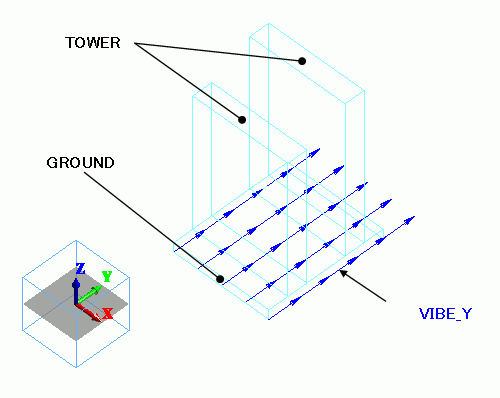
Two bars (TOWER) are standing on a plate (GROUND).
As a boundary condition, the displacement boundary condition (VIBE_Y) is set to the face topology
of the bottom face of GROUND to force the displacement in the Y direction.
Body Number/Type |
Body Attribute Name |
Material Name |
0/Solid |
TOWER |
001_Al * |
1/Solid |
TOWER |
001_Al * |
2/Solid |
GROUND |
001_Al * |
* Available from the material DB
To make the forced vibration, the displacement is set on the bottom face
of GROUND in the Y direction and the displacement in X and Z directions are fixed.
Boundary Condition Name/Topology |
Tab |
Boundary Condition Type |
Settings |
VIBE_Y/Face |
Mechanical |
Displacement |
Select all X/Y/Z components. UX=UX=0.0, UY=1×10⁻³ [m] |
This means the magnitude of Y displacement is 1[mm].
The displacement diagrams are shown below. The oscillation frequencies are 1000 [Hz], 1250 [Hz], 1450 [Hz], 1600 [Hz], and 2000 [Hz], respectively.
The contour diagram shows the magnitude of displacement.
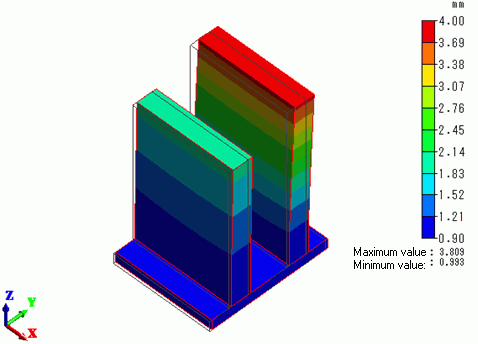
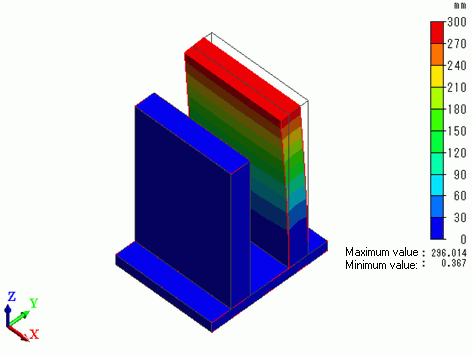
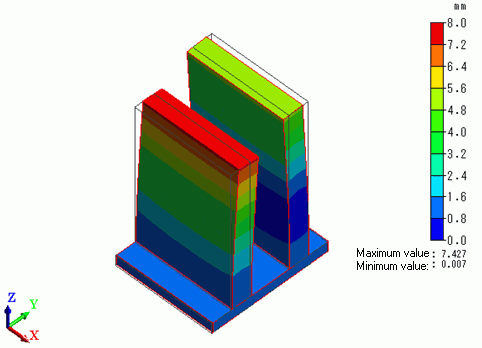
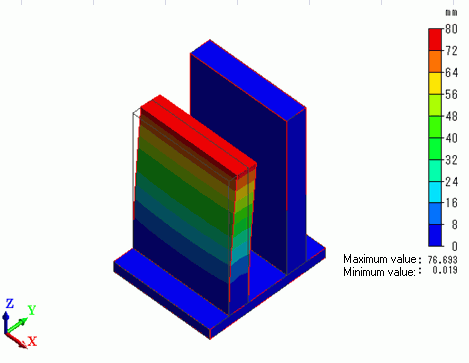
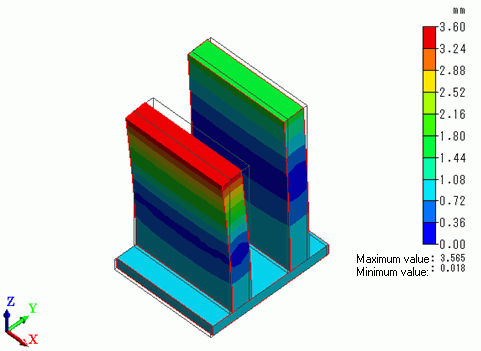
The displacement is high at the resonant frequencies: 1250 [Hz] and 1600 [Hz]. (Watch out for the maximum value of color scales)
The phases of each tower at the intermediate frequency between the two resonant frequencies are inversely related.