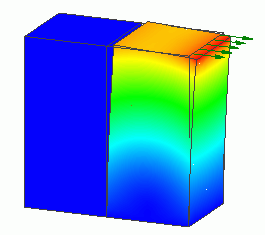
General
Home / Examples / Stress Analysis [Galileo] / Example 22: Blocks Set with Discontinuous Boundary
The [discontinuous] boundary condition is studied in this example. The model consists of two blocks in contact with each other.
The bodies in contact are usually considered to be fixed.
The bodies will never separate through the pulling force caused by mechanical loads. By setting the discontinuous boundary condition on the contacting face, the bodies in contact can separate.
The deformation, the displacement distribution, and the stress distribution are solved.
Unless specified in the list below, the default conditions will be applied.
Results will vary depending on Femtet version and the PC environment.
Item |
Settings |
Analysis Space |
3D |
Model Unit |
mm |
Item |
Settings |
Solver |
Stress Analysis [Galileo] |
Analysis Type |
Static Analysis |
Options |
N/A |
The two bodies are made of polyethylene.
The bottom faces of the bodies are fixed and one body is pulled outward. The pulling force is applied on an edge of the body.
The discontinuous boundary condition is set on the contacting face of the two bodies.
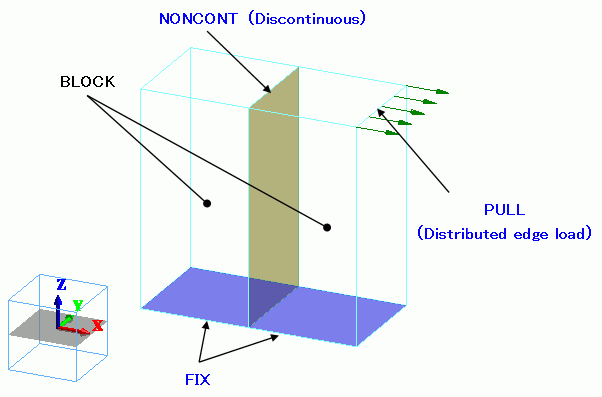
Body Number/Type |
Body Attribute Name |
Material Name |
0/Solid |
BLOCK |
000_Polyethylene(PE) * |
1/Solid |
BLOCK |
000_Polyethylene(PE) * |
* Available from the material DB
Boundary Condition Name/Topology |
Tab |
Boundary Condition Type |
Settings |
FIX/Face |
Mechanical |
Displacement |
UX=0, UY=0, UZ=0 |
NONCONT/Face |
Symmetry/Continuity |
Discontinuous |
Select [Discontinuous] |
PULL/Edge |
Mechanical |
Distributed Edge Load |
X=1,Y=Z=0 [N/m] |
The contour diagram shows the magnitude of displacement.
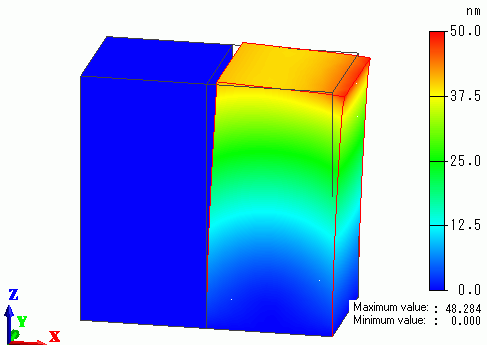
The face on which the discontinuous boundary condition is set is treated as two independent faces. Therefore the two bodies are separated by a gap.
For comparison, the model with the continuous boundary condition is analyzed.
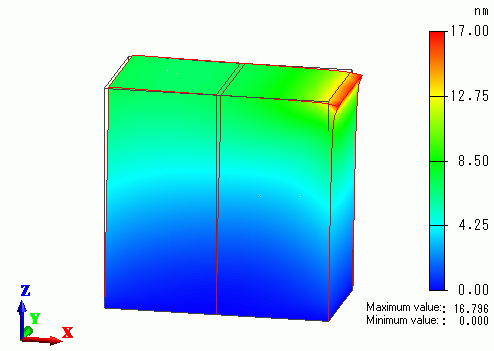
If the continuous boundary condition is set on it, the two bodies remain in contact and deform simultaneously as shown below.
In this example, one of the bodies is pulled outward and it bends away from the other.
If the force is applied inward, one of the bodies will bend towards the other, and get into it as if it does not exist, which causes the wrong result. In such a case, simple contact should be used.
The simple contact boundary condition with off-contact can be used the same as the discontinuous boundary condition. Please note, however, that the calculation time of the simple contact boundary condition is longer than that of the discontinuous boundary condition.