
General
Home / Examples / Stress Analysis [Galileo] / Example 31: Material with Temperature-Dependent Anisotropic Elasticity
The material has the temperature-dependent anisotropic elasticity. The deformation under thermal load is analyzed.
Multi-step thermal load analysis is performed with multiple reached temperatures. The stresses for each temperature are solved.
Unless specified in the list below, the default conditions will be applied.
Results will vary depending on Femtet version and the PC environment.
Item |
Settings |
Analysis Space |
3D |
Model Unit |
mm |
The temperature is applied evenly on the model.
Opt for the thermal load in the analysis condition, and set the reference temperature and the reached temperature.
There is no need to couple with the thermal analysis [Watt].
Item |
Settings |
Solver |
Stress Analysis [Galileo] |
Analysis Type |
Static Analysis |
Options |
Select Thermal Load |
The Step/Thermal Load tab is set as follows.
In this setting, thermal load analysis is performed with 3 reached temperatures step by step.
Tab |
Setting Item |
Settings |
|||||||||||
Step/Thermal Load |
Step Setting |
Multi-step Thermal Load Analysis |
|||||||||||
Reference Temperature |
25 [deg] |
||||||||||||
Step/Reached Temperature Setting |
|
The model is a cubic solid body. The material has the temperature-dependent anisotropic coefficient of linear thermal expansion.
The outer boundary condition is set with no displacement.
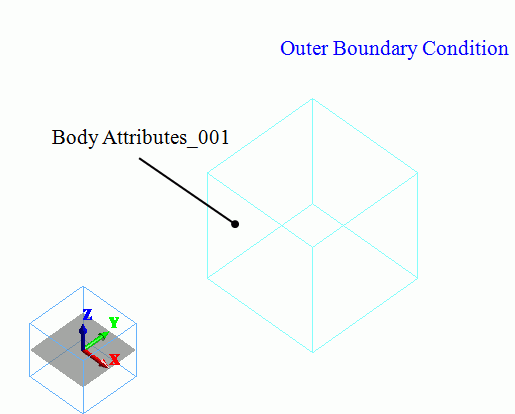
The temperature dependency for the elastic modulus is set for the temperature of 50, 75, and 100 deg.
At these three temperatures, the components 1, 2, and 3 of Young's modulus are set to 1 [Pa], respectively. At other temperatures, the components are set to 2 [Pa].
Material Name |
Tab |
Properties |
Material_Property_001 |
Elasticity |
Material Type: Elastic/Anisotropic Temperature Dependency: Yes
The temperature dependency of the elasticity is set as follows. The direction of the body attribute is by default. Components (x, y, z) of the elastic modulus correspond to the coordinates (X, Y, Z) of the modeling window.
* This is not the actual material's property. |
Coefficient of Linear Thermal Expansion |
Temperature Dependency: None Anisotropy: Isotropic Coefficient of Linear Thermal Expansion: 10×10-6 [1/deg]
|
Boundary Condition Name/Topology |
Tab |
Boundary Condition Type |
Settings |
Outer Boundary Condition |
Mechanical |
Displacement |
Select all X/Y/Z components. UX=0, UY=0, UZ=0 |
The figure below shows the principal stress at 50 deg.

At 50 deg, the compressive stress caused by isotropic expansion is smaller in X direction, as the X component of Young's modulus is smaller than the others.
The figure below shows the principal stress at 75 deg.
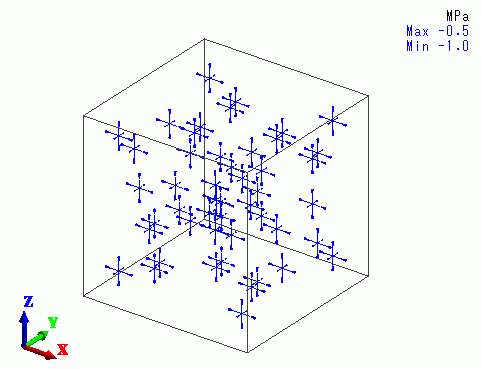
At 75 deg, the compressive stress caused by isotropic expansion is smaller in Y direction, as the Y component of Young's modulus is smaller than the others.
The figure below shows the principal stress at 100 deg.
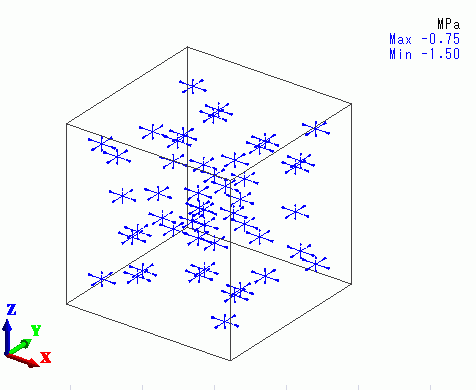
At 100 deg, the compressive stress caused by isotropic expansion is smaller in Z direction, as the Z component of Young's modulus is smaller than the others.
