Home / Examples / Stress Analysis [Galileo] / Example 32: Elastic Collision
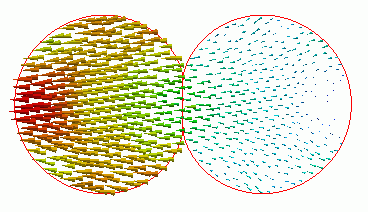
An object with an initial velocity collides with another still object. Transient analysis is performed.
The stresses and the deformations are solved.
Unless specified in the list below, the default conditions will be applied.
Item |
Settings |
Analysis Space |
2D |
Model Unit |
mm |
To simplify the simulation, the 2D model is created and analyzed.
[Large deformation] is selected, as it is expected.
Item |
Setting |
Solver |
Stress Analysis [Galileo] |
Analysis Type |
Transient Analysis |
Large Deformation |
Select Large displacement |
The transient analysis is set up as follows.
The time steps after the collision are smaller than those before the collision.
Tab |
Setting Item |
Settings |
||||||||||||
Transient Analysis |
Table |
|

Circular sheet bodies represent objects.
Each side periphery is set with a contact boundary (contactor or contactee face), and they are paired in the [Boundary Pair] dialog box.
Body Number/Type |
Body Attribute Name |
Material Name |
0/Sheet |
Body_Attribute_001 |
005_Polyurethane * |
1/Sheet |
Body_Attribute_002 |
005_Polyurethane * |
(*) Available from the material DB
The initial velocity of the right object is set as follows. That of the left object is 0 by default.
Body Attribute Name |
Initial Velocity |
Body_Attribute_002 |
X Component: -100 [m/s] Y and Z Components: 0 [m/s] |
Boundary Condition Name/Topology |
Tab |
Boundary Condition Type |
Setting |
Contactor/Edge |
Mechanical |
Contact Surface |
Select [Contactor Surface]. |
Target/Edge |
Mechanical |
Contact surface |
Select [Contactee Surface]. |
The contactor and contactee surfaces are designated as a contact pair in the [Boundary Pair] dialog box. In contact analyses, the contact surfaces must be designated as a boundary pair.
The principal stress distribution at 1.5e-4 [s] is shown on the displacement diagram below.
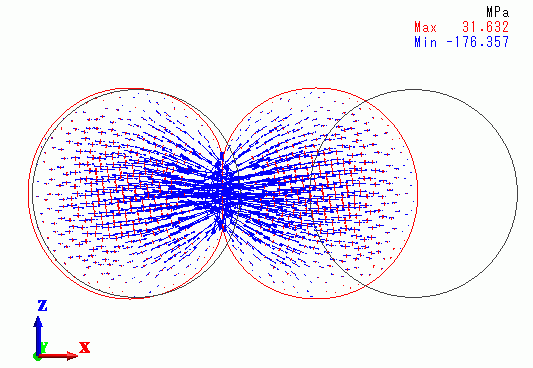
Large deformations and stresses are exhibited around the contact area.
The chart below shows the velocities of 2 objects over time.
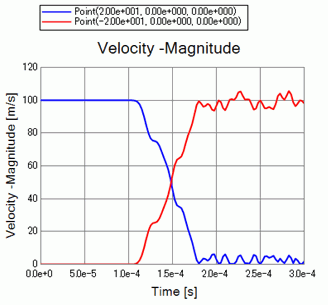
The blue and red plots are for the right and left objects, respectively.
The velocity is transferred from the right object to the left from 1.0e-4 [s] over to 2.0e-4 [s].
This is explained by the theory of elastic collision in which exchange of velocity takes place before and after the elastic collision between objects of the same mass on the straight line.
While the results displayed, on the [Show Results] tab

, click [Create Animation]  . The animation file (.avi) will be created.