Home / Examples / Stress Analysis [Galileo] / Example 34: Energy Release Rate
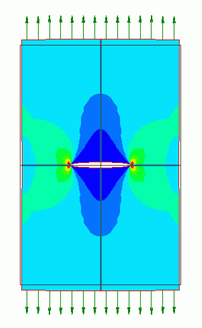
A plate with a crack is pulled and the resulting stress is analyzed.
From the resulting strain energy, the energy release rate and the stress intensity factor are calculated.
These values are used to evaluate the ultimate tensile strength.
See Example 46: Energy Release Rate Calculated by J Integral for another way to solve it.
Unless specified in the list below, the default conditions will be applied.
Results will vary depending on Femtet version and the PC environment.
Item |
Settings |
Analysis Space |
2D |
Thickness in Depth Direction |
1000 [mm] |
Model Unit |
mm |
Item |
Settings |
Solver |
Stress Analysis [Galileo] |
Analysis Type |
Static Analysis |
Options |
N/A |
A plate with a crack is pulled and the resulting stress is analyzed.
The tensile strength can be evaluated by the stress intensity factor, K.
The theoretical value of K is given by the equation below.
We acquire K through the simulation and compare it with the theoretical value.

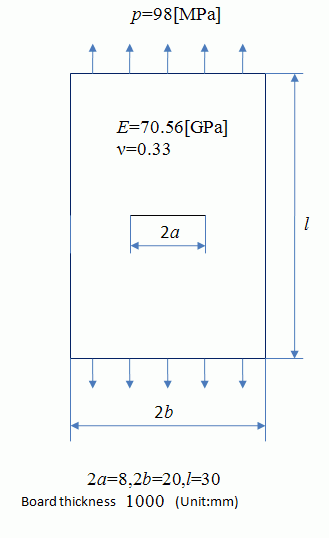
The model is symmetric vertically and horizontally. Therefore a quarter of the model is analyzed.
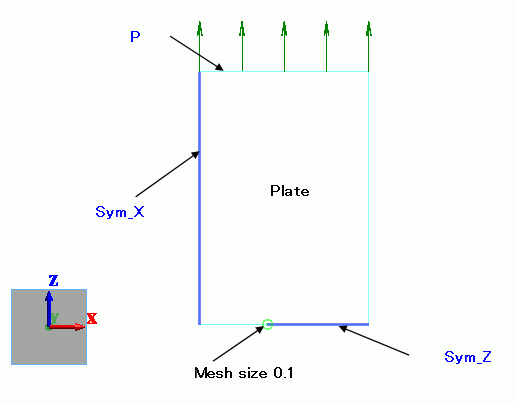
Select [Reflective] on the Symmetry/Continuity tab for each face of symmetry.
Body Number/Type |
Body Attribute Name |
Material Name |
0/Sheet |
Plate |
Fe |
Set Young's modulus and Poisson's ratio.
Material Name |
Young's Modulus |
Poisson's Ratio. |
PlateMat * |
70.56X10⁹ [Pa] |
0.33 |
* Depends on the material.
Boundary Condition Name/Topology |
Tab |
Boundary Condition Type |
Settings |
Sym_X/Edge |
Symmetry/Continuity |
Symmetry |
Reflective |
Sym_Z/Edge |
Mechanical |
Symmetry |
Reflective |
P/Edge |
Mechanical |
Pressure |
-98X106 [Pa] |
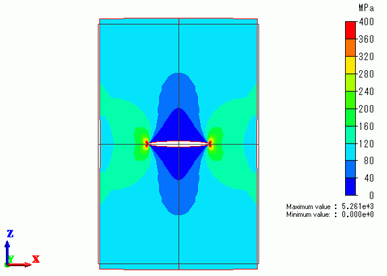
In the figure below, the maximum principal stress is superposed on the displacement diagram.
The color scale range is 0 to 400 MPa.
The full model can be viewed.
High stress is exhibited at the end of the crack.
It is not practical to directly relate the stress to the ultimate tensile strength,
since the stress depends on the meshing.
It is common to use the energy release rate and the stress intensity factor to estimate the ultimate tensile strength.
The energy release rate (g) is given by the following equation in terms of the strain energy (U) and the length (a).
 (1)
(1)
Here, the length changes from a=4.05 to a=3.95.
With this quarter model, U=12.1805977 [J] at a=4.05 [mm] and
U=12.0728236 at a=3.95. So for the full model,
 (2)
(2)
Note that it is multiplied by 4 as the full model's energy is 4 times as much as the quarter model's energy.
Also note that it is divided by 2 as the full model's crack is twice as long as the quarter model's crack.
In the 2D analysis, the energy release rate “g” and the stress intensity factor “K” have following relationship.
Plane stress
 (3)
(3)
Plane strain
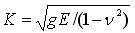 (4)
(4)
Equation (3) is applicable for this example. By using Equation (2), we get the stress intensity factor as follows.
 (5)
(5)
This value matches quite well with the theoretical value with about a 2% error.