Home / Examples / Stress Analysis [Galileo] / Example 36: Damping Vibration of Cantilever
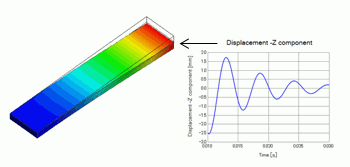
A cantilever is mechanically loaded. After it is unloaded, it starts to vibrate. The vibrations decay over time.
The displacement and the stress are solved for each timestep.
Unless specified in the list below, the default conditions will be applied.
Item |
Settings |
Analysis Space |
3D |
Model Unit |
mm |
Item |
Settings |
Solver |
Stress Analysis [Galileo] |
Analysis Type |
Transient Analysis |
The transient analysis is set up as follows.
Tab |
Setting Item |
Settings |
|||||||||
Transient Analysis Tab |
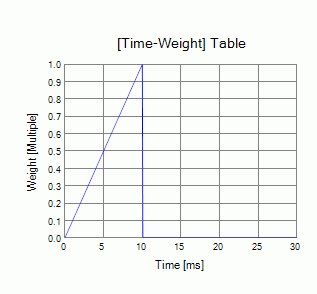
Table |
|
|||||||||
Rayleigh Damping Coefficients |
Beta=0.0002 |
The load gradually increases in the first 5 steps. In the next 100 steps,
it is unloaded, and the damping vibration occurs.
0 to 0.01 [sec]: Loading Period
0.01 to 0.03 [sec]: Vibration Period
Body Number/Type |
Body Attribute Name |
Material Name |
0/Sheet |
Body_Attribute_001 |
002_Polycarbonate(PC) |
Boundary Condition Name/Topology |
Tab |
Boundary Condition Type |
Settings |
||||||||||
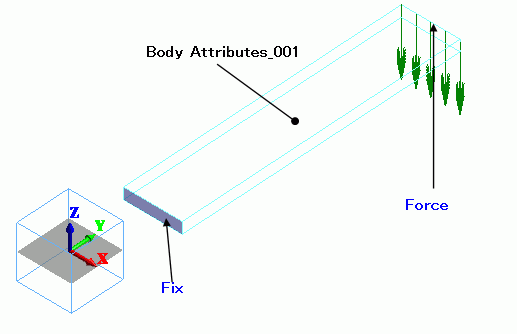
Fix/Face |
Mechanical |
Displacement |
Select all X/Y/Z components. UX=0, UY=0, UZ=0 |
||||||||||
Force/Face |
Mechanical |
Distributed Face Load |
X=0, Y=0, Z=-0.5x10⁵
Time Dependency: Yes
The loading is removed instantaneously at 0.01 [sec]. |
Perform a static analysis and obtain the adequate loading condition for the target displacement beforehand.
Perform a resonant analysis and obtain the adequate timestep for the expected vibration period.
If a timestep is large, it may degrade the analysis accuracy.
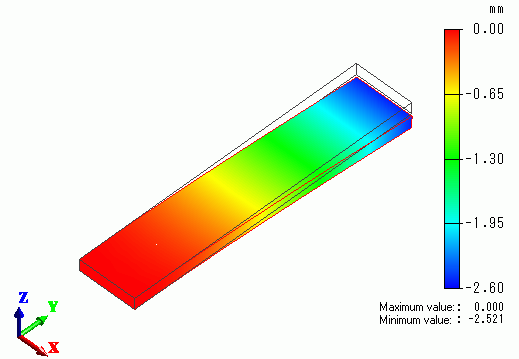
The displacement diagram below shows the displacement at the time of 0.01 [sec] (mode number of 5). The color gradation contour indicates the Z displacement.
Plotted below is the Z displacement of the cantilever tip in 0.01 to 0.03 [sec] (Mode numbers 5 through 105)
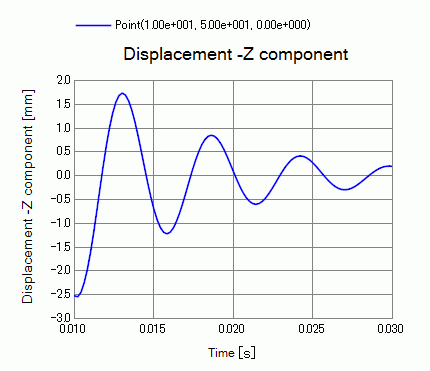
The vibration decays as time passes.
The figure below shows the vibration when Beta, Rayleigh Damping Coefficients, is set to zero for no damping loss.
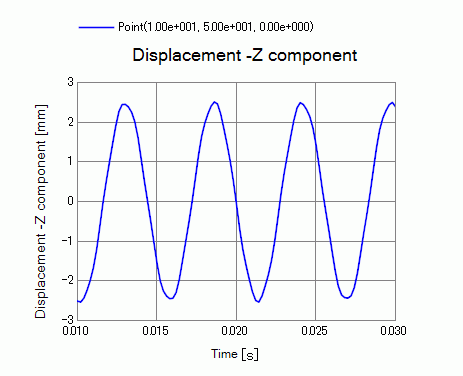
There is no decay.