Home / Examples / Stress Analysis [Galileo] / Example 39: Elasto-Plastic Creep Material Subjected to Repetitive Thermal Loading
This is an example of multi-step thermal load analysis for elasto-plastic creep material.
The solder as a temperature-dependent elasto-plastic creep material is sandwiched with two materials having different coefficients of linear thermal expansion, and subjecting to the thermal load.
The plastic and creep strains accumulating over time are solved.
Unless specified in the list below, the default conditions will be applied.
The elasto-plastic creep analysis is a special option.
Item |
Settings |
Analysis Space |
Axisymmetric |
Model Unit |
mm |
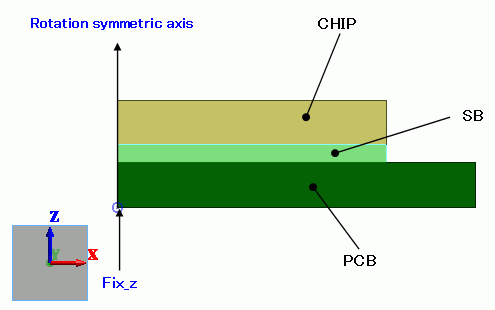
To simplify the analysis, the axisymmetric model is analyzed.
Select the thermal load option.
Item |
Settings |
Solver |
Stress Analysis [Galileo] |
Analysis Type |
Static Analysis |
Options |
Select Thermal Load |
The Step/Thermal Load tab is set as follows.
Tab |
Setting Item |
Settings |
|||||||||||||||||||||||||||||||||||
Step/Thermal Load |
Step Setting |
Multi-step Thermal Load Analysis |
|||||||||||||||||||||||||||||||||||
Time Setting |
Set up |
||||||||||||||||||||||||||||||||||||
Reference temperature |
25 [deg] |
||||||||||||||||||||||||||||||||||||
Step/Reached Temperature Setting |
|
||||||||||||||||||||||||||||||||||||
Options for the Multi-Step Analysis |
Save the results of substeps : Select |
The reference temperature (non-stress temperature) is 25 [deg]
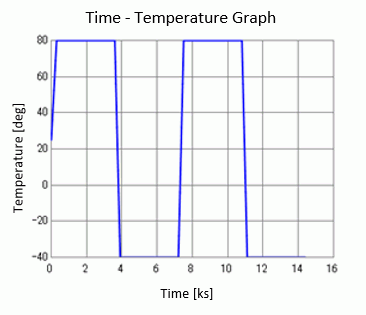
Select [Multiple steps] for the step setting and [Set up] for the time setting,
and set the time, substeps, and reached temperature for the step/reached temperature setting.
The duration of the temperature-rise/fall steps is 300 [s] = 5 [min] each and the number of substeps is 10.
The duration of the temperature-keep steps is 3300 [s] = 55 [min] and the number of substeps is 10.
The absolute time is a physical parameter required for the creep materials analysis.
The creep strain changes even during the temperature-keep steps.
The number of substeps is set to 10, the same number as the temperature-rise/fall steps.
Save results of substeps is selected by default to output all the results at substeps.
A silicon chip is to be soldered on a glass-epoxy PCB.
The mesh size of the solder ball is set to 0.2.
Body Number/Type |
Body Attribute Name |
Material Name |
0/Sheet |
PCB |
006_Glass_epoxy |
1/Sheet |
SB |
SOLDER |
2/Sheet |
CHIP |
301_Silicon(single-crystal) |
The material properties of SOLDER are set up as follows:
Material Name |
Tab |
Properties |
SOLDER |
Elasticity |
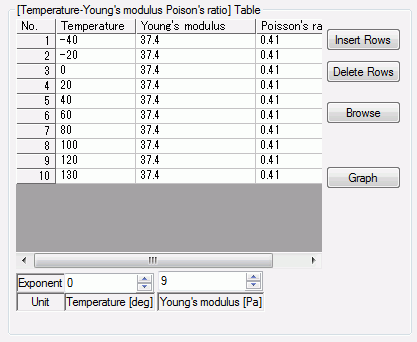
Material Type: Elasto-plastic/Multilinear Hardening Law: Kinematic Hardening Temperature Dependency: Yes Material Property: [Young's Modulus Poison's Ratio Temperature] Table:
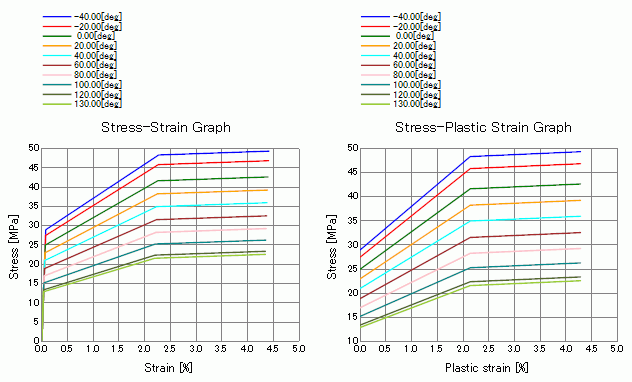
[Plastic strain-Stress] Multilinear: omitted due to too many points
Stress-Strain Graph, Stress-Plastic strain Graph
|
Creep |
Creep Type: Power Law Temperature Dependency: Yes Units in Creep Equation: Stress [MPa], Time [h] Material Property: See the table below
|
|
Coefficient of Linear Thermal Expansion |
23X10-6 [1/deg] |
Boundary Condition Name/Topology |
Tab |
Boundary Condition Type |
Settings |
Fix_z/Vertex |
Mechanical |
Displacement |
Select the Z-direction component. UZ=0 |
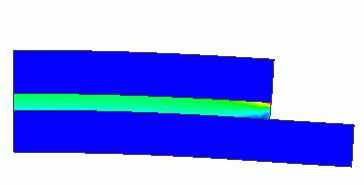
The accumulated equivalent creep strain at the final time 14400 [s] is shown below.
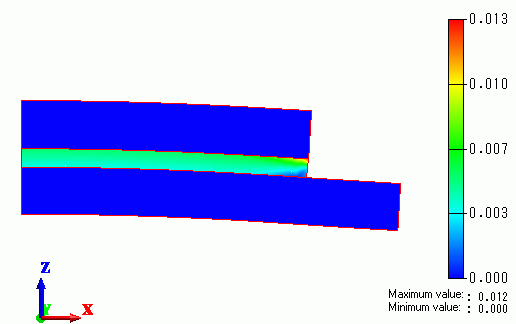
Creep strains are exhibited all over the solder.
Creep strains are concentrated at the top right corner of the solder.
The accumulated equivalent creep strain over time is shown below.
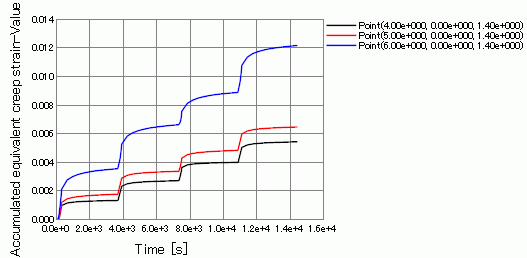
The accumulated equivalent creep strain increases drastically when the temperature changes.
It increases slowly even in the temperature-keep period.
The accumulated equivalent plastic strain over time is shown below.
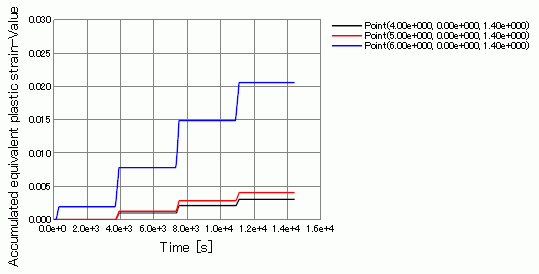
Unlike the creep strain, it increases only when there is a temperature change.
Compared to Ex-38, the plastic strain is reduced.
The von Mises equivalent stress at the border of SB and CHIP over time is shown below.
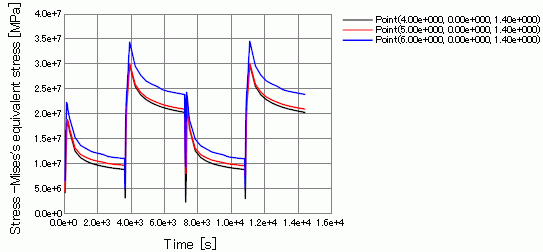
Compared to Ex-38, the Mises's equivalent stress is relaxed during the temperature-keep period.