Home / Examples / Stress Analysis [Galileo] / Example 47: Peel Off
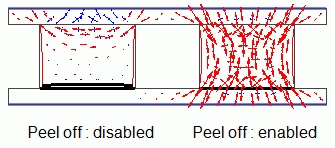
Simple contact analysis is performed with peeling taken into account.
Two cubes are sandwiched by two plates. Both cubes are attached to the upper plate. The right cube is sticky and adheres to the lower plate. The left cube does not adhere to the lower plate at all. Their simple boundary conditions reflect the difference.
Unless specified in the list below, the default conditions will be applied.
Results will vary depending on Femtet version and the PC environment.
Item |
Settings |
Analysis Space |
2D |
Model Unit |
mm |
Item |
Settings |
Solver |
Stress Analysis [Galileo] |
Analysis Type |
Static Analysis |
Options |
Select thermal load |
The Step/Thermal Load tab is set as follows.
Tab |
Setting Item |
Settings |
|||||||||||
Step/Thermal Load |
Step Setting |
Multi-step Thermal Load Analysis |
|||||||||||
Reference Temperature |
25 [deg] |
||||||||||||
Step/Reached Temperature Setting |
|
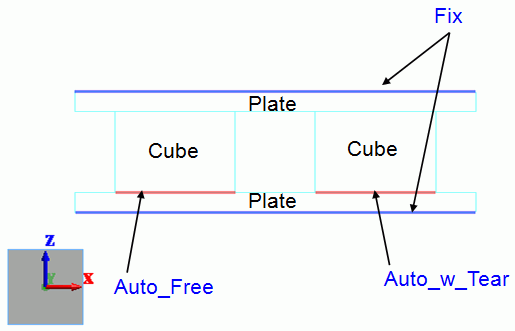
Two cubes are sandwiched by two plates. Both cubes are attached to the upper plate. The top face of the upper plate and the bottom face of the lower plate are fixed.
The right cube is sticky and adheres to the lower plate. The left cube does not adhere to the lower plate at all. Their simple boundary conditions reflect the difference.
Body Number/Type |
Body Attribute Name |
Material Name |
0/Sheet Body |
Fixed_Plate |
Plate |
1/SheetBody |
Fixed_Plate |
Plate |
2/SheetBody |
Bond_Cube |
Cube |
3/SheetBody |
Bond_Cube |
Cube |
The material properties are set as follows. The coefficient of linear thermal expansion is set only to Cube.
Material Name |
Tab |
Properties |
Plate |
Elasticity |
Material Type: Elastic/Isotropic Young's Modulus: 1x10⁹ [Pa] Poisson's Ratio: 0.3 |
Coefficient of Linear Thermal Expansion |
0.0 [1/deg] |
|
Cube |
Elasticity |
Material Type: Elastic/Isotropic Young's modulus: 1x10⁹ [Pa] Poisson's Ratio: 0.3 |
Coefficient of Linear Thermal Expansion |
10.0 [1/deg] |
The boundary conditions set on the bottoms of the two cubes are different. See the table below for details.
Boundary Condition Name/Topology |
Tab |
Boundary Condition Type |
Settings |
Fix/Edge |
Mechanical |
Displacement |
Select the X and Z components. UX=0, UZ=0 |
Auto_Dry/Edge |
Mechanical |
Simple contact |
Simple Contact Classification : Automatic Judgment |
Automatic Judgment Setting : Coefficient of Friction : 0.0 Take into account peeling: Deselected |
|||
Auto_Sticky/Edge
|
Mechanical |
Simple contact |
Simple Contact Classification : Automatic Judgment |
Automatic Judgment Setting : Take into account peeling: Selected Peel Strength : 5x10³ [Pa] |
The principal stresses and the displacement are shown below for each step. The scale factor for the displacement is 200.
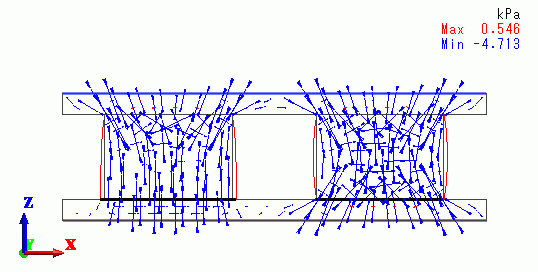
< Step 1 / Reached temperature = 50 deg. >
 |
| Slip Bond |
The cubes expand due to the temperature rise. Compressive stresses are generated inside the cubes.
The left cube slips on the lower plate and the right cube adheres to the lower plate.
The directions of the compressive principal stress differ and the deformations differ between the right and left.
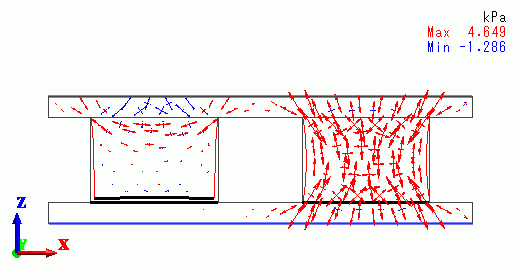
< Step 2 / Reached temperature = 0 deg. >
 |
| Off contact Bond |
The cubes contract due to the descent of the temperature. Tensile stresses are generated inside the cubes.
The left cube is off the lower plate. The right cube still adheres to the plate because the tensile stress on the boundary is less than the peel strength (5 [kPa]).
< Step 3 / Reached temperature = -25 deg. >
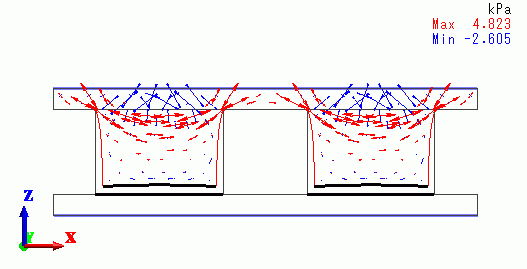 |
| Off contact Off contact |
Finally, the right cube is off the lower plate because the tensile stress exceeds the peel strength.