General
Home / Examples / Stress Analysis [Galileo] / Example 50: Harmonic Analysis of a Tower with Mechanical Loss
A tower which has certain mechanical loss is forced to oscillate.
The relation between the oscillation amplitude and the mechanical loss is examined.
Unless specified in the list below, the default conditions will be applied.
The oscillation amplitude near the resonant frequency depends on the mechanical loss. Adjust the mechanical loss if needed.
Results will vary depending on Femtet version and the PC environment.
Item |
Settings |
Analysis Space |
3D |
Model Unit |
m |
The analysis type is harmonic analysis.
Item |
Settings |
Solver |
Stress Analysis [Galileo] |
Analysis Type |
Harmonic Analysis |
The harmonics analysis tab is set up as follows.
Item |
Settings |
Sweep Type |
Linear Step by Frequency |
Setting |
Minimum Frequency: 0.8 [Hz] Maximum Frequency: 1.0 [Hz] Frequency Step: 0.01 [Hz] |
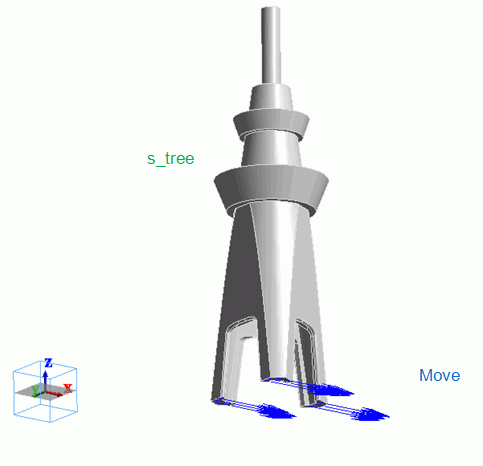
The forced X displacement is applied on the bottom of the tower. The applied displacement is set to 0.1 [m] on the bottom as boundary condition.
Body Number/Type |
Body Attribute Name |
Material Name |
0/Solid |
Tower |
002_Polycarbonate(PC) * |
* Available in Material DB. However the mechanical loss tanδ is set to 0.1 without any bases.
Boundary Condition Name/Topology |
Tab |
Boundary Condition Type |
Settings |
Move/Face |
Mechanical |
Displacement |
Select all X/Y/Z components. UX=0.1, UY=0, UZ=0 [m] |
If the loss is considered, the displacement might not be the maximum at the phase 0° due to the phase shift. To prevent it, go to Results > Phase, where [Maximum] is selected to show the maximum displacement.
The relation between the maximum displacement at the top of the tower and the oscillation frequency is shown in the following graph.
Three curves shown in this graph are obtained by different tanδ values (0.05, 0.1, 0.2).
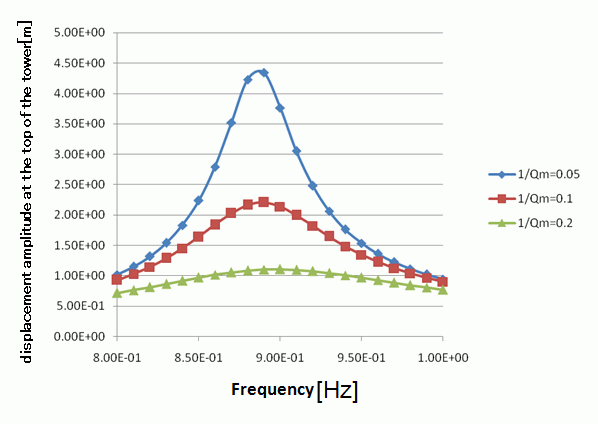
When smaller tanδ value is set, the shape of the curve becomes steeper.
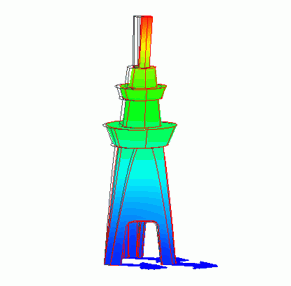
The displacement shown below is when the oscillation of 0.88 [Hz] is applied. The tanδ value is set to 0.1.
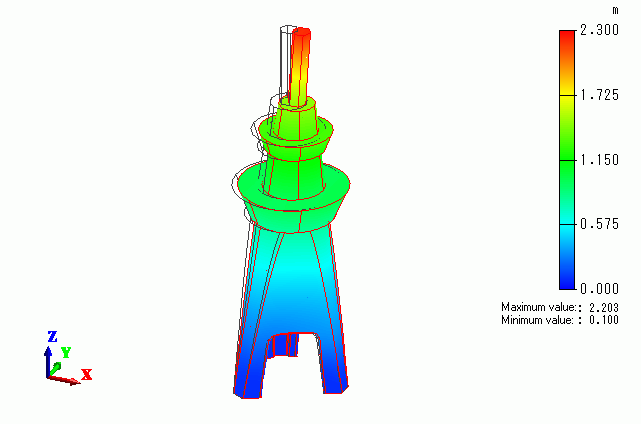
While the amplitude applied on the bottom of the tower is 0.1 [m], the amplitude of the generated oscillation is 2.2 [m] at the top of the tower.
Note: Resonant analysis is available by changing the analysis type to resonant analysis. The resonant frequency will be given. It should be noted that the displacement acquired is relative.