General
Home / Examples / Stress Analysis [Galileo] / Example 51: Deformation of Viscoelastic Bar
The model is a bar made of viscoelastic plastic, polystyrene. It is forced to bend.
The bar is subjected to the temperature change below and over the glass transition temperature.
Unless specified in the list below, the default conditions will be applied.
The viscoelastic analysis is a special option.
Item |
Settings |
Analysis Space |
3D |
Model Unit |
mm |
The bar is subjected to the temperature change below and over the glass transition temperature.
Select [Thermal Load].
Item |
Settings |
Solver |
Stress Analysis [Galileo] |
Analysis Type |
Static Analysis |
Options |
Select Thermal Load |
The Step/Thermal Load tab is set as follows.
Tab |
Setting Item |
Settings |
|||||||||||||||||||||||||||||||
Step/Thermal Load |
Step Setting |
Multi-step Thermal Load Analysis |
|||||||||||||||||||||||||||||||
Time Setting |
Set up |
||||||||||||||||||||||||||||||||
Reference temperature |
25 [deg] |
||||||||||||||||||||||||||||||||
Step/Reached Temperature Setting |
|
||||||||||||||||||||||||||||||||
Options for the Multi-Step Analysis |
Save the results of substeps : Select |
The reference temperature (non-stress temperature) is 25 [deg]
Time setting is required in the viscoelasticity analysis. Select [Multiple steps] for the step setting and [Set up] for the time setting,
and set the time, substeps, and reached temperature for the step/reached temperature setting.
Each step below consists of 5 substeps.
Step 1 : 60 [s] : The load is increased gradually for 1 min.
Step 2 : 3540 [s] : The load is sustained for almost 1 hour.
Step 3 : 3600 [s] : The load is decreased gradually for 1 min.
Step 4 : 3660 [s] : The temperature is increased to 120 [deg] in 1 min.
Step 5 : 3720 [s] : The load is increased gradually for 1 min.
Step 6 : 7200 [s] : The load is sustained for almost 1 hour.
Step 7 : 7260 [s] : The load is decreased gradually for 1 min.
Save results of substeps is selected by default to output all the results at substeps.
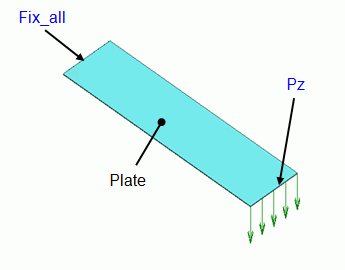
The model is a box solid body with a thickness of 0.4 mm. The material is polystyrene.
Body Number/Type |
Body Attribute Name |
Material Name |
0/Solid |
Plate |
PS |
The material properties for PS are set up as follows:
Material Name |
Tab |
Properties |
PS |
Elasticity |
Material Type: Elastic/Isotropic Temperature Dependency: None Material Property: Young's Modulus: 1.39x10⁹ [Pa] Poisson's Ratio: 0.35 |
Viscoelasticity |
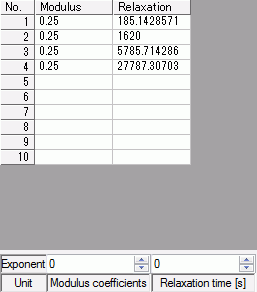
Defined by: Prony Series [Coefficient Input] Relaxation Component: Shear Only Relaxation Table:
Temperature Dependency and Shift Function: WLF Reference Temperature: 113 [deg] C1: 8.86 C2: 101.6
|
|
Coefficient of Linear Thermal Expansion |
0X10-6-6 [1/deg] |
Boundary Condition Name/Topology |
Tab |
Boundary Condition Type |
Settings |
Fix_all/Face |
Mechanical |
Displacement |
Select all X/Y/Z components. UX=0, UY=0, UZ=0 |
Pz/Edge |
Mechanical |
Distributed Edge Load |
Select [Set the total load]. X=0, Y=0, Z=-1.0x10⁻²
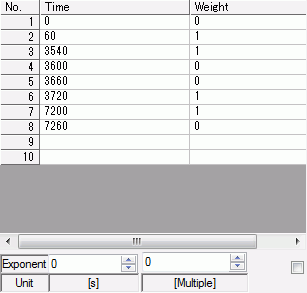
Select [Time Dependency] and set [Weight function] as follows.
This setting means the following. 60 [s] : The load is increased gradually for 1 min. 3540 [s] : The load is sustained for almost 1 hour. 3600 [s] : The load is decreased gradually for 1 min. 3720 [s] : The load is increased gradually for 1 min. 7200 [s] : The load is sustained for almost 1 hour. 7260 [s] : The load is decreased gradually for 1 min. |
Below are the diagrams of displacements at time 3540 s (about one hour after retaining the bending at 25℃) and
at time 7200 s (about one hour after retaining the bending at 120℃).
The magnitude of displacement is shown.
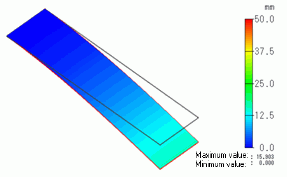
Displacement at 3540 [s] (Temperature: 25 [deg])
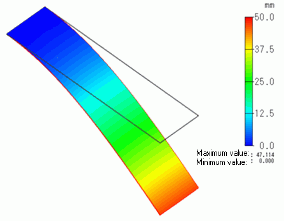
Displacement at 7200 [s] (Temperature:120 [deg])
The deformation is larger at 120 [deg], even though the mechanical load is the same as that of 25 [deg].
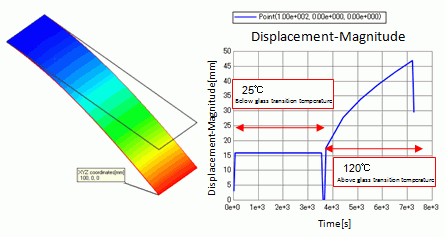
The graph below shows the displacement of the plate tip.
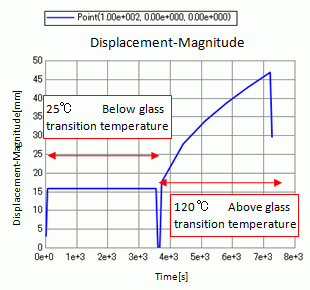
The displacement is constant at 25 [deg].
If unloaded, it returns to the original state.
The displacement increases at 120 [deg] even though the load is constant.
If unloaded, it doesn't return to the original state.