General
Home / Examples / Coupled Analysis / Thermal-Stress Analysis [Watt/Galileo] / Example 2: Deformation due to the Temperature Gradient #2 - Multiple Materials
A heating source is placed on a substrate to cause a temperature gradient. The temperature distribution is calculated using the thermal analysis with
forced air flow cooling taken into account. The resulting thermal expansion is analyzed by the stress analysis.
The temperature distribution is calculated using the thermal analysis [Watt].
The result is forwarded to the stress analysis [Galileo] as a thermal load corresponding to the reached temperature.
The deformation, the displacement and the stress are solved.
Unless specified in the list below, the default conditions will be applied.
Results will vary depending on Femtet version and the PC environment.
Item |
Settings |
Analysis Space |
3D |
Model Unit |
mm |
The coupled analysis of the thermal analysis [Watt] and the stress analysis [Galileo] is performed.
Item |
Settings |
Solver |
Thermal Analysis [Watt] |
Thermal-Analysis Type |
Steady-State Analysis |
Options |
N/A * |
* [Thermal Load] is selected by default for the thermal-stress coupled analysis.
The Step/Thermal Load tab is set as follows.
Tab |
Setting Item |
Settings |
Step/Thermal Load * |
Reference Temperature |
25 [deg] |
* The reached temperatures come from the thermal analysis.
The same as example 7 of thermal analysis.
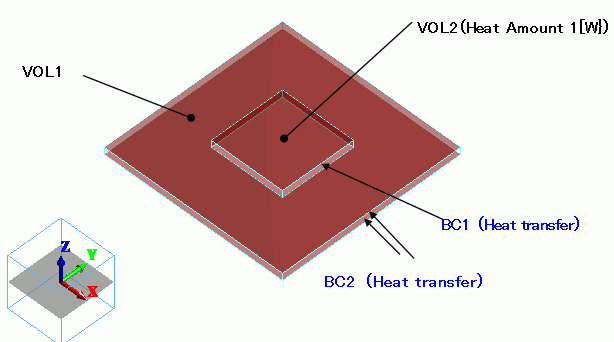
Body Number/Type |
Body Attribute Name |
Material Name |
0/Solid |
VOL1 |
006_Glass_epoxy * |
1/Solid |
VOL2 |
001_Alumina * |
* Available from the material DB
The heat transfer coefficients for the forced convection are calculated as follows.
h = 3.86 x (V/L)0.5xC [W/m2/deg]
where
Air flow V=1 [m/s]
Top and Bottom Faces of VOL1: Typical Length L =0.05, C=1 -> h=17.26
Top Face of VOL2: Typical Length L=0.02, L'=0.015, C=1 * -> h=27.3
*
The thickness (d) of the speed boundary layer at the edges of the heat source is calculated as follows
δ = 0.0182 x (L’/V)0.5= 2.3 [mm]
This is close enough to the thickness of heat source, so we set C=1.
Boundary Condition Name/Topology |
Tab |
Boundary Condition Type |
Settings |
BC1/Face |
Thermal |
Heat Transfer: Convection |
Heat Transfer Coefficient: 17.26 [W/m2/deg] Ambient Temperature: 25 [deg] |
BC2/Face |
Thermal |
Heat Transfer: Convection |
Heat Transfer Coefficient: 27.3 [W/m2/deg] Ambient Temperature: 25 [deg] |
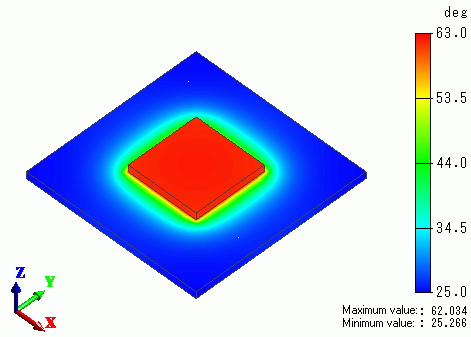
Thermal analysis is performed based on the boundary conditions below. The resulting temperature distribution is forwarded to stress analysis.
The temperature distribution as a result of Watt is shown below.
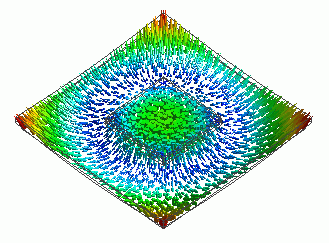
The next figure shows the vectors of displacement as a result of Galileo following Watt.
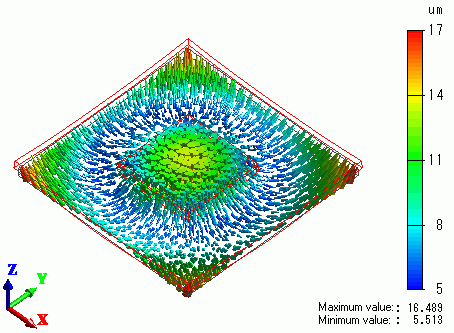
The temperature gradient results in deformation, warping at the four corners of the substrate.