General
Home / Examples / Coupled Analysis / Thermal-Stress Analysis [Watt/Galileo] / Example 4: Deformation due to the Temperature Gradient #4 - Transient Analysis
The model is a bimetal bar stuck with plate materials having different coefficients of linear thermal expansion.
The bar is subjected to the thermal load with temperature distribution.
The deformation, the displacement distribution, and the stress distribution over the time are solved.
Unless specified in the list below, the default conditions will be applied.
Results will vary depending on Femtet version and the PC environment.
Item |
Settings |
Analysis Space |
3D |
Model Unit |
mm |
Select Thermal Analysis and Stress Analysis.
Item |
Settings |
Solver |
Thermal Analysis [Watt] |
Thermal-Analysis Type |
Transient Analysis |
Options |
N/A * |
* [Thermal Load] is selected by default for the thermal-stress coupled analysis.
The Step/Thermal Load tab is set as follows.
Tab |
Setting Item |
Settings |
Step/Thermal Load * |
Reference temperature |
25 [deg] |
* The reached temperatures come from the thermal analysis.
* Thermal coupled steps are set up on the transient analysis tab.
The transient analysis is set up in transient tab as follows.
Tab |
Setting Item |
Settings |
||||||||
Transient analysis |
Table |
|
||||||||
Initial Temperature |
25 [deg] |
Two rectangular solid bodies are created to form plates. One is of copper and the other is of tungsten.
Their coefficients of linear thermal expansion are different.
As it deforms itself, there is no need to set up the boundary conditions to constrain.
The [temperature] boundary conditions are set on both ends of the plates at different temperatures.
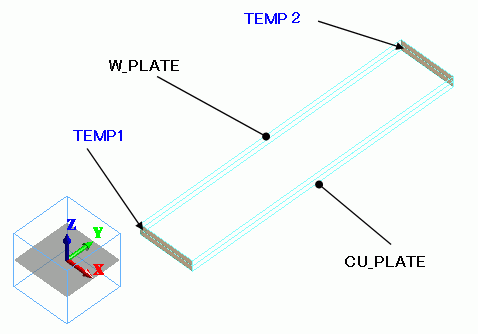
Body Number/Type |
Body Attribute Name |
Material Name |
0/Solid |
CU_PLATE |
008_Cu * |
1/Solid |
W_PLATE |
005_W |
* Available from the material DB
Thermal analysis is performed based on the boundary conditions below. The resulting temperature distribution is forwarded to stress analysis.
Boundary Condition Name/Topology |
Tab |
Boundary Condition Type |
Settings |
TEMP1/Face |
Thermal |
Temperature |
-10 [deg] |
TEMP2/Face |
Thermal |
Temperature |
60 [deg] |
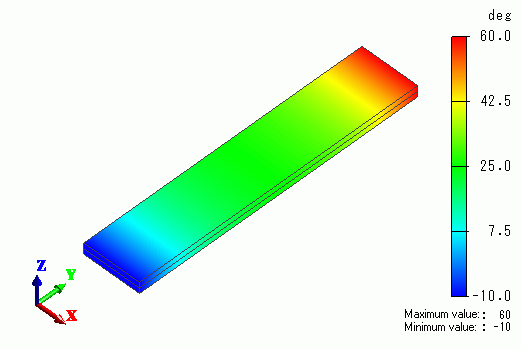
The temperature distributions as a result of thermal analysis are shown below.
In 0.2 sec:
In 1.0 sec:
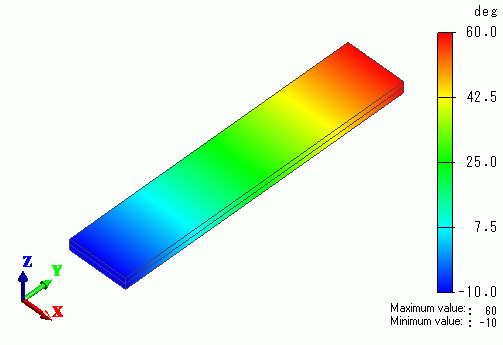
The temperature gradient converges as time passes.
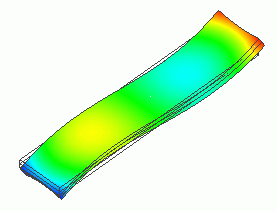
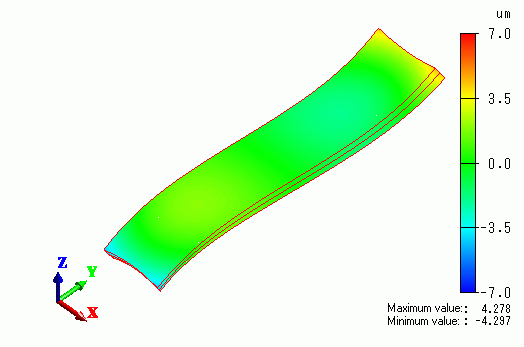
The deformations as a result of stress analysis are shown below.
In 0.2 sec:
In 1.0 sec:
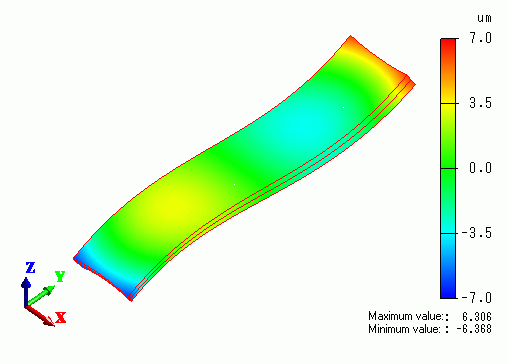
The bimetal deforms greater with the temperature gradient converged.