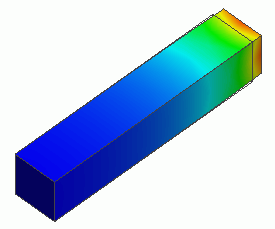
General
Home / Examples / Coupled Analysis / Thermal-Stress Analysis [Watt/Galileo] / Example 6: Temperature Dependency of Young's Modulus
The model is a bar of the material having a temperature-dependent Young's modulus.
The bar is subjected to a thermal load to make an uneven deformation.
The deformation, the displacement distribution, and the stress distribution are solved.
Unless specified in the list below, the default conditions will be applied.
Results will vary depending on Femtet version and the PC environment.
Item |
Settings |
Analysis Space |
3D |
Model Unit |
mm |
Select Thermal analysis and Stress analysis.
Item |
Settings |
Solver |
Thermal Analysis [Watt] |
Thermal-Analysis Type |
Steady-state Analysis |
Options |
N/A * |
The Step/Thermal Load tab is set as follows.
Tab |
Setting Item |
Settings |
Step/Thermal Load * |
Reference Temperature |
0 [deg] |
* The reached temperatures come from the thermal analysis.
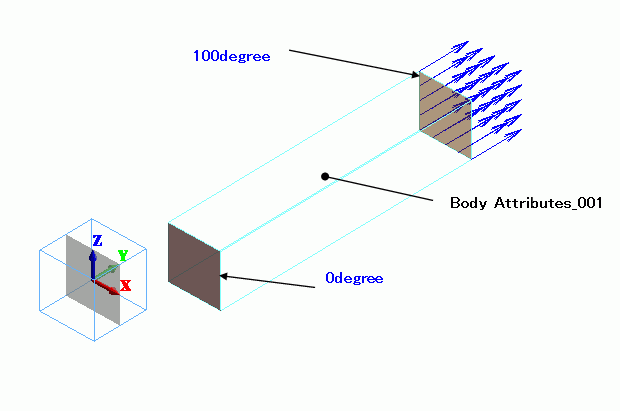
A rectangular rod is defined. The material is set with temperature-dependent coefficient of expansion.
The rod's end faces are set with different temperature and displacement by [temperature] and [displacement] boundary
conditions.
Body Number/Type |
Body Attribute Name |
Material Name |
0/Solid |
Body_Attribute_001 |
Material_Property_001 |
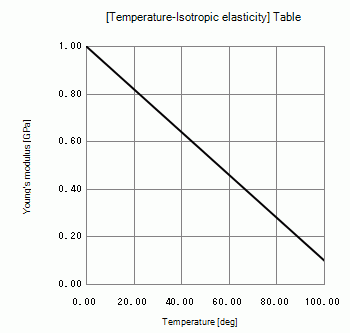
Temperature dependency of Young's modulus is set on the nonlinearity table.
Material Name |
Tab |
Settings |
|||||||||
ElasticMaterial |
Elasticity |
Material Type: Elastic/Isotropic
Temperature Dependency: Yes
[Temperature-Isotropic elasticity] Table *
* This is not the actual material's property. |
|||||||||
Thermal Conductivity |
1 [W/m/deg] |
Press the Graph button. The following graph will appear.
Thermal analysis is performed based on the boundary conditions below. The resulting temperature distribution is forwarded to stress analysis.
Boundary Condition Name/Topology |
Tab |
Boundary Condition Type |
Settings |
100degree/Face |
Thermal |
Temperature |
100 [deg] |
Mechanical |
Displacement |
Select UY UY=0 [m] |
|
0degree/Face |
Thermal |
Temperature |
0 [deg] |
Mechanical |
Displacement |
Select UY Uy=0.1x10⁻³ [m] |
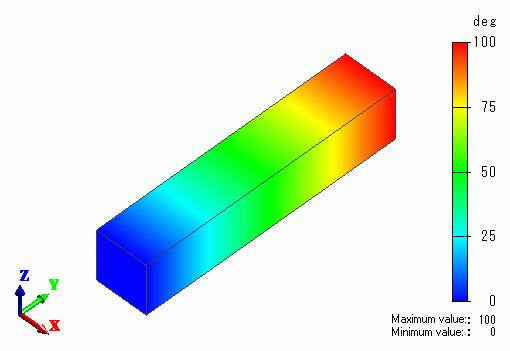
The temperature distribution as a result of Watt is shown below.
The vectors of the strain are shown below.
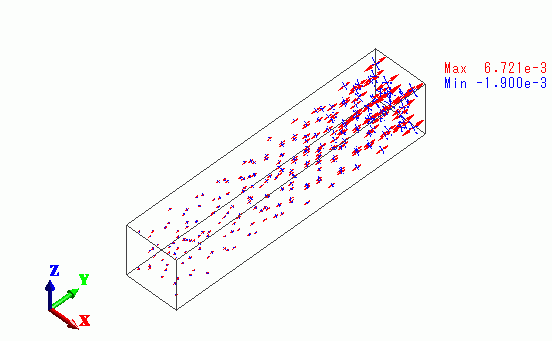
The strain is greater towards the rod's right end.
The vectors of the stress are shown below.
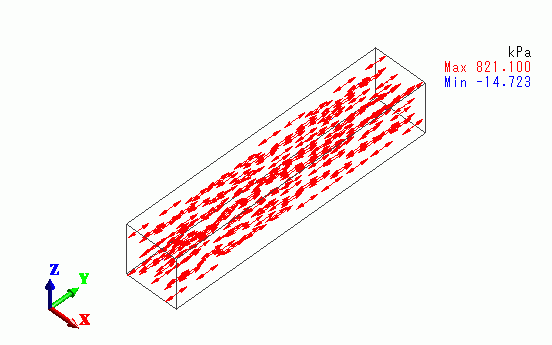
The tensile stress is exhibited in the y direction.