


|
Home / Modeling / The Basic of Modeling / Reconsider the Model
Reconsider the Model
Study the following for better simulation accuracy and faster calculation speed.
Utilize the Symmetry
If the model and the analysis conditions are symmetric, try to use a half model, a quarter model or an axisymmetric model instead of a full model by setting symmetric conditions.
Such models allow smaller meshes and improve the analysis accuracy with maintaining the calculation speed unchanged.
If the mesh size is not reduced, the calculation can be speeded up compared to the original model.
The symmetric conditions referred to here are the boundary conditions, which are expected to satisfy by the symmetry.
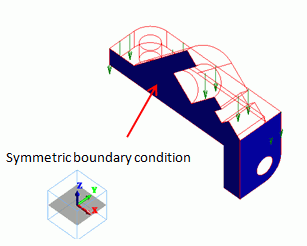
In the half model of the stress analysis below for example, the reflective symmetry is set on the section normal to Y axis, so it is expected not to displace in the Y direction at all. Therefore, the boundary condition of displacement=0 in Y direction is the symmetric condition in this analysis.
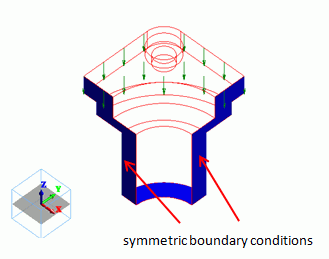
In the case of the quarter model, the sections are normal to Y axis, so the boundary condition where the Y direction is fixed, is the symmetric condition.
If the sections are normal to the X axis, the boundary condition where the X direction is fixed, is the symmetric condition.
For the symmetric conditions, appropriate boundary conditions are required to be set according to the model. (See electromagnetic analysis Example 17 for example.)
For analyses where [Plane of Symmetry] is used for the boundary condition, appropriate boundary condition will be set automatically. (See Thermal-stress analysis Example 7 for reference.)
-
Half Model
The full model is sectioned by a plane of symmetry. Appropriate boundary conditions need to be set on the section.
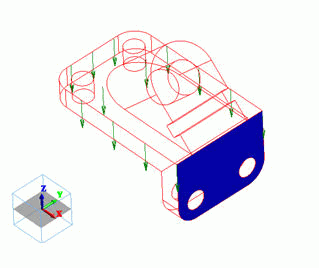

Full model
Half model
-
Quarter model
The full model is sectioned by two planes of symmetry. Appropriate boundary conditions need to be set on the sections.
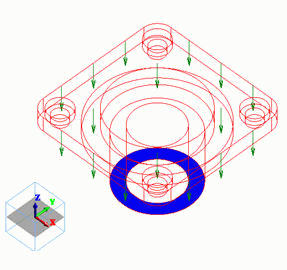
Full model
Quarter model
-
Axisymmetric model
A cross section of the original model is modeled and analyzed. The symmetric axis is Z axis and the model is to be created on XY plane.
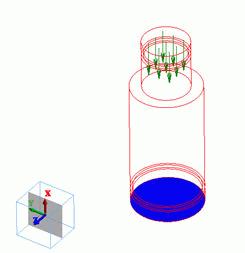
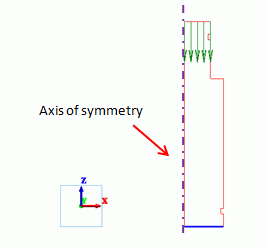
Full model
Axisymmetric model
Compare the Results
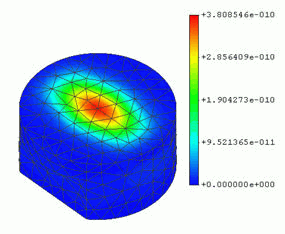
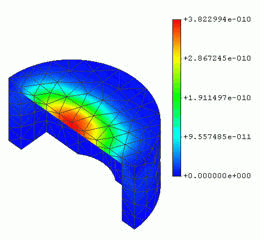
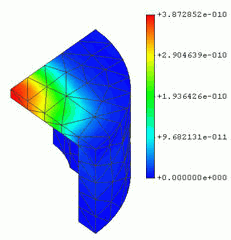
The figures below are the results of stress analysis for full, half and quarter models.
The contours of displacement are shown.
Some results need to be multiplied to get the value for the full model.
For example, the reactive force needs to be doubled for a half model and quadrupled for a quarter model.
|
Full model |
Half model |
Quarter model |
|
|
|
|
|
Reactive force -0.0136 [N] |
Reactive force -0.0068 [N] |
Reactive force -0.0034 [N] |
Utilize the 2D Model
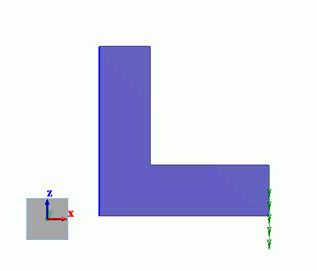
The simulation of just a cross section of 3D model might be good enough for your analysis. With 2D models, the calculation will be much faster and you can apply finer meshes.
-
2D Model
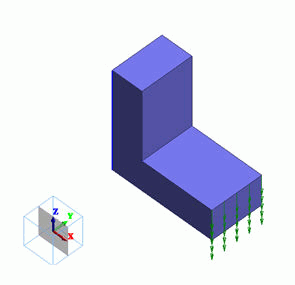
Full model
2D model
Simplify the Model
The simulation accuracy and speed could be improved by simplifying the part insignificant to the analysis.