


|
Home / How to Set Body Attribute, Material Property and Boundary Condition / Material Property Tabs / Iron Loss Tab
Iron Loss Tab
The material's iron loss is set on this tab.
The tab is activated for magnetic harmonic analysis and transient analysis.
See also [Loss Calculation in the Magnetic Analysis] for details of the loss.
-
Hysteresis loss in rotation and anomalous eddy current loss cannot be calculated.
Anomalous eddy current loss: The loss by minute eddy current which is generated on and near the magnetic wall. It is generated apart from the ordinary eddy current loss due to the shift of magnetic wall.
It is in the [Edit Material Property] dialog box. See [How to Set Body Attribute/Material Property].
|
Setting Items |
Notes |
|
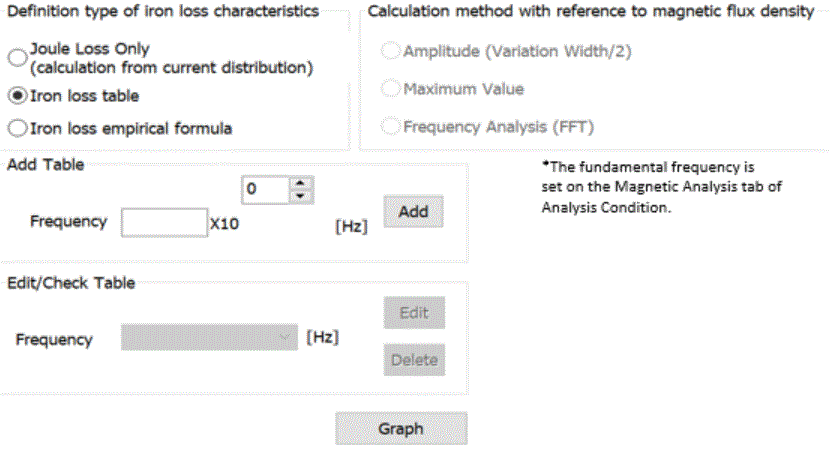
Iron Loss Calculation Type |
Select one of the following: [Joule Loss Only (calculation from current distribution)], [Iron loss empiric formula], [Iron loss table]
The details of setup for each type are explained as follow.
|
|
Calculation method with reference to magnetic flux density |
To obtain the total iron loss, the iron loss density is calculated for each mesh from the magnetic flux density and the frequency. It is available for the magnetic transient analysis only.
Amplitude (Variation Width/2) The maximum and minimum values are obtained from the time series data of the magnetic flux density for each mesh. The amplitude is calculated from (max value - min value)/2. The fundamental frequency is referred to.
The maximum values is obtained from the time series data of the magnetic flux density. The fundamental frequency is referred to.
Frequency Analysis (FFT) The Fourier transform (FFT) is applied to the series data of the magnetic flux density for each mesh to decompose into frequency components. The components of the frequencies higher than the fundamental frequency are handled. The higher frequency components can be calculated in proportion to the number of calculation points. Select this option if the waveform of the input current is not sine wave, or if the iron loss of the harmonics needs to be taken into account.
|
|
[Joule Loss Only (calculation from current distribution] |
Only Joule loss is calculated. Hysteresis loss is not taken into account. Select this for the material with no hysteresis loss taken into account.
|
|
[Iron Loss Empiric Formula] |
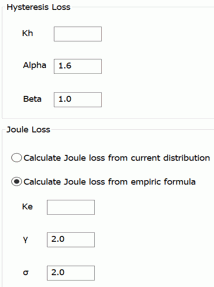
The iron loss is calculated from the formula with the magnetic flux density and the frequency. Enter the constants in the formula.
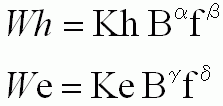
Empiric Formula
Wh: Hysteresis loss density [W/m^3] We: Joule loss density [W/m^3] B: Magnetic flux density [T] f: Fundamental frequency [Hz]
Magnetic flux density refers to the maximum value. Frequency refers to the fundamental frequency.
If "Calculate Joule loss from current distribution" is selected, only the Joule loss will be calculated from the current distribution.
|
|
[Iron Loss Table] |
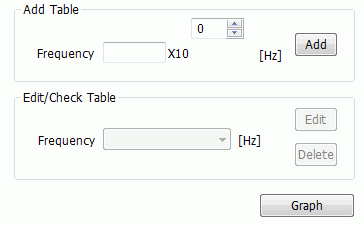
The iron loss is calculated from the table of magnetic flux density and loss density. The magnetic flux density and the loss density need to be entered for each frequency. Magnetic flux density refers to the maximum value. Frequency refers to the fundamental frequency.
At [Add Table], enter the frequency and click At [Edit/Check Table], the contents of the table can be checked, edited and deleted. Click the [Graph] button. The [Magnetic flux density-Loss density] graph will show up for each frequency.
|
 . Set the