


|
Home / Examples / Fluid Analysis [Bernoulli] / Example 23: Shear Thinning in Resin Melts
Example 23: Shear Thinning in Resin Melts
General
-
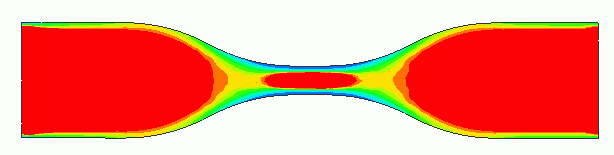
The shear thinning phenomenon (a reduction in viscosity with increasing shear rate) is reproduced by using the viscosity of a non-Newtonian fluid.
-
Shear thinning can be determined from the coefficient of kinematic viscosity in the fields.
-
Unless specified in the list below, the default conditions are applied.
-
Obtain this session's project file. (Right-click and choose 'Save link as')
-
Results will vary depending on Femtet version and the PC environment.
Analysis Space
|
Item |
Settings |
|
Analysis Space |
2D |
|
Model Unit |
mm |
Analysis Conditions
|
Item |
Settings |
|
Solver |
Fluid Analysis [Bernoulli] |
|
Analysis Type |
Steady-state Analysis |
|
Laminar Flow/Turbulent Flow |
Select Laminar Flow |
|
Meshing Setup |
General Mesh Size: 1 [mm] |
A non-Newtonian fluid can be analyzed only under laminar flow. Select [Laminar Flow].
Model
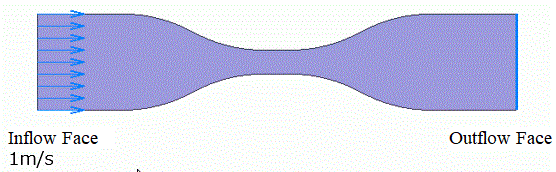
Define a sheet body that simulates the Venturi tube and specify LDPE (Low-Density Polyethylene) as its material. The boundary conditions of inlet and outlet are set on the left edge and the right edge respectively.
The solid wall outer boundary condition is automatically applied to the top and bottom edges where the boundary condition is not set.
The Venturi tube shape is modeled as shown below.
Body Attributes and Materials Setting
|
Body Number/Type |
Body Attribute Name |
Material Name |
|
0/Solid |
flow_path |
LDPE |
Viscosity Tab
・Parameters fitted by power law from the relationship between shear rate and LDPE viscosity are already specified on the viscosity tab. (Refer to Viscosity Tab)
・The relationship between shear rate and LDPE viscosity that has been used for fitting is listed on the share rate-viscosity table. Note that much of the data has been thinned out from the original measurements.
・If the measurement data from a rotational viscosimeter (Rheometer) is used as it is, logarithmic fitting is recommended. If data is thinned out at equal intervals, linear fitting is recommended.
・In this example, calculate with logarithmic fitting once, recalculate with linear fitting once, recalculate with logarithmic once, and apply the resultant parameters of power law.
Other Tabs than Viscosity
Selects [Liquid] on the Solid/Fluid tab.
Since the density of LDPE above its melting point is reported to be between 0.92 and 0.94 g/cm3, enter 0.93 g/cm3 on the density tab.
Boundary Conditions
|
Boundary Condition Name/Topology |
Tab |
Boundary Condition Type |
Settings |
|
Inlet/Edge |
Fluid |
Inlet |
Forced Inflow |
|
Outlet/Face |
Fluid |
Outlet |
Natural Outflow |
Results
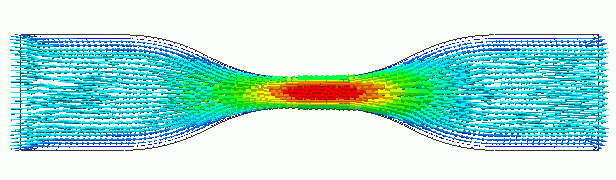
The distribution of the flow velocities is shown below.
It is observed that the flow velocity changes significantly near the inlet and outlet sections of the throat, which is located at the center of the Venturi tube.
The coefficient of viscosity is shown below. The maximum value in the contour diagram is changed to 200 Pa·s. (Enter 0.2 k for maximum value of contour)
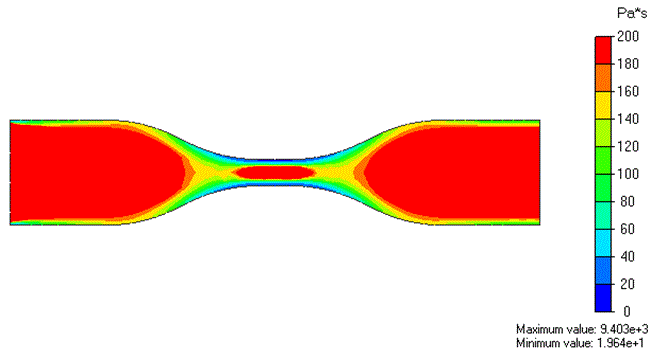
It is observed that the viscosity near the inlet and outlet sections of the throat is lower than in the surrounding area.
This is due to shear thinning: shear rate increases in areas where flow velocity drastically changes, causing the melted LDPE, which is a pseudoplastic fluid, to decrease in viscosity.
Similarly, near the wall, especially near the throat, the shear rate is significantly high, and the coefficient of viscosity is very low.
Dilatant fluids have different characteristics for viscosity: the higher shear rate, the higher viscosity. (Shear thinning)