


|
Home / Examples / Magnetic Analysis (Gauss, Static Analysis/Harmonic analysis) / Example 38: Solenoid actuator
Example 38: Solenoid actuator
General
-
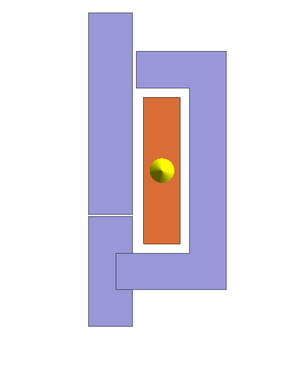
Analyze the electromagnetic force of the solenoid actuator.
-
This example contains three analysis models (Nonlinear_gap_sweep, Nonlinear_current_sweep, and Linear_current_sweep).
Parametric analysis is used for all three analysis models.
-
In the Nonlinear_gap_sweep analysis model,
the nonlinear variation of electromagnetic force with respect to the movable part's position can be observed.
-
In the Nonlinear_current_sweep and Linear_current_sweep analysis models,
the difference between nonlinear and linear analysis can be seen from how the electromagnetic force changes with current.
-
Unless specified in the list below, the default conditions will be applied.
-
Unless otherwise noted, the conditions apply to all three analysis models.
Analysis Model Download
-
Project file Download (Save the project file before open. Femtet 2026 or later is required.)
Analysis Space
|
Item |
Subject |
|
Analysis Space |
Axisymmetric |
|
Unit |
mm |
Analysis Condition
|
Item |
Subject |
|
Solver |
Magnetic Analysis [Gauss] |
|
Analysis Type |
Static analysis |
|
Options |
None |
Model
This model applies current to the coil to generate magnetic flux in the magnetic material and produce electromagnetic force.
To calculate the force on the Plunger, an air gap (Air_gap) is introduced between the Plunger and the Base_core.
-
Because the magnetic field concentrates in the air gap, refine the mesh there in advance.
See [Calculation of the Electromagnetic Force] for more details.
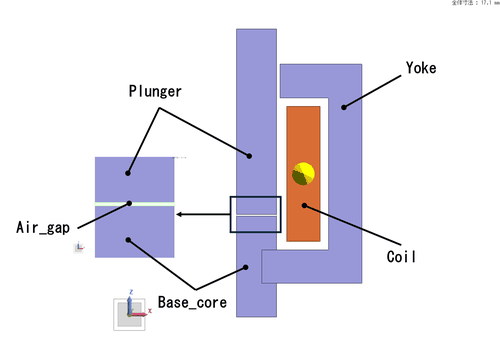
The Air_gap spacing is varied to move the Plunger upward and the electromagnetic force is calculated at each position.
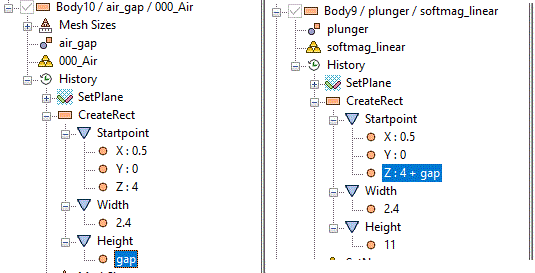
The gap spacing is parameterized by a variable named 'gap', which is set to 0.1 mm.
Specifically, as shown below, the air_gap height and the Plunger's starting z-coordinate are defined using the variable 'gap'.
The Plunger's starting z-coordinate is set to 4+gap according to the figure.
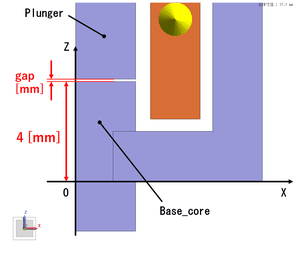
The gap will be swept later in a parametric analysis.
Body Attribute and Material Setting
|
Body Number/Type |
Body Attribute Name |
Material Name |
|
4/Solid |
Yoke |
softmag_nonL, *1 |
|
7/Solid |
base_core |
softmag_nonL, *1 |
|
8/Solid |
coil |
008_Cu *3 |
|
9/Solid |
plunger |
softmag_nonL, *1 |
|
10/Solid |
air_gap |
000_Air *3 |
Note *1: The conditions apply to the analysis models Nonlinear_gap_sweep and Nonlinear_current_sweep. The nonlinear magnetization characteristic (B-H curve) shown below is used (nonlinear analysis).
Note *2: The conditions applies to the Linear_current_sweep analysis model. The linear magnetization characteristic (constant relative permeability) shown below is used (linear analysis).
Note *3 Available from the material DB.
The following material constants are set for the Nonlinear_gap_sweep and Nonlinear_current_sweep analysis models.
|
Material name |
Tab |
Settings |
||||||||||||||||||||||||||||||
|
softmag_nonL |
Permeability |
Material Type: Soft Magnetic Material Magnetization Characteristic Type: B-H curve B-H Curve Table
|
||||||||||||||||||||||||||||||
|
Electric Conductivity |
Conductivity Type: Conductor Conductivity: 0.25 [S/m] |
The following material constants are set for the Linear_current_sweep analysis models.
|
Material name |
Tab |
Settings |
|
softmag_nonL |
Permeability |
Material Type: Soft Magnetic Material Magnetization Characteristic Type: Linear (Constant) Relative Permeability: 6500 |
|
Electric Conductivity |
Conductivity Type: Conductor Conductivity: 0.25 [S/m] |
Body attribute is set up as follows to apply current to the coil.
|
Body Attribute Name |
Tab |
Setting |
|
coil |
Current |
Waveform: Constant Current: current[A] * Turns: 840 [Turns] Direction: toward the front |
The current is defined by the variable 'current', which is set to 0.1 A. The current will be swept later in a parametric analysis.
To accurately compute the electromagnetic force on the Plunger, set the mesh size in the Air_gap to 0.02 mm which is smaller than gap/2.
|
Body attribute name |
Setting |
|
air_gap |
Mesh Sizes: 0.02 |
Boundary Conditions
None
Parametric Analysis
Below are the parametric analysis settings for each model.
See How to Proceed with the Parametric Analysis for the detail.
|
Analysis Model |
Sweep Setting |
Output Setting |
|
Nonlinear_gap_sweep |
Variable Name gap Type: Linear Step by Step Value Start Value: 0.1 Stop Value: 1 Step: 0.1 |
Type: Calculated Values Solver: magnetic Analysis Modes: 0: Static Analysis Output: z-component of the electromagnetic force [N], plunger |
|
Nonlinear_current_sweep |
Variable Name: current Type: Linear Step by Step Value Start Value: 0 Stop Value: 0.14 Step: 0.02 |
Type: Calculated Values Solver: magnetic Analysis Modes: 0: Static Analysis Output: z-component of the electromagnetic force [N], plunger |
|
Linear_current_sweep |
Result
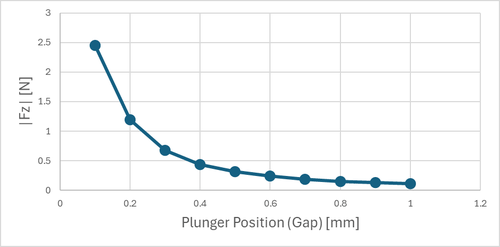
This plot shows the results from the Nonlinear_gap_sweep analysis (output CSV file).
The vertical axis is the z-component of the electromagnetic force on the Plunger, displayed as its absolute value for clarity. ( |Fz| )
As the gap increases, the electromagnetic force decreases in a nonlinear manner.
The plot overlays results from the Nonlinear_current_sweep and Linear_current_sweep models.
The vertical axis, as in the previous figure, is the absolute value of the z-component of the electromagnetic force ( |Fz| ).
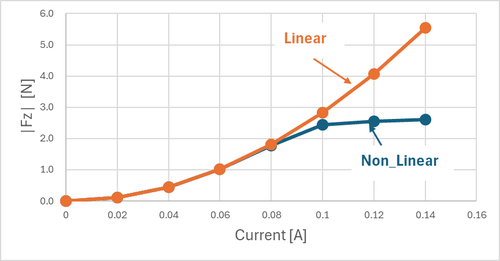
A divergence between the linear and nonlinear results becomes apparent from 0.08 A onward.
This is because the linear model does not take magnetic saturation into account.
The nonlinear results show that for currents of 0.08 A or higher, magnetic saturation limits further increases in electromagnetic force as current increases, making further current increases inefficient.