


|
Home / What Femtet Can Do / Details of Analysis Functions / Electric analysis
Electric Analysis
Th features of Coulomb (the electric solver) are explained here with some examples.
-
The electric potentials, the electric field, the capacitances across the electrodes, etc are solved.
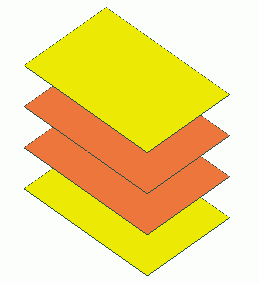
In Example 4 of Electric Analysis, the potentials of top and bottom electrodes are specified.
The potentials of other two electrodes in between are floating.
Solved are the distributions of the electric potential and the electric field of the surrounding space,
the electric potentials of the floating electrodes and the capacitances across the electrodes. -
The electrostatic forces applied on the dielectric material can be obtained too.
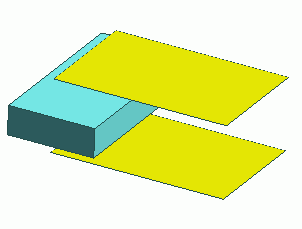
In Example 7 of Electric Analysis, a dielectric material is placed between two electrodes.
Solved are the distributions of the electric potential and the electric field of the surrounding space,
and the electrostatic forces applied on the dielectric material.
-
The resistance value of the conductor is analyzed.
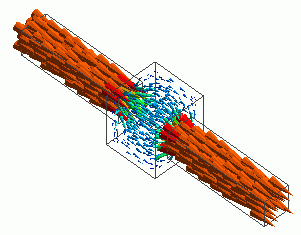
In Example 11 of Electric Analysis, voltage is applied across either ends of the model. The model's material is conductor.
The center portion of the model is thicker than the rest.
Solved are the electric field and the current density inside the bar, and its resistance.
The functions of the electric field analysis are listed below. For more examples, see [Example List for Electric Analysis].
|
Analysis Types
|
Static Analysis, Harmonic Analysis, Plating Analysis, Hall Effect Analysis |
|
Materials |
Dielectric Material (Isotropy/Anisotropy), Conductor (Isotropy/Anisotropy), Temperature Dependency |
|
Boundary Conditions |
Electric Potential Specified, Floating Electrode, Open Boundary, Periodic Boundary, Current Boundary, Resistance Boundary |
|
Obtained Properties |
Electric Potential, Electric Field, Electric Flux Density, Electric Current, Capacitance Matrix, Electrostatic Force, Loss Density |
|
Miscellaneous |
Space Charge |