


|
Home / What Femtet Can Do / Details of Analysis Functions / Thermal Analysis
Thermal Analysis
Th features of Watt (the thermal conduction solver) are explained here with some examples.
-
The temperature distribution can be analyzed for models with temperature boundary conditions.
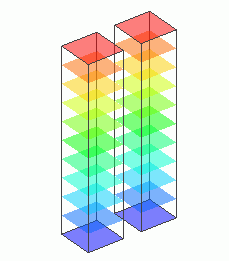
In Example 1 of Thermal Analysis, steady-sate analysis is performed for metal pillars. The temperatures are set on the top and bottom faces.
The temperature distribution and the heat flux are solved.
In the example 2 of thermal analysis, transient analysis is performed for the same model as the example 1.
-
Models with the heat source can be analyzed as well.
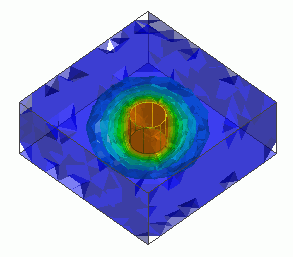
In Example 3 of Thermal Analysis, the temperature distribution is solved for a resin cuboid. A heat source exists in its center.
The temperature distribution inside the cuboid is solved.
In the example 4 of thermal analysis, transient analysis is performed for the same model as the example 1.
-
Coefficient of heat transfer can be defined as boundary condition.
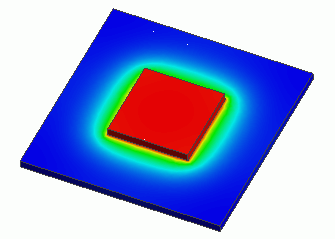
In Example 7 of Thermal Analysis, a heat source is placed on a substrate. There is a forced convection over the substrate. Heat transfer is selected as the boundary condition.
The temperature distribution of he substrate is solved.
In the example 8 of thermal analysis, transient analysis is performed for the same model as the example 7.
The functions of the thermal analysis are listed below. For more examples, see [Example List for Thermal Analysis].
|
Analysis Types
|
Steady-state Analysis, Transient Analysis, Simple Fluid-Thermal Analysis |
|
Materials |
Isotropy, Anisotropy, Temperature Dependency |
|
Boundary Conditions |
Temperature, Heat Flux, Heat Transfer (Coefficient Specified, Natural Convection, Forced Convection, Heat Sink), Thermal Resistance, Radiation, Optional Distribution |
|
Obtained Properties |
Temperature, Heat Flux, Heat Density, Heat Flow Rate, Thermal Resistance |
|
Miscellaneous |
Heat Source |