


|
Home / What Femtet Can Do / Details of Analysis Functions / Fluid Analysis
Fluid Analysis
The features of Bernoulli (fluid solver) are explained here with some examples.
-
The flow velocity distribution is analyzed when a fluid flows at a constant velocity in an domain. The domain can be set in any form.
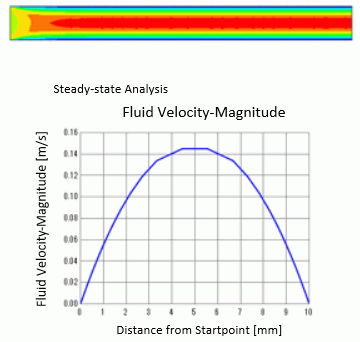
Example 1 solves the flow between the parallel plates by the steady-state analysis.
The flow velocity distribution and pressure distribution are obtained.
The turbulent flow analysis is needed if the flow velocity is large.
See Example 2 for the details.
-
The fluid flows in the space at a constant velocity. A solid is placed In the space. The flow velocity around the solid is solved. The force applied to the solid by the fluid is solved as well.
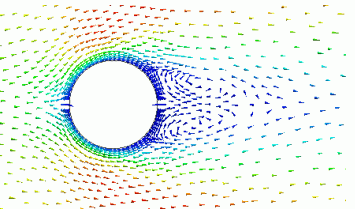
Example 3 solves the flow around a cylinder placed in the space. Analysis type is the steady-state analysis.
The flow velocity distribution and pressure distribution are obtained.
Force on the wall face is output for the table value.
Drag and lift on the cylinder, which are created from the force on the wall face, are calculated.
The functions of the fluid analysis [Bernoulli] are listed below. For analysis examples, see [Example List for Fluid Analysis].
|
Analysis Types
|
Steady-state Analysis, Fluid-Thermal Analysis (Forced Convection and Natural Convection)(*), Diffusion Analysis (Passive Scalar), Free Surface Analysis (VOF Method) |
|
Flow Type to Analyze |
Incompressible Flow, Single-phase Flow, Gas-Liquid Multiphase Flow (Surface Tension), Forced Convection, Natural Convection *, Diffusion of Diffusing Material |
|
Materials |
Density, Viscosity (Newtonian Fluid, Power Law, Carreau Model), Molar Mass , Temperature Dependency (*) |
|
Boundary Condition |
Solid Wall(Static, Translation, Rotation), Slip Wall, Forced Inflow/Forced Outflow (Flow Velocity, Pressure, Fan, Direction Specified, Optional Distributed Flow Velocity, Swirl), Natural Inflow/Natural Outflow, Inlet/Outlet Pair, Contact Angle |
|
Body Attribute |
Fluid Internal Flow Specified (Velocity, Flow Rate, Fan, Direction Specified, Optional Distributed Flow Velocity, Swirl), Porous |
|
Obtained Properties |
Flow Velocity, Pressure, Turbulent Flow Energy K, Energy Dissipation Factor ε, y+, Force on Wall Face, Pressure Loss, Volumetric Flow Rate, Coefficient of Heat Transfer *, Operating Point of Fan |
|
Laminar Flow/Turbulent Flow |
Laminar flow, Turbulent flow (Realizable K- ε model) |
|
Analysis Space |
2D, Axisymmetric, 3D |
|
Analysis Method |
Finite volume method |
|
Advection Scheme |
1st-order Upwind Difference/2nd-order Upwind Difference |
|
Mesh |
1st order Element |
(*) Fluid-Thermal Analysis is optional.