


|
Home / Examples / Electromagnetic Analysis [Hertz] / Example 21: Waveguide Analysis of Differential Lines
Example 21: Waveguide Analysis of Differential Lines
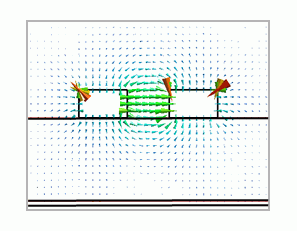
General
-
The characteristics of differential lines are analyzed.
-
The differential impedance and the propagation constant are solved.
-
Unless specified in the list below, the default conditions will be applied.
-
Obtain this session's project file. (Right-click and choose 'Save link as')
-
Results will vary depending on Femtet version and the PC environment.
Analysis Space
|
Item |
Settings |
|
Analysis Space |
2D |
|
Model Uit |
mm |
Analysis Conditions
|
Item |
Settings |
|
Solver |
Electromagnetic Analysis [Hertz] |
|
Analysis Type |
Waveguide Analysis |
Mesh tab, Harmonic analysis tab and Open boundary tab are set as follows.
|
Tab |
Setting Item |
Settings |
|
|
Meshing Setup |
Deselect Automatically set the general mesh size * General Mesh Size 0.2 [mm] |
|
Mesh Tab |
Frequency-Dependent Meshing |
Reference Frequency: 1x10⁹ [Hz] Select [The conductor bodies thicker than the skin depth constitute the boundary condition]. |
|
Waveguide Analysis |
Sweep Type |
Select [Linear Step by Number of Divisions] |
|
Sweep Setting |
Minimum: 1×10⁹ [Hz] Maximum: 1x10⁹ [Hz] Division: 0 |
|
|
Maximum Number of Propagation Modes |
2 |
* The general mesh size is a bit too large in this example. Smaller mesh size is set.
Model
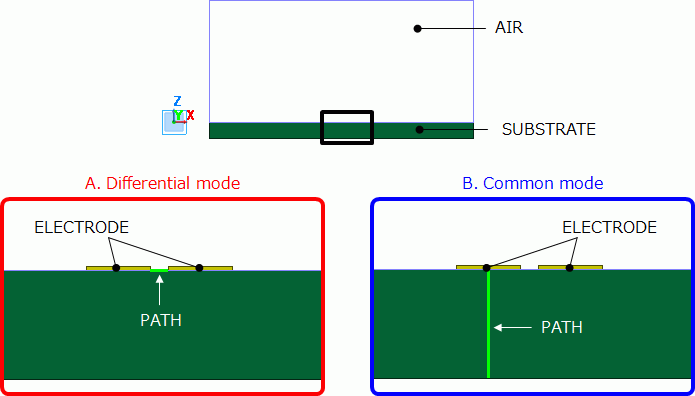
Two electrodes are created on a substrate. They function as differential lines.
Rectangle air space (AIR) is defined to cover them.
Setting place of the wire body for integral path (PATH) depends on the mode to analyze.
For the differential mode analysis, place the wire body between the electrodes as in the diagram A.
For the common mode analysis, place the wire body between one of the electrodes and the ground as in the diagram B.
Body Attributes and Materials
|
Body Number/Type |
Body Attribute Name |
Material Name |
|
0/Sheet |
SUBSTRATE |
006_Glass_epoxy * |
|
1/Sheet |
ELECTRODE |
008_Cu * |
|
2/Sheet |
ELECTRODE |
008_Cu * |
|
3/Sheet |
AIR |
000_Air(*) |
|
4/Wire |
|
|
* Available from the material DB
Boundary Conditions
|
Boundary Condition Name/Topology |
Tab |
Boundary Condition Type |
|
Outer Boundary Condition |
Electric |
Electric Wall |
|
PATH |
Electric |
Integral Path |
Results
1. Propagation Mode
As the maximum number of the propagation modes is set to 2 in the analysis condition,
two propagation modes are calculated for one frequency.
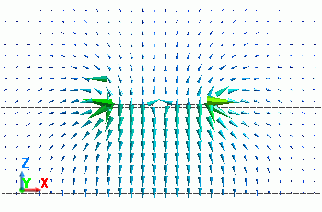
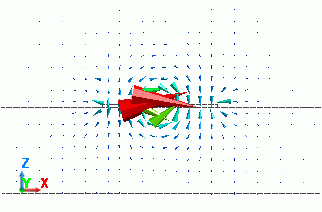
Regardless of the integral path location, electric fields of two modes are as follows
From the distributions of the electric fields, you can tell that the first mode is the common mode and the second mode is the differential mode.
|
Mode |
Electric Field |
|
0: 1.000000e+09 [Hz](0) |
|
|
1: 1.000000e+09 [Hz](1) |
|
2. Characteristic Impedance
On the Characteristic impedance (Zpv) [ohm] tab in Table, you can check the characteristic impedance.
The following diagram shows the characteristic impedance obtained for the models with integral path locations A and B above.
Be aware that the characteristic impedances of the common and the differential modes calculated with
the integral path A for the differential mode and the integral B for the common mode, respectively, are not accurate.
|
Mode |
Integral Path Location A |
Integral Path Location B |
|
0: 1.000000e+09 [Hz](0) (Common mode) |
1.307 Ω (inaccurate) |
60.754 Ω |
|
1: 1.000000e+09[ Hz](1) (Differential mode) |
93.237 Ω |
23.196 Ω (inaccurate) |
3. Propagation Constant
Unlike characteristic impedance, propagation constant is not affected by the location of integral path.
Propagation constant tab in Table, you can check the propagation constant as follows.
Regardless of the integral path location, the same values are calculated.
|
Mode |
Integral Path Location A |
Integral Path Location B |
|
0: 1.000000e+09[Hz](0) (Common mode) |
Attenuation Constant: 0.236 Np/m |
Attenuation Constant: 0.239 Np/] |
|
1: 1.000000E+09 Hz](1) (Differential Mode) |
Attenuation Constant: 0.408 Np/m |
Attenuation Constant: 0.424 Np/m |