


|
Home / Technical Notes / Electromagnetic analysis / Analysis Condition / Complex Resonant Frequency
Complex Resonant Frequency
In the resonant analysis of piezoelectric solver and electromagnetic solver, the resonant frequency may be obtained as the complex number in some cases.
- If the mechanical loss tangent or dielectric tangent is specified as a non-zero value in the piezoelectric resonant analysis, the resonant frequency obtained will be complex.
- In the electromagnetic resonant analysis, if [Calculate the Q factor with high accuracy] is opted, the frequency obtained will be complex.
Also in the 2D waveguide analysis, if the frequency analysis is selected, the resonant frequency obtained will be complex.
Complex resonant frequencies can be obtained in Example 3 of the piezoelectric analysis or Example 11 of the electromagnetic analysis.
The results table are shown below.
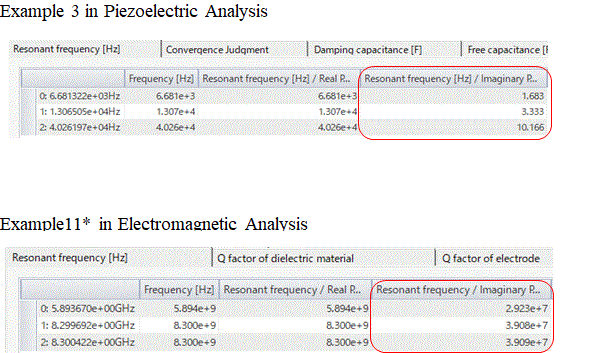
Note: Settings are modified in Example 11 of the electromagnetic analysis as shown below.
1. Set the dielectric tangent of the material, DR_MAT, to 0.01.
2. Select [Calculate the Q factor with high accuracy] on Resonant Analysis tab in the analysis condition dialog box.
What the imaginary part of the complex resonant frequency signifies is as follows. By multiplying the complex resonant frequency by 2π,
the angular frequency is obtained in the complex number with real part and imaginary part as in the equation (1).
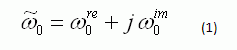
Substitute it into the equation representing oscillation. Equation (2) is obtained. The real and imaginary parts of the frequency are related to the period of oscillation and the attenuation respectively.

If the loss is small, the relation between the Q factor of this oscillation mode and the complex resonant frequency is as follows.
Q factor = 0.5*(real part of the complex resonant frequency)/(imaginary part of the complex resonant frequency)