


|
Home / Technical Notes / Electric analysis / Differential Equations in Electric Analysis
Differential Equations Solved in the Electric Analysis
Static Analysis for Dielectric Material
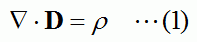

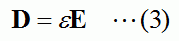
D: Electric Flux Density
ρ: Charge Density
E: Electric Field
φ: Electric Potential
When analyzing capacitance, the electrostatic analysis (Coulomb static analysis) solves the Equations (1), (2b) and (3), and spatial distribution of electric field E and electric flux density D is obtained.
Equation (1): Gauss's law.
Equation (2b): Faraday's law with no induction.
Equation (3): The relation between material's electric flux density (D) and field (E).
Equation (2b) is derived from equation (2a), the original formulation of Faraday's law because the time derivative of the magnetic flux density B in the static analysis is zero.
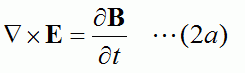
E: Electric field
B: Magnetic flux density
ρ is the electric charge density given as a condition. It is, however, zero in the actual analysis except for one case
because in the steady state, the electric charge does not exist in dielectric material.
The electric charge exists on the surface of the conductor. In the static analysis of capacitance, however, the conductor is not modeled as a body but given as an electric wall boundary condition. Therefore it is considered that the electric charge does not exist in the analysis space.
The only exception where ρ is non-zero is when the electric charge density is set as a body attribute.
In that case, it is considered that the distributed static charge exists in the body. The charge distribution is given on the right side of Equation (1).
Governing Equation
Please not that Femtet solver Coulomb does not directly solve Expressions (1), (2b), and (3).
The following is an explanation of the governing equation employed by "Coulomb".
Equation (2b) yields Equation (2c):
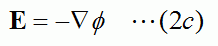
E: Electric Field
φ: Electric Potential
Femtet solver Coulomb solves Equation (4) which is the combination of (1), (2c) and (3).

Once φ is obtained, E and D can be obtained from Equations (2c) and (3).
Some boundary conditions must be given to solve Equation (4).
The electric wall and magnetic wall are the typical boundary conditions:
Electric field lines always meet the electric wall at right angles. This condition is applied.
Therefore, the electric potential φ is constant on a given electric wall.
If the electric potential is specified for the electric wall, its value is given to the electric wall.
If the electric potential is not specified, the electric potential boundary condition is not given to the electric wall of floating electrode. (The potential is obtained as a result of governing equation (4).)
Electric field lines always run in parallel to the magnetic wall. Therefore, the electric field is orthogonal to the normal vector of magnetic wall.
Static Analysis (Resistance)
J: Current Density
ρ: Charge Density
σ: Conductivity
E: Electric Field
φ: Electric Potential
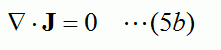
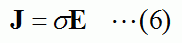
Equations (5b), (2b) and (6) are solved and J and E are obtained.
Equation (5b): The charge conservation law.
Equation (2b): Faraday's law with no induction.
Equation (6): Ohm's law for each material
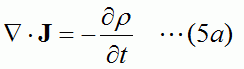
The extended forms of Equations (5b) and (2b) are Equations (5a) and (2a). In the static analysis, the time derivative is zero. Hence, Equations (5b) and (2b) are true.
Governing Equation
Femtet solver Coulomb does not directly solve Equations (5b), (2b), and (6).
The governing equation used by Femtet is as below.
Equation (2b) yields Equation (2c):
E: Electric Field
φ: Electric Potential
Femtet solver Coulomb solves Equation (7) which is derived from the combination of (5b), (2c), and (6).
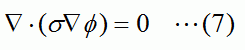
Spatial distribution of the electric potential φ is obtained by solving Equation (7). It will give the spatial distribution of the electric field E by applying Equation (2c).
From the given electric field E, spatial distribution of the current density J is given by applying Equation (6).
Some boundary conditions are required to solve Equation (7).
The electric wall and magnetic wall are the typical boundary conditions:
Electric field lines always meet the electric wall at right angles. This condition is applied.
Therefore, the electric potential φ is constant on a given electric wall.
If the electric potential is specified for the electric wall, its value is given to the electric wall.
If the electric potential is not specified, the potential boundary condition is not given to the electric wall of floating electrode. (The potential is obtained as a result of governing equation (4).)
The electric field lines always run in parallel to the magnetic wall. Therefore, the electric field is orthogonal to the normal vector of magnetic wall.
Harmonic Analysis
D: Electric Flux Density
ρ: Charge Density
E: Electric Field
J: Current Density
σ: Conductivity
φ: Electric potential
For a given angular frequency ω., equations above are solved, and D, E, J and ρ are obtained.
Equation (1): Gauss's law.
Equation (5a): The charge conservation law
Equation (2b): Approximated Faraday's law with no induction (*)
Equation (3): The relation between material's electric flux density (D) and field (E).
Equation (6): Ohm's law for each materail
Faraday's law with induction is given by:
E: Electric Field
B: Magnetic Flux Density
In the harmonic analysis, we should be using Equation (2a). Instead, we are using Equation (2b) assuming the frequency is low and the time derivative of B is nearly 0.
* In the case of static analysis, the time derivatives are equal to 0. Therefore, no approximation is done even if Equation (2b) is used. This approximation is acceptable in the harmonic analysis.
If the frequency is high, however, the error will increase.
For high-frequency simulations, please use solver Hertz. See Overview of Electromagnetic Analysis.
Governing Equation
Femtet solver Coulomb does not directly solve Equations (1), (5a), (2b), (3) and (6).
Governing equation used by Femtet is Equation (8') as shown below.
Equation (8') is derived as follows.

Equation (8') is solved for the electric potential φ at a given angular vibration ω.
It is represented by phasor.
Once φ is obtained, E and J can be obtained from Equations (2c) and (6).
Some boundary conditions are required to solve Equation (8').
The electric wall and magnetic wall are the typical boundary conditions:
Electric field lines always meet the electric wall at right angles. This condition is applied.
Therefore, the electric potential φ is constant on a given electric wall.
If the electric potential is specified for the electric wall, its value is given to the electric wall.
If the electric potential is not specified, the potential boundary condition is not given to the electric wall of floating electrode. (The potential is obtained as a result of governing equation (4).)
The electric field lines always run in parallel to the magnetic wall. Therefore, the electric field is orthogonal to the normal vector of magnetic wall.
<How to derive Governing Equation (8')>
The governing equation (8') is derived from Equations (1), (5a), (2b), (3), and (6).
Equation (2b) yields Equation (2c):
E: Electric Field
φ: Electric Potential
Equation (4) is derived from Equations (1), (2c) and (3):
* This equation is also used as a governing equation in the capacitance analysis.
Equation (9) is derived from Equations (5), (2c) and (6):
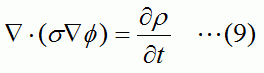
Equations (4) and (9) represent Equations (1), (5a), (2b), (3) and (6) in terms of φ.
Equation (8) is derived from Equations (4) and (9).

Equation (8') is derived from Equation (8) at the given angular frequency ω.