


|
Home / Technical Notes / Stress Analysis / Contact analysis / Frictional Contact
Frictional Contact
The coefficient of friction can be set for "contact pair" and "automatic judgment" of "simple contact".
If it is non-zero, the friction is taken into account.
If it is zero, the friction is not taken into account. It will be the frictionless slippage.
1. The coefficient of friction is zero
The normal forces will be balanced on the contact surface.
There will be no frictional force as there is no friction. (Frictionless slippage)
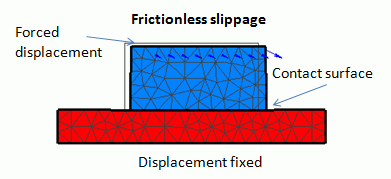
2. The coefficient of friction is non-zero
There are two types of contact as listed below, where F is the contact force, μ is the coefficient of friction and N is the normal component of the contact force.
|
Force Magnitude |
Contact Type |
Note |
|
F < μN
|
Nonslip (Static friction) |
The contact face is not allowed to move. |
|
F > μN
|
Slip (Kinetic friction) |
The contact face is allowed to move. The tangent component of the contact force is equal to μN. |
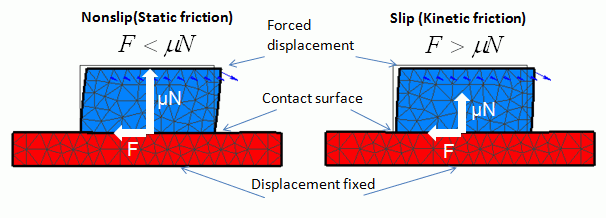
For the examples above, μ = 1.0 for the left and μ = 0.3 for the right. The identical forced displacement is applied on them.
No slipping is exhibited under μ = 1.0, while slipping is exhibited under μ = 0.3.
The shear deformation due to the friction is exhibited in both of them.
In the actual analysis, the contact state is judged locally at node or element.
3. Examples of frictional contact
Example 43 analyzes a block pressed onto a plate. The "simple contact" boundary condition with friction is applied.

Example 44 analyzes a ball colliding with a plate. It is "contact surface" boundary condition with friction is applied.
