


|
Home / Technical Notes / Magnetic analysis / Differential Equations Solved in the Magnetostatic Analysis
Differential Equations Solved in the Magnetostatic Analysis
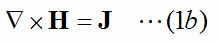
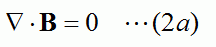
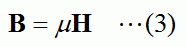
H: Magnetic field
B: Magnetic flux density
J: Current density
μ: permeability
Equations (1b), (2a) and (3) are solved for the given J and boundary conditions, and B and H are obtained.
Equations above express the following.
Equation (1b) is Ampere's law. * Note
Equation (2a) is Gauss's law for magnetism.
Equation (3) defines the relation between the material's magnetic flux density B and magnetic field H.
* Note
The extended form of Equation (1b) is Equation (1a). For static analysis, the time derivative of D is equal to 0.
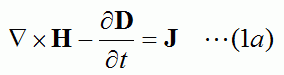
B: Magnetic flux density
μ: permeability
D: Electric flux density
J: Current density
Governing Equation
Solver "Gauss" solves equations which are derived from Equations (1b), (2a), and (3).
The magnetic vector potential A defined by Equation (2b) is obtained first. Then B and H are obtained.
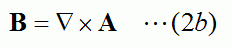
B: Magnetic flux density
A: Magnetic vector potential
Equation (2b) automatically satisfies Equation (2a).
Equation (4) is derived from Equations (1b), (2b) and (3).
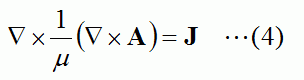
A: Magnetic vector potential
J: Current density
μ: permeability
Femtet Solver "Gauss" solves Equation (4). Once A is obtained, B and E can be obtained from Equations (2b) and (3).
Some boundary conditions must be given to solve Equation (4). For example,
Magnetic wall: The magnetic flux density B meets the magnetic wall ar right angle. The magnetic flux density B and the normal vector n of magnetic wall run in the same or opposite direction.
Electric wall: The magnetic flux density B meets the electric wall at right angle. The magnetic flux density B meets the normal vector n of electric wall at right angle (B・n=0).
Note 1)
You don't need to define J for the full analysis space.
From the given conditions, Femtet deduces J's space distribution and gives that on the right side of Equation (4).
Note 2)
As J is the curl of H, the divergence of J must be 0.
If div (J) is not equal to 0, Solver "Gauss" manages to process null vectors and obtains the approximated solutions.
If div (J) is equal to 0, Solver "Gauss" simply solves the equations.
Note 3)
If a magnet is included in the model, Equation (3) is replaced by Equation (3').
Also, Equation (4) is replaced by Equation (4').


μ0: Vacuum permeability
M: Magnetization