


|
Home / Technical Notes / Electromagnetic analysis / Boundary Condition / Comparison of Open Boundary Conditions
Comparison of Open Boundary Conditions
Absorbing boundary and PML are the open boundary conditions available in Hertz. Their differences are shown below.
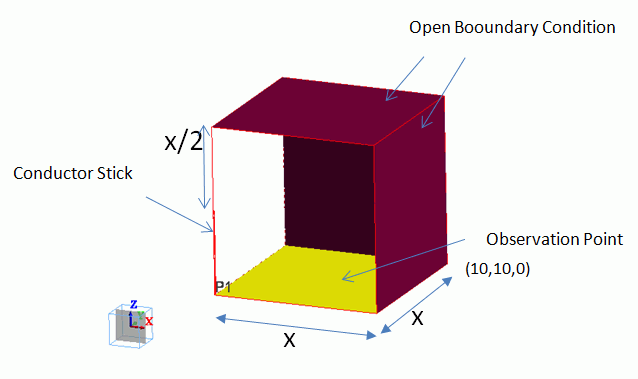
Fig.1 1/8 model of a dipole antenna
Fig.1 shows the 1/8 model of a dipole antenna. X is the model's side length. The electric field strength at each point is calculated with X varied.
In this analysis, the frequency is 4.5GHz and the wavelength is 6.6cm. The parametric analysis is useful since the same type of calculation is repeatedly performed for various sizes of the analysis region.
Fig.2 shows the results. The horizontal axis is X, and the vertical axis is the electric field strength.
Five series of plots on the graph represent different open boundary conditions.
The four series for PML are different in the PML thickness, which varies from 0.02λ to 0.2λ, where λ is the wavelength.
Ideally the electric field strength should remain constant at any given X. It, however, varies more with the absorbing boundary and the 0.02λ PML than with the 0.2λ PML.
This means PML with the thickness of 0.2λ gives good results. Note that the calculation time becomes longer with the increase of PML thickness, because the number of meshes increases.
Femtet uses the absorbing boundary as default.
Acquire the project file for this comparison.
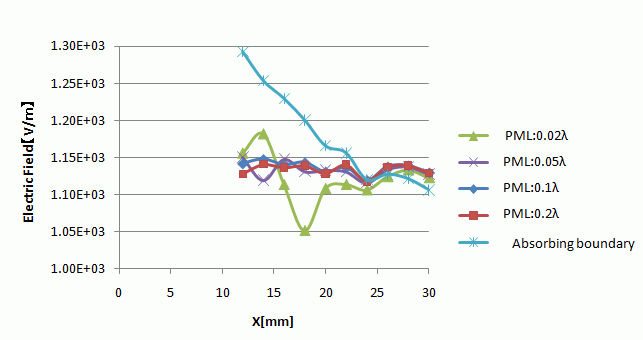
Fig.2 Electric field strength at (10,10,0) and the size of the analysis region