|
Home / Technical Notes / Electromagnetic analysis / Analysis Condition / Fast sweep
Fast Sweep
1. Overview
Simultaneous linear equations below are solved in harmonic analysis.

where ω is the angular frequency, x is the field to solve, f is the force that drives the field,
and A is the matrix carrying the information of the shape and materials of the model. If the frequency ranging from fa to fb is divided into n sections,
it is necessary to calculate the inverse of n+1 matrices for each frequency in the harmonic analysis.
A is basically very large and takes time to solve the equations. In order to shortcut the calculations of inverting matrices, therefore,
the fast sweep has been introduced.
Femtet assumes that x(ω) is the linear sum of the solutions of some frequencies as in Equation (2) below.

Ci's are coefficients, which are obtained by the least squares method. For some frequencies, x(ω)'s are obtained by solving Equation (1). For others, x(ω)'s are approximated from the x(ω)'s which have been already obtained from Equation (1). Equation (1) must be solved for the minimum frequency first. After that, it will be solved for the frequencies which have the large residual shown in Equation (3).
When the residual becomes smaller than the user-specified value, it is judged that all solutions are obtained.
Note that in the electromagnetic waves analysis where the frequency response of S-parameters are also calculated, the solutions are considered to have been converged and the calculations will be over when the variation of frequency response become smaller than the "S-parameters variation".

The calculation must be performed for quite a few frequencies if there are many resonances in the specified frequency range.
It is because many vectors are needed to represent the field for the frequencies.
The fast sweep, therefore, is not effective if there are many resonances.
2. Electromagnetic analysis
In the electromagnetic analysis, the frequency sweep is faster than the basic method above. It is achieved by modifying Equation (2) to use not only the solution vectors but also other vectors.
Also, some equations are simplified for faster calculations.
The analysis is performed under the assumption that the surface impedance of conductor is the same as that obtained at the reference frequency throughout the analysis frequencies,
although the surface impedance is frequency-dependent..
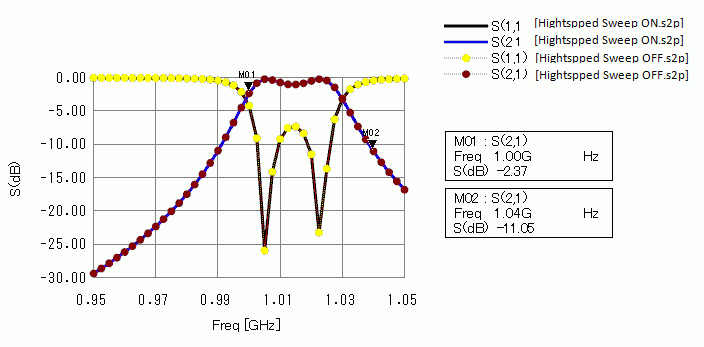
S-parameters in "Example 5: Cavity Resonator" are calculated with and without the fast sweep.
These plots are pretty close.
The inverse matrix is calculated only at two frequencies indicated by markers M01 and M02.