


|
Home / Technical Notes / Piezoelectric Analysis / Matrix Equations for Piezoelectric Analysis
Matrix Equations for Piezoelectric Analysis
1. Analysis type and matrix equation
In piezoelectric analysis, the following matrix equations are solved:
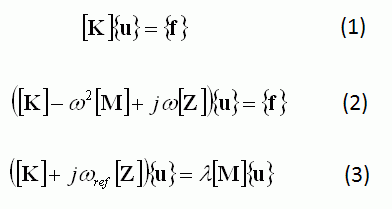
Static analysis: The unknown vector {u} is calculated by solving Linear Equation (1) below. Vector {u} has displacement and voltage,
which means the distributions of displacement and electric potential are obtained by calculating {u}.
Harmonic analysis: The unknown vector {u} is calculated by solving Linear Equation (2) below.
This equation is solved under the condition that the displacement, the voltage, and the load (the force, the displacement etc) oscillate sinusoidally.
Resonant analysis: Eigenvalues of Equation (3) are calculated. As a result, the resonant frequency for each eigenvalue is obtained.
The magnitude of eigenvector can't be decided because equation (3) has the vectors {u} in the both sides.
Therefore, the calculated field amplitudes such as the displacement etc are different from the true ones.
For some cases, the amplitudes can be obtained. See "Cautions when performing the resonant analysis" below for details.
| Static analysis Harmonic analysis Resonant analysis |
 |
|
|
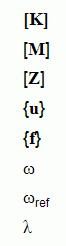
: Matrix relating to the elasticity, piezoelectricity, permittivity, and shape |
| : Matrix relating to the density and the shape | |
| : Matrix relating to the acoustic impedance boundary condition | |
| : Unknown vector relating to the displacement and the electric potential | |
| : Mechanical load vector | |
| : Angular frequency | |
| : Approximated frequency | |
| : Eigenvalue (=ω²) |
2. Cautions when performing the resonant analysis
-
The amplitude in the resonant analysis
It is known that the amplitude in the resonant analysis is roughly the same as that calculated in the harmonic analysis in two conditions below.
- The material is lossy.
- The driving source is voltage.
Note that the result may not be the same as that of harmonic analysis if there is another mode resonating at nearby frequency.
If the material is not lossy or there is no driving source of voltage, the amplitude can't be obtained.
The calculated amplitude is meaningless while the shape of displacement is meaningful.
-
To perform a resonant analysis for a model having the acoustic impedance
Equation (3) contains the variable of ωref. It indicates that the approximated frequency entered on the Resonant Analysis tab is used for the matrix.
To perform the resonant analysis for a model having the acoustic impedance,
the approximated frequency must be entered.