


|
Home / Technical Notes / Thermal Analysis / Differential Equations in Thermal Analysis
Differential Equations Solved in the Thermal Analysis
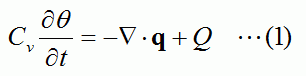
Cv: Volumetric heat capacity (the product of specific heat and density)
θ: Temperature
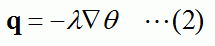
q: Heat flux
Q: Heat density
λ: Thermal conductivity
Femtet Solver "Watt" solves Equations (1) and (2) to obtain the distributions of θ and q.
Expressions (1) and (2) express the following.
Equation (1): law of conservation of energy that holds in the solid with volumetric specific heat Cv
Equation (2): Fourier's law that holds in the solid with thermal conductivity λ
Governing Equation
Solver "Watt" solves Equation (3), which is derived from Equations (1) and (2).
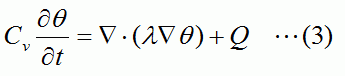
Cv: Volumetric heat capacity (the product of specific heat and density)
θ: Temperature
λ: Thermal conductivity
In steady state, the left side of Equation (3) is equal to zero.
For transient analysis, fully-implicit method is used.
Once θ is obtained, q can be obtained from Equations (2).
Some boundary conditions must be given to solve Equation (3).
The typical boundary conditions:
Temperature: The temperature θ of the boundary is fixed at the entered value.
Adiabatic: The normal component of heat flux q (-λ∇θ) on the boundary is equal to zero.
Heat flux: The normal component of heat flux q (-λ∇θ) on the boundary is set at the entered value.
By applying the heat transfer: convection or radiation boundary condition, the relationship of ⊿θ and the amount of heat radiation can be set where ⊿θ is the difference between surface temperature θ and ambient temperature θroom, and amount of heat radiation is in reversed normal direction to the heat flux boundary.