


|
Home / Technical Notes / Electromagnetic analysis / Boundary Condition / PML
PML
1. Overview
PML stands for Perfect Matched Layer.
It absorbs the electromagnetic waves completely, and realizes the open space.
It is supported in:
- Electromagnetic waves 3D harmonic analysis
- Piezoelectric 3D harmonic analysis
- Piezoelectric 2D harmonic analysis (2D cross section)
2. How to apply PML
1) Select PML on the open boundary tab of the analysis condition setting.
2) Set the open boundary around the analysis region like red lines in Fig.1.
Note that the faces must be perpendicular to the x, y or z-axis.
3) Femtet creates PML around those faces automatically when generating meshes.
If they are contacting other boundary conditions, those conditions will be applied on PML as well.
PML can be displayed on the results window.
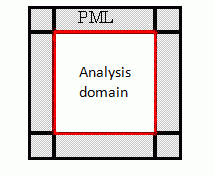 |
| Figure 1 Analysis domain with PML applied |
3. PML in electromagnetic analysis
PML is perpendicular to the x-axis in this example. PML satisfies Equation (1).
where the incident plane waves approach obliquely and decay inside the PML.
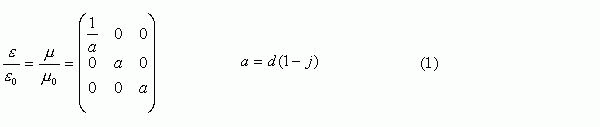
The propagation constant is β=k0*d(1-j). The outer boundary of PML is the magnetic wall, where the electromagnetic waves are completely reflected.
The amplitude of the reflected waves coming back into the analysis region is controlled by the coefficient d.
Femtet sets the d value so that the reflected waves' amplitude becomes 1/100 the incident waves' amplitude.
Therefore the amplitude of the electromagnetic waves will be 1/100 by going through PML,
and about 0.7 of wavelength is in it.
( d=-ln(0.01)/(2L*k0),
where L[m] is the PML thickness, and the wavelength in PML is 2L*Re(β)/(2π) )
[Reference]
Pelosi, G., Coccioli, R. and Selleri, S., "Quick Finite Elements for Electromagnetic Waves",
6 Scattering and Antennas, Artech House
4. PML in piezoelectric analysis
The displacement decays exponentially in PML.
u(x) = u0 exp[-cβx]
u: amplitude of displacement, u0: amplitude of displacement on the border between PML and the analysis region.
c: coefficient of damping, β: wavenumber [rad/m]
x: distance from the border to a point in PML
Three parameters (thickness, coefficient of damping c and wavelength λ) need to be specified. As the wavenumber is given by
β=2π/λ
the displacement decays quicker with shorter wavelength.
These parameters are determined as follows. First, perform the simulation with the default values (thickness = 0.3, coefficient of damping = 1.0 and wavelength = 0.0)
and estimate the wavelength. Then, enter the wavelength and perform the simulation. The PML thickness is to be appropriate.
By setting the wavelength to 0, the PML thickness is decided based on the wavelength of the longitudinal wave which has long wavelength. This means PML is thicker than the minimally required thickness.
If PML has more than 3 meshes in the direction of thickness, you can make the PML thinner while keeping the coefficient of damping.
Increasing the coefficient of damping will make the displacement decay quickly as well.
Note that the reflection is to decrease if damped in more than 2 meshes.
It is to increase if damped in 2 meshes or less.