|
Home / Simulation Accuracy Setting (Mesh/Element) / Meshing Setup / Meshing Control
Meshing Control
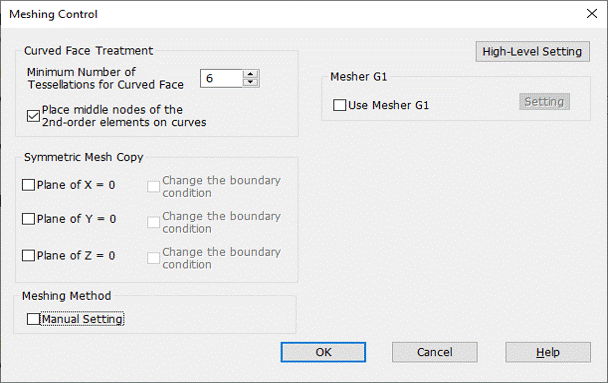
Various meshing conditions are specified here.
|
Setting Item |
Notes |
||||||||
|
Curved Face Process |
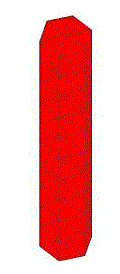
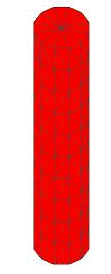
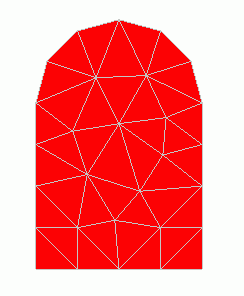
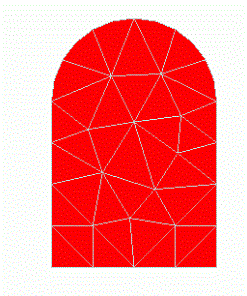
Minimum Number of Tessellations for Curved Face Specifies the number of tessellations for the periodic surface such as cylinder and sphere. The larger value generates meshes close to smooth curved face. However, the calculation takes more time. If the mesh size is small, the number of tessellations determined by the mesh size has precedence.
Place middle nodes of the 2nd-order elements on curves Used for the 2nd-order elements. Deselect it if the calculation doesn't converge with iterative method. That might solve the problem. If deselected, accuracy of the curving form of the model will be deteriorated. Not applicable to the following cases. ・Adaptive meshing is activated ・3D magnetic analysis ・3D electromagnetic analysis and 2D waveguide analysis
|
||||||||
|
Symmetric Mesh Copy |
Copies meshes symmetrically over the specified plane. See [Symmetric Meshing] for more information.
|
||||||||
|
User-defined Meshing |
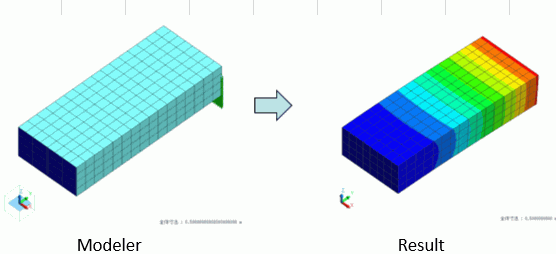
If [Manual Setting] is selected, meshes of any shape can be built by creating solid bodies in the structure of mesh.
|
||||||||
|
High-Level Setting |
Activates the [High-Level Setting for Meshing] dialog box. See [High-level setting] for more information.
|
||||||||
|
Mesher G1 |
Executes meshing with Mesher G1. See [Mesher G1 Setting] for more information.
|
||||||||
|
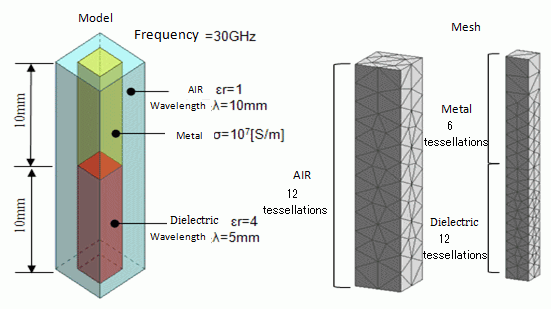
Generates finer meshes for the shorter wavelength and coarser meshes for the longer wavelength. This function is effective for electromagnetic and acoustic analyses. The wavelength is based on the reference frequency for electromagnetic analysis. It is based on the average of the minimum and maximum frequencies for acoustic analysis. The general mesh size will be replaced with the size of the meshes above. However, if the individually specified mesh size is smaller, the smaller size will take precedence. In the electromagnetic analysis, the mesh size of the metals is the same as that of adjacent dielectric materials.
Below is an example. The wavelength of air, 10 [mm] is tessellated by 6 and that of dielectric material, 5 [mm] is also tessellated by 6.
|
|||||||||
|
Periodic mesh for magnetic rotating machinery |
Generates periodic meshes. Available for the 2D magnetic analysis of rotating machinery. See [Periodic Meshing] for more information.
|