


|
Home / How to Set Analysis Condition / List of Analysis Condition Tabs / Electric-Stress Tab
Electric-Stress Analysis Tab
Analysis conditions for the electric-stress coupled analysis are set on this tab. The solvers are Coulomb and Galileo.
It is in the [Analysis Condition Setting] dialog box. See also [How to Set Analysis Condition].
|
Setting Item |
Notes |
|
Analysis Type |
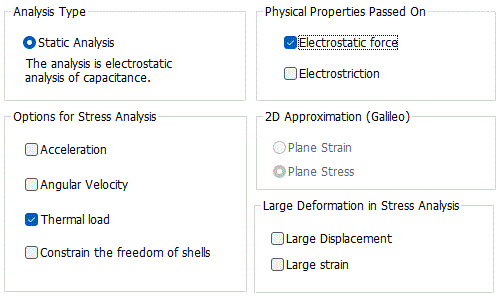
Static analysis Constant load, voltage or current is applied.
|
|
Materials |
Dielectric material This is the only material selectable in the electric-stress coupled analysis. |
|
Physical Properties Passed On |
Electrostatic force to be taken into account The stress is calculated with the electrostatic force acquired by Coulomb taken into account.
Electrostriction The stress is calculated with the electrostriction taken into account. The electrostriction is calculated from the electric flux density solved by electric analysis. |
|
2D Approximation |
To perform 2D analysis, select either one below.
Planar strain If the object is fixed in the Y direction, there will be no displacement in the Y direction. Then we can take into account the X/Z components of the strain only. This is called the planar strain approximation.
Plane stress If the object's Y dimension is considerably smaller than the X/Z dimensions and the object can deform freely in the Y direction, we can assume that the stress has X/Z components only. This is called the plane stress approximation. |
Options
|
Options |
Notes |
|
Large Deformation |
Analyzes the geometric nonlinearity involving large deformation.
Large deformation means large rotation and strain of elements. See Technical Note Analysis of Large Deformation (Geometric Nonlinearity for details.
- Select "Large displacement" to have large rotation involved. The total Lagrangian formulation with Green-Lagrangian strains is used.
- Select both "Large displacement" and "Large strain" to have large rotation and large strain involved. The updated Lagrangian formulation with logarithmic strain is used. It is recommended to select "Large displacement" when you are selecting "Large strain".
- Select "Large strain" to have large strain involved. The updated Lagrangian formulation with logarithmic strain is used.
Iterative calculations will be performed for large deformation and the simulation will take longer time. Available for the static analysis only. |
|
Acceleration |
Takes the weight of the model into account. |
|
Angular velocity |
Takes the centrifugal force into account. Available for the axisymmetric or 3D static analysis. The rotation axis is fixed to Z. |
|
Thermal load |
Takes the thermal load into account. If selected, the thermal load can be set on the thermal load tab. |
|
Constrain the freedom of shells
|
Available for the 3D analysis. If selected, the freedom of displacement in the rotational direction can be constrained on the mechanical tab. |
The Relating Tabs
The relating tabs are [Open Boundary] tab, [Step/Thermal Load] tab, [Acceleration] tab, [Angular Velocity] tab, and [High-Level Setting] tab.
How to Modify Analysis Conditions
To modify the analysis conditions, go to [Model] tab
and click [Analysis Condition]  . The dialog box will appear.