|
Home / Technical Notes / Stress Analysis / Analysis of Large Deformation (Geometric Nonlinearity)
Analysis of Large Deformation (Geometric Nonlinearity)
Large Deformation Options
There are 2 types of large deformation (geometric nonlinearity).
1) Large displacement
Used when the rotation is quite large and cannot be ignored.
Large deformation or large rotation sometimes means this large displacement.
2) Large strain
Used when the strain is large (more than several %).
When these are selected, the loading is updated in accordance with the deformation.
For example, the direction of pressure will be normal to the deformed face.
Total load and torque load distribution will reflect the resulting area and length.
Explanations on why this option is needed and its formulation follow.
Large Deformation (Geometric Nonlinearity)
In linear analysis, it is assumed that the deformation of model shape is not large.
Therefore, if the deformation is going to be large, the deformed shape and conditions need to be taken into consideration.
This kind of deformation is geometric nonlinearity.
It is nonlinear because the displacement is not proportional to the stress.
The definition of deformation is as follows.
The transformation from A to B involves the following three steps.
1) Translation A to B'
2) Strain (enlargement, reduction, shear) B' to B"
3) Rotation B" to B
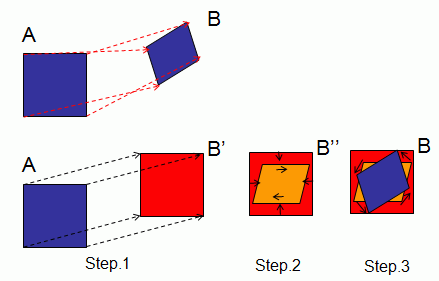
The transformation having 2) and 3) is "large deformation".
Large Displacement
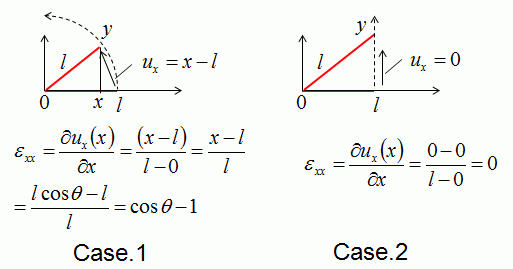
In linear analysis, 2) and 3) cannot be differentiated.
Simple rotation causes strain. See Case 1.
The change of length results in no strain. See Case 2.
These inconveniences come from the fact that small strains cannot cope with rotations.
In linear analyses, for example,
- Curling due to large bending. See Example 6: Deformation of Spring Plate.
- String tension
- Buckling
cannot not be simulated properly
unless Large displacement is selected.
* Buckling might result in no convergence. See Buckling Analysis.
Large Strain
Suppose the length changes from L to l,
there are 3 types of strains to be considered. They are plotted against l/L for comparison.
|
Type |
Expression |
Condition |
Notes |
|
Small strain ≒ Engineering strain, nominal strain |
|
"Large displacement" and "Large strain" both deselected |
The rate of change of length
Paired stress: Nominal stress |
|
Green-Lagrange strain |
|
"Large displacement" |
The rate of change of squared length
Paired stress: 2nd Piola-Kirchhoff stress |
|
True strain = Logarithmic strain |
|
"Large strain" |
Integration of incremental strain
Paired stress: True stress |
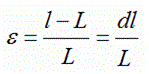
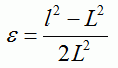
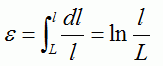
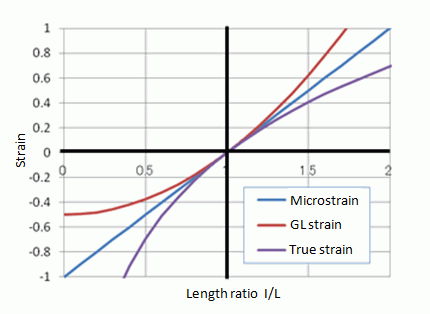
When engineering or Green-Lagrange strain is applied, the length might become zero or negative after the deformation.
It means if large strain is applied, the length will become zero though it will never occur in reality.
The length could also become negative where the meshes might flip over.
Logarithmic strain approaches minus infinity as the length approaches zero.
If just "Large displacement" is used in Example 54: Inelastic Collision,
the volume will become nearly zero and the calculation might not converge.
The elasto-plastic materials' stress-strain relation is based on true stress and true strain. See Elasticity Tab.
If the strain is large, the results will deviate from those expected from the entered material properties unless the true strain is used.
It is indicated by the graph of strain vs. l/L above.
In the example below, Au bump (elasto-plastic material) which has Radius = 50um, Height = 50um (Volume = 3.4 x 10⁵ um3)
is pressed down to Height = 10um. Axisymmetric analysis is performed for this model.
The volume of elasto-plastic materials doesn't change before and after the deformation.
In this example, the deformation is large and the changes are mostly plastic deformation.
The analysis is done for 3 types of strain:
- No large displacement and strain (Engineering strain)
- Large displacement only (Green-Lagrange strain)
- Large displacement and strain (True strain)
Results are as follows.
|
Type |
Result |
Volume after Deformation |
|
|
|
Radius: 68μm , Volume: 1.45 x 105 μm3 |
|
"Large displacement" only |
did not converge at 45% of displacement load |
N/A |
|
"Large displacement" and "Large strain" both selected |
|
Radius: 103.5μm, Volume: 3.36 x 105μm3 |
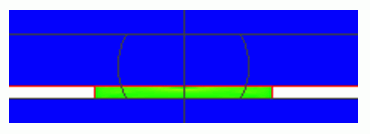
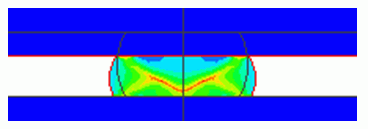
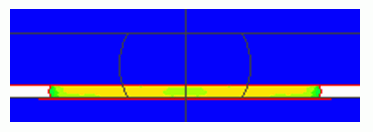
When "Large displacement" and "Large strain" are both deselected, the calculation has converged but the volume is tremendously reduced. It is obvious that the result is not correct.
When only "Large displacement" is selected, the calculation went out of convergence with displacement load. Some meshes are crushed.
When "Large displacement" and "Large strain" are both selected, the calculation has converged and the volume has remained unchanged before and after the deformation. It is well representing the characteristic of plastic deformation.
Formulation of Large Displacement and Large Strain
The matrix equation used for large displacement/strain is as follows.

[K] is the stiffness matrix, which is related to the material's elasticity.
[KG] is the nonlinear stiffness matrix, which is related to the displacement, strain and stress resulting from deformation so far.
{f} is the load vector, which is related to the displacement boundary and the load boundary.
{Q} is the internal force vector, which represents the strains and stresses resulting from the previous step.
{Δu} is the displacement increment vector, which is the unknown.
There are 2 methods to formulate these matrices and vectors.
1) Total Lagrangian Formulation
This formulation is used when;
- only "Large displacement" is selected.
- either "Large displacement" or "Large strain" is selected and the hyperelastic material set on the Hyperelasticity tab is included.
The Green-Lagrange strain and the 2nd Piola-Kirchhoff stress are applied.
The Green-Lagrange strain and the true stress (Cauchy stress) are output as a solution.
As shown in the Stress Analysis of Hyperelastic Materials, the relationship of strain and stress of the hyperelastic material is defined by
the Green-Lagrange strain and the 2nd Piola-Kirchhoff stress.
Therefore, Total Lagrangian Formulation is used.
2) Updated Lagrangian Formulation
This formulation is used when;
- "Large strain" is selected and hyperelastic material is not included.
If "Large strain" is selected and "Large displacement" is deselected, geometric stiffness matrix [KG] will be equal to 0 in the calculation.
Regardless of the value of [KG], the deformation when {f} and {Q} match will be the solution. Therefore, when the solution converges, the same solution will be obtained.
It is recommended to select "Large displacement" when you are selecting "Large strain" as it often reduces the number of iterations if [KG] is taken into account.
When the calculation does not converge with both "Large strain" and "Large displacement" being selected, it may converge if "Large displacement" is deselected.
The true strain (logarithmic strain and the true stress (Cauchy stress) are applied
and output as a solution.
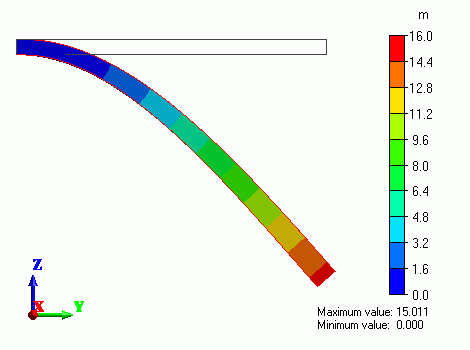
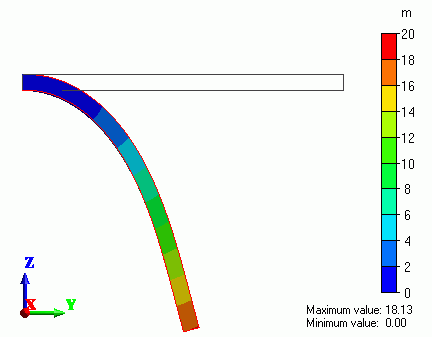
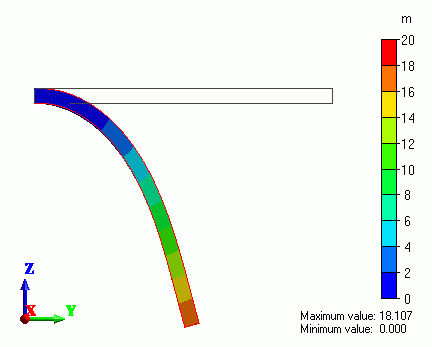
Example 6: Deformation of Spring Plate is studied below with regard to large deformation.
The tip of the plate doesn't curl up when "Large displacement" and "Large strain" are both deselected.
|
Type |
"Large strain" not selected |
"Large strain" selected |
|
|
|
Updated Lagrangian Formulation |
|
"Large displacement" selected |
Total Lagrangian Formulation |
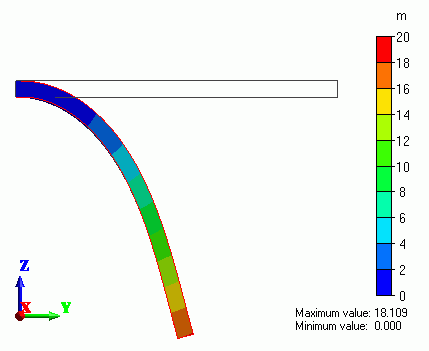
Updated Lagrangian Formulation |