


|
Home / What Femtet Can Do / Details of Analysis Functions / Magnetic analysis
Magnetic analysis
The features of Gauss and Luvens (the magnetic solver) are explained here with some examples.
Static or Harmonic analysis (Gauss)
-
The magnetic field created by magnets and magnetic materials can be analyzed.
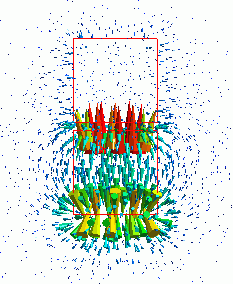
In Example 2 of Magnetic Analysis, the magnetic field created by bar magnet and magnetic material is analyzed.
Solved are the distributions of the magnetic field and the magnetic flux of the surrounding space,
and the electromagnetic force between the magnet and the magnetic material.
-
Loop coils can be defined and the inductances can be solved.
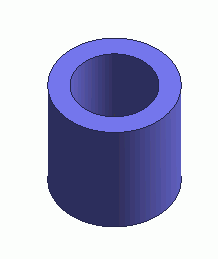
In Example 10 of Magnetic Analysis, a cylinder-shaped loop coil is defined and the inductance is analyzed.
Solved are the distributions of the magnetic field and the magnetic flux of the surrounding space,
the current through the coil and the inductance of the coil.
-
Electromagnetic induction is solved with harmonic analysis.
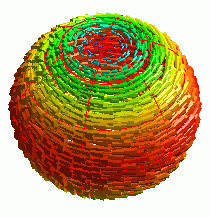
In Example 16 of Magnetic Analysis, the magnetic field oscillating at the specified frequency is applied to the conductive shell.
As a result, current (eddy current) is induced and solved.
The current density inside the conductor and the magnetic field of the surrounding space are solved as well.
Transient analysis (Luvens)
-
Torque and starting characteristics of rotating machinery such as motor are solved with induced current and external circuit taken into account.
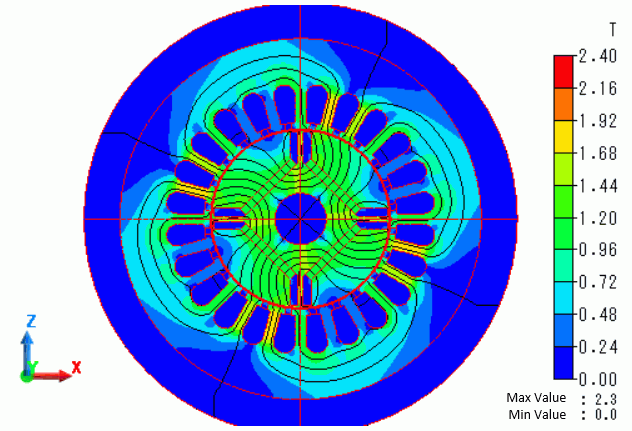
In Example 1 of Magnetic Analysis, torque of IPM motor (Interior Permanent Magnet Motor) is analyzed when the current is applied.
The torque and magnetic flux density are obtained.
-
Analysis can be performed with nonlinear permeability (B-H curve) materials and AC applied.
The functions of the magnetic analysis are listed below. For more examples, see [Example List for Magnetic Analysis].
|
Analysis types
|
Static Analysis, Harmonic Analysis, Transient Analysis *, External Circuit Coupled Analysis *, Rotating Machinery *, Translational Machinery * |
|
Materials |
Magnetic Material (Isotropy/Anisotropy/Nonlinearity), Magnet (Nonlinearity), Conductor, Temperature-Dependency |
|
Boundary conditions |
Magnetic Wall, Electric Wall, Open Boundary, Surface Impedance Boundary |
|
Obtained Properties |
Magnetic Field, Magnetic Flux Density, Induced Current, Inductance Matrix, Electromagnetic Force, Impedance, Torque, Iron Loss (Joule Loss, Hysteresis Loss), Coefficient of Permeance |
|
Miscellaneous |
Superimposed DC Characteristics, Current Specified (I/O Faces, Current Value, Turns, Phase), Bulk Coil, Magnetization, Integration with MATLAB®Simlink® Motor Drive Analysis |
(*)Transient analysis is available in an optional package.