


|
Home / What Femtet Can Do / Details of Analysis Functions / Piezoelectric Analysis
Piezoelectric Analysis
Th features of Rayleigh (the piezoelectric solver) are explained here with some examples.
-
The piezoelectric material generates electric potential when it is accelerated.
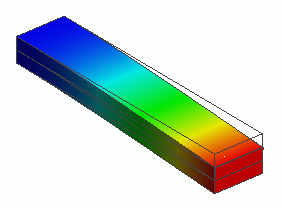
In Example 5 of Piezoelectric Analysis, the piezoelectric bar is deformed by the acceleration, and voltage is generated on the floating electrode.
-
The piezoelectric material generates electric potential when it is mechanically loaded or pressurized.
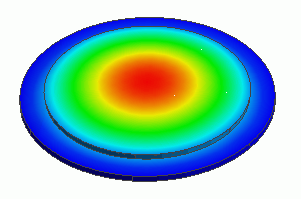
In Example 4 of Piezoelectric Analysis, the piezoelectric disc is deformed by the loading, and voltage is generated on the floating electrode.
-
The piezoelectric material deforms when voltage is applied.
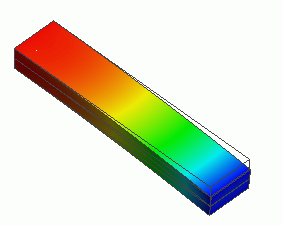
In Example 1 of Piezoelectric Analysis, the piezoelectric bar is deformed by the applied voltage.
The functions of the piezoelectric analysis are listed below. For more examples, see [Example List for Piezoelectric Analysis].
|
Analysis Types
|
Static Analysis, Harmonic Analysis, Resonant Analysis, Transient Analysis, Analysis with Initial Stress Taken into Account |
|
Materials |
Piezoelectric Material, Dielectric Material, Perfect Conductor, Viscoelastic Material, Anisotropic Material |
|
Boundary Conditions
|
Displacement, Normal Displacement, Rotational Displacement, Acceleration, Lumped Load, Distributed Load, Pressure, Torque Load, Contact (Friction), Simple Contact, Remote Load, Acoustic Impedance, Open Boundary, Optional Distributed Boundary, Free
Electric wall (specify electric potential, floating electrode), Magnetic wall
Periodic boundary, Symmetric face, Discontinuous
|
|
Obtained Properties |
Displacement, Stress, Strain, Electric Field, Electric Flux Density, Electric Charge, Electric Potential, Electric Current, Impedance, Resonant Frequency, Pressure at Contact Face, Contact Area |
|
Miscellaneous |
Fast Sweep, Acceleration, Heat Load, External Resistance, Centrifugal Force, Coriolis Force |
|
Options |
Items |
Static Analysis |
Harmonic Analysis |
Resonant Analysis (*) |
Transient Analysis |
|
|
Linear Analysis |
Nonlinear Analysis (*3) |
|||||
|
Sheet body in 3D analysis |
Plane stress element (*2) |
Yes |
Yes |
Yes |
Yes |
Yes |
|
Large deformation (geometric nonlinearity) |
Large displacement |
No |
Yes |
No |
No |
Yes |
|
Thermal options |
Thermal load |
Yes |
Yes |
No |
No |
No |
|
Constant temperature |
- |
- |
Yes (only for viscoelasticity) |
No |
Yes (only for viscoelasticity) |
|
|
Velocity / Acceleration |
Angular velocity |
Yes |
Yes |
Yes |
No |
No |
|
Acceleration |
Yes |
Yes |
Yes |
X |
Yes |
|
|
Nonlinear material |
Mechanical loss |
No |
No |
Yes |
Yes |
Yes (Coefiicientr of Rayleigh damping, Viscoelasticity) |
|
No |
No |
Yes (only for shear and volume) |
No |
Yes |
||
|
Analysis with the initial stress taken into account |
- |
Yes |
No |
Yes |
Yes |
No |
|
Thermoelastic Damping |
- |
No |
No |
Yes |
Yes |
No |
|
Body attribute: Direction tab |
Directional distribution |
Yes |
No |
Yes |
Yes |
No |
Caution: The following functions are applicable in the stress analysis but not in the piezoelectric analysis.
- Analysis type: Multistep of static analysis and buckling analysis
- Geometric nonlinearity: Large strain
- Shell element
- Multilayer plane stress sheet (*2)
- Nonlinear material: Elasto-plastic, Hyperelastic, Creep
- Thermal coupled analysis
- Mass / Moment of inertia
- Option of material: Birth/death, Material change, fatigue life assessment
(*) Including transient analysis using resonant mode.
(*2) Plane stress element is supported but not multilayer plane stress sheet.
(*3) Nonlinear analysis is a large deformation analysis and an analysis with contact boundary condition.
|
Analysis Condition Tab |
Items |
Static Analysis |
Harmonic Analysis |
Resonant Analysis (*) |
Transient Analysis |
|
|
Linear Analysis |
Nonlinear Analysis |
|||||
|
Mechanical |
Displacement |
Yes |
Yes |
Yes |
Yes |
Yes |
|
Normal displacement |
Yes |
Yes |
Yes |
Yes |
Yes |
|
|
Rotational displacement |
Yes |
Yes |
Yes |
No |
Yes |
|
|
Acceleration |
No |
No |
Yes |
No |
No |
|
|
Lumped vertex load |
Yes |
Yes |
Yes |
No |
Yes |
|
|
Lumped face load |
Yes |
Yes |
Yes |
No |
Yes |
|
|
Distributed face load |
Yes |
Yes |
Yes |
No |
Yes |
|
|
Pressure |
Yes |
Yes |
Yes |
No |
Yes |
|
|
Torque load |
Yes |
Yes |
Yes |
No |
Yes |
|
|
Simple contact |
Yes |
Yes |
Yes (only for slip and off contact) |
No |
No |
|
|
Contact |
No |
Yes |
No |
No |
Yes |
|
|
Remote load |
Yes |
Yes |
Yes |
No |
Yes |
|
|
Acoustic impedance |
No |
No |
Yes |
Yes |
No |
|
|
Open boundary |
No |
No |
Yes |
Yes |
No |
|
|
Free |
Yes |
Yes |
Yes |
Yes |
Yes |
|
|
Electric |
Electric wall |
Yes |
Yes |
Yes |
Yes |
Yes |
|
Magnetic wall |
Yes |
Yes |
Yes |
Yes |
Yes |
|
|
Symmetry/Continuity |
Face of symmetry |
Yes |
Yes |
Yes |
Yes |
Yes |
|
Periodic |
Yes |
No |
Yes |
Yes |
No |
|
|
Discontinuous |
Yes |
Yes |
Yes |
Yes |
Yes |
|
(*) Not supported for the following types of the mechanical tab in the boundary condition.
Joint load
Spring connection