Femtet Help/Manual
 

Home / How to Set Body Attribute, Material Property and Boundary Condition / Fluid Analysis [Bernoulli] / Boundary Condition / Turbulent Flow Setting

Turbulent Flow Setting

If turbulent flow is selected in the analysis condition setting, the turbulent flow energy and the energy dissipation rate are required to set the state of incoming fluid.
The turbulent inflow rate is defined by inlet or inlet/outlet setting in the boundary condition.


For the general explanations of the boundary condition setting, refer to [Boundary Condition of Fluid Analysis] of Technical Note.


Setting Item

Notes

K_Turbulent Flow Energy

Specifying Method

Notes

Automatic Calculation

The flow is judged to be either internal flow or the external flow from the boundary condition.

The turbulent flow energy is calculated for each flow.

If the area around the inlet boundary contacts with the solid wall, it is judged to be an internal flow.


The internal flow and the external flow are explained in [Boundary Condition of Fluid Analysis] of Technical Note.


Internal Flow


Calculates the turbulent flow energy assuming the intensity of the turbulence is as high as 5 [%].


External Flow


Calculates the turbulent flow energy assuming the intensity of the turbulence is as low as 1 [%].


The turbulence intensity is the ratio of the velocity fluctuation to the flow velocity.
Generally, it is 1 to 10%.


U'[m/s]: velocity fluctuation due to the turbulence

U[m/s]: inflow velocity

I[%]: turbulence intensity

K[m2/s2]: turbulent flow energy


Turbulence Intensity

Specifies the turbulent flow energy by the turbulence intensity.
The turbulence intensity is the ratio of the velocity fluctuation to the flow velocity.
Generally, it is 1 to 10%.

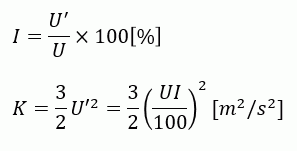
K is calculated as follow.


U'[m/s]: velocity fluctuation due to the turbulence

U[m/s]: inflow velocity

I[%]: turbulence intensity

K[m2/s2]: turbulent flow energy

Direct Entry

Specifies the turbulent flow energy directly.
Used when the value is known from the measurement.


ε_Energy Dissipation Rate


Specifying Method

Notes

Automatic Calculation

The flow is judged to be either internal flow or the external flow from the boundary condition.

The energy dissipation rate is calculated for each flow.

If the area around the inlet boundary contacts with the solid wall, it is judged to be an internal flow.


The internal flow and the external flow are explained in [Boundary Condition of Fluid Analysis] of Technical Note.


Internal Flow


Calculates the hydraulic diameter automatically assuming the inflow face is circular.


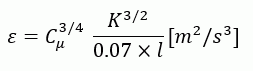
ε is calculated as follow.

The equation takes into account that the vortex is limited by the size of the inlet.


Cμ=0.09: model constant

K[m2/s2]: turbulent flow energy

L[m]: hydraulic diameter of inlet

ε[m2/s3]: energy dissipation rate


The hydraulic diameter is calculated by the following equations according to the shape of the area to which the boundary condition is set.


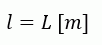
2D model

L[m]: edge length


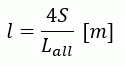
3D model

Lall[m]: total length of perimeter

S[m2]: area


External Flow


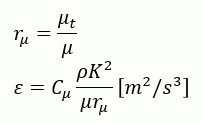
Specifies by the turbulent viscosity ratio. It is the ratio of the viscosity of turbulent viscosity to the material's viscosity.

The turbulent viscosity in the external flow is low. The calculation is carried out assuming the turbulent viscosity ratio is 1.


μ[Pa*s]: viscosity

μt[Pa*s]: coefficient of turbulent viscosity

rμ: turbulent viscosity ratio

Cμ=0.09: model constant

K[m2/s2]: turbulent flow energy

ρ[kg/m3]: density

ε[m2/s3]: energy dissipation rate


Mixing Length

Specifies the mixing length.


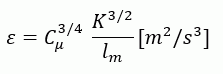
ε is calculated as follow.


Cμ=0.09: model constant

K[m2/s2]: turbulent flow energy

lm[m]: mixing length

ε[m2/s3]: energy dissipation rate


Hydraulic Diameter

Specifies assuming the inflow face is circular.


ε is calculated as follow.

The equation takes into account that the vortex is limited by the size of the inlet.


Cμ=0.09: model constant

K[m2/s2]: turbulent flow energy

L[m]: hydraulic diameter of inlet

ε[m2/s3]: energy dissipation rate


Turbulent viscosity ratio

Specifies by the turbulent viscosity ratio. It is the ratio of the viscosity of turbulent viscosity to the material's viscosity.

Generally, it is 1 to 10.


μ[Pa*s]: viscosity

μt[Pa*s]: coefficient of turbulent viscosity

rμ: turbulent viscosity ratio

Cμ=0.09: model constant

K[m2/s2]: turbulent flow energy

ρ[kg/m3]: density

ε[m2/s3]: energy dissipation rate


Direct Entry

Specifies the energy dissipation rate directly.
Enter the value known from the measurement.


ω_specific dissipation rate

Calculate ω in the same way as ε. Convert ε calculated above into ω using the equation below.