


|
Home / Technical Notes / Electromagnetic analysis / Analysis Condition / Time Domain Setting
Time Domain Setting
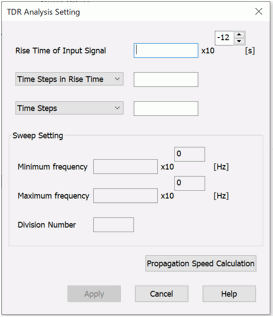
With Descartes, by reading a Touchstone file as a result of harmonic electromagnetic analysis,
S-parameters can be converted to the results of TDR, which analyzes time domain.
This dialog box allows you to automatically convert the time setting of the TDR analysis to the analysis frequency setting of the harmonic analysis required to obtain the results.
|
Setting Item |
Notes |
|
Rise Time of Input Signal |
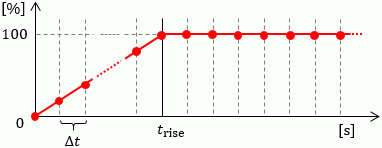
Sets the rise time of the input signal: trise [s]. The input signal is assumed to be stepped wave.
|
|
Number of Timesteps in Rise Time/Timestep Width |
Sets the timestep width Δt [s].
Number of Timesteps in Rise Time Sets the timestep width by the number of time steps included in the rise time.
Timestep Width Sets the timestep width Δt [s] directly.
|
|
Number of Timesteps/Time |
Sets the number of timesteps to draw a result graph.
Number of Timesteps Sets the number of timesteps to draw. In the case of nstep
Time A graph of the change of TDR impedance with time greater than the specified time can be obtained.
|
|
Calculation of Propagation Speed |
Calculates propagation speed and propagation time of the electromagnetic waves. |
-
Fourier transform and inverse Fourier transform are used to convert S-parameters to TDR impedance.
Since the number of data that can be handled by the Fourier transform and inverse Fourier transform is 2n (n is a positive integer),
the number of timesteps may not be the number as entered in some cases.
For example, if the number of timesteps are set to 100, the actual calculation will be for 127 steps.
Although the number of data (time points) for 100 steps is 101,
by calculating for 127 steps, the number of data will be 128 (= 27), which makes the Fourier transform and the inverse Fourier transform possible.
-
If the number of timesteps is set according to the specified time, the specified time may not be exactly as entered due to the time step width.
For example, if 320 ps is entered for the time when the timestep width is 15 ps, the time will be adjusted to 330 ps (=22 steps x 15 ps).
Next, the number of timesteps is adjusted to 31 because the number of data must be 32 (= 25) for executing the Fourier transform.
Finally, the calculation is done for 465 ps (=31 steps x 15 ps).
-
In the electromagnetic analysis, the accuracy is sometimes low at the frequencies lower than 10MHz.
When the rise time of signal, timestep width, and number of time steps are entered,
the minimum frequency, maximum frequency, and number of divisions are automatically calculated. Please make sure that the frequency is not too low.