


|
Home / Technical Notes / Acoustic Analysis / Open Boundary Condition
Open Boundary Condition
The absorbing boundary is the open boundary condition of the acoustic analysis. The difference between the1st and the 2nd order absorbing boundaries is examined here.
Model 1 is from the acoustic analysis example 1. Model 2 and 3 are reduced versions of Model 1 with smaller analysis domain.
The driving source is a circle with radius of 0.15 m for all three models.
The analyses are executed with the 1st order and the 2nd order absorbing boundary. The sound pressure of each analysis is obtained at the observation point A that is 15 cm above the driving source.
Fig. 2 is a graph with radius of the analysis domain on the horizontal axis and the absolute value of sound pressure on the vertical axis.
As the graph shows, the sound pressure converges to a certain value as the analysis space expands. The calculation error is large with a small analysis domain.
The calculation error of the 1st order absorbing boundary is larger than the 2nd order absorbing boundary.
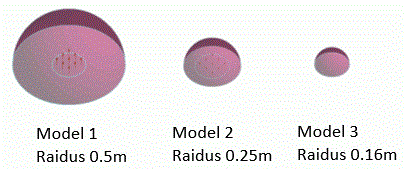
Fig.1: Analysis Model The radius of the driving face is constant.
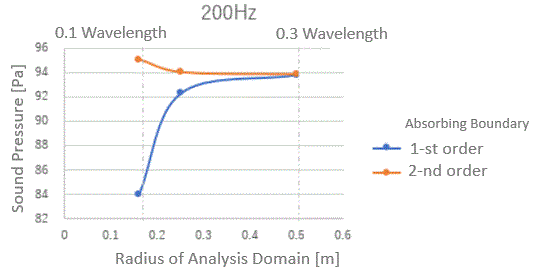
Fig.2: Absolute Value at Observation Point A (0, 0, 0.15) The unit of the coordinates is [m].
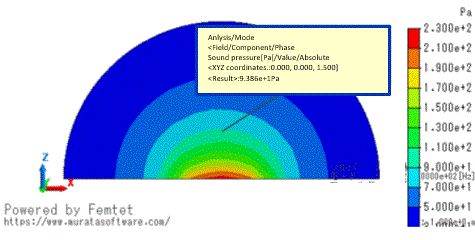
Fig.3: Position of Observation Point A in the Model 1