


|
Home / What Femtet Can Do / Details of Analysis Functions / Stress Analysis
Stress Analysis
Th features of Galileo (the stress solver) are explained here with some examples.
-
The deformation and the stress distribution can be solved for objects when they are loaded or are forced to displace.
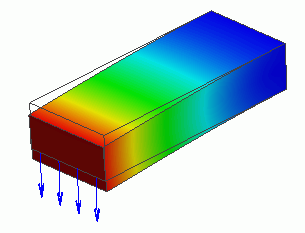
In Example 3 of Stress Analysis, a bar is fixed at one end, while the other end is forced to displace.
The stress of the bar is analyzed.
Distributions of displacement and stress are solved.
-
Resonant modes can be solved as well.
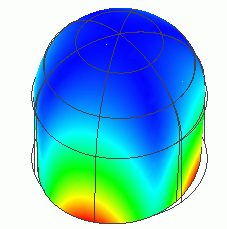
In Example 11 of Stress Analysis, resonant analysis is performed for a church bell.
Resonant frequencies and distributions of displacement and stress of each resonant mode are solved.
-
Thermal load due to the temperature change can be taken into account.
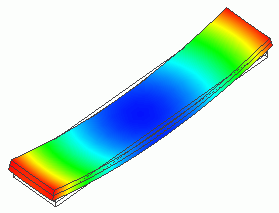
In Example 7 of Stress Analysis, a piece of bimetal is analyzed.
It consists of two sheets of different metals.Distributions of displacement and stress are solved.
The functions of the stress analysis are listed below. For more examples, see [Example List for Stress Analysis].
|
Analysis Types
|
Static Analysis, Harmonic Analysis, Resonant Analysis, Transient Analysis *, Buckling Analysis, Large Deformation (Large Displacement/Large Strain *), Analysis with Initial Stress Taken into Account |
|
Materials |
Elastic Material (Isotropy, Anisotropy), Elasto-plastic Material (Bilinear/Multilinear, Isotropic/Kinetic Hardening)*, Creep (Power Law) Material *, Viscoelastic Material *, Hyperelastic Material * , Coefficient of Linear Thermal Expansion (Isotropy, Anisotropy). Temperature Dependency |
|
Boundary Conditions |
Displacement, Normal Displacement, Rotational Displacement, Acceleration, Lumped Load, Distributed Load, Pressure, Torque Load, Joint Load, Simple Contact, Contact (Friction), Spring Connection, Remote Load |
|
Obtained Properties |
Displacement, Stress, Strain, External/Reactive Force, Torque, Contact Force, Strain Energy, J Integral, Participation Factor, Effective Mass, Pressure at Contact Face, Contact Area |
|
Miscellaneous |
Acceleration, Centrifugal Force, Thermal Load (possible to be coupled with thermal analysis), Initial Strain, Birth/Death, Fatigue Life * |
(*) Transient analysis, large strain, elasto-plastic material, creep material, viscoelastic material, hyperelastic material, and fatigue life are available in an optional package.
Various setting options are summarized below.
|
Options |
Items |
Static Analysis |
Harmonic Analysis |
Resonant Analysis |
Buckling Analysis |
Transient Analysis |
||
|
Single Step |
Single Step |
Multiple Steps |
||||||
|
3D |
Plane Stress Element |
Yes |
Yes |
Yes |
Yes |
Yes |
No |
Yes |
|
Shell Element |
Yes |
Yes *6 |
Yes |
Yes |
Yes |
No |
Yes |
|
|
Large deformation |
Large displacement |
No |
Yes |
Yes |
No |
No |
Yes (automatic) |
Yes |
|
Large strain |
No |
Yes *6 |
Yes |
No |
No |
No |
Yes |
|
|
Contact |
Contact |
No |
Yes |
Yes |
No |
No |
No |
Yes |
|
Simple Contact |
Yes *5 |
Yes |
Yes |
Yes, only for "Slip" and "Off Contact" |
No |
No |
No |
|
|
Thermal Options |
Thermal Load |
Yes |
Yes |
Yes |
No |
No |
Yes |
No |
|
Constant Temperature |
N/A |
N/A |
N/A |
Yes |
Yes |
N/A |
Yes |
|
|
Thermal Coupled Analysis |
Yes |
Yes *3 |
Yes *4 |
No |
No |
No |
No |
|
|
Velocity / Acceleration |
Angular Velocity |
Yes |
Yes |
Yes |
No |
No |
Yes |
No |
|
Acceleration |
Yes |
Yes |
Yes |
Yes |
No |
Yes |
Yes |
|
|
Mass / Moment of Inertia |
Yes |
Yes |
Yes |
Yes |
Yes |
Yes |
No |
|
|
Nonlinear Materials |
Mechanical Loss |
No |
No |
Yes (viscoelasticity) |
Yes |
Yes |
No |
Yes (Coefficient of Rayleigh Damping, Viscoelasticity) |
|
No |
Yes |
Yes |
No |
No |
No |
Yes |
||
|
No |
No |
Yes |
No |
No |
No |
Yes |
||
|
No |
No |
Yes |
Yes, only for "Shear and Bulk" |
No |
No |
Yes |
||
|
No |
Yes |
Yes |
No |
No |
No |
Yes |
||
|
Material Options |
No |
No |
Yes |
No |
No |
No |
No |
|
|
No |
No |
Yes |
No |
No |
No |
No |
||
|
No |
No |
Yes |
No |
No |
No |
No |
||
|
Analysis with Initial Stress Taken into Account |
N/A |
No |
No |
No |
Yes |
Yes |
No |
No |
(*1) Selected automatically depending on the material setting and other settings.
(*2) Transient analysis, large strain, elasto-plastic materials, creep materials, viscoelastic materials, hyperelastic materials, and fatigue life are available in an optional package.
(*3) Contact can be solved, but thermal solver cannot consider the contact state calculated in the stress analysis because the stress solver uses the results of the thermal analysis.
(*4) After multiple steps of heat history, thermal coupled steps are calculated.
(*5) Simple contact cannot is not executable if the shell elements exist in the model.
(*6) Large strain is not supported for shell elements.