


|
Home / Technical Notes / Stress Analysis / Analysis of Nonlinear Materials / Analysis of Elasto-plastic Materials
Analysis of Elasto-plastic Materials
(Note) The elasto-plastic analysis is available in an optional package.
Stress and Strain of Elasto-Plastic Materials
In the elastic material analysis, the stress and the strain are always proportional.
In case of elasto-plastic materials, however, they are proportional up to the elastic limit or the yield stress.
If the (von Mises equivalent) stress goes beyond this point,
the plastic strain is exhibited. Stress and strain are no longer proportional.
The graphs below show the stress and strain of elastic material and elasto-plastic material.
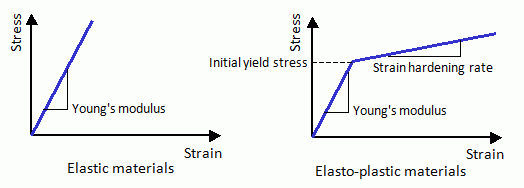
The strain hardening is the rate of stress increase against stain increase in the plastic region.
Strain and Plastic Strain of Elasto-Plastic Bilinear Materials
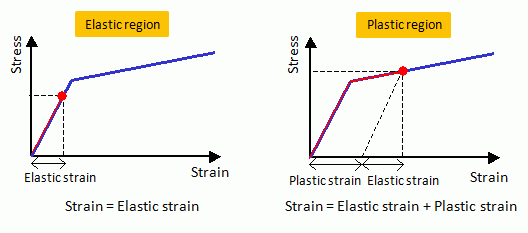
Elastic region (the left figure)
Stress and strain are proportional. The elastic strain is exhibited.
Plastic region ( the right figure)
The plastic strain is exhibited beyond the yield stress. The total strain is the sum of plastic strain and elastic strain.
Strain and Plastic Strain of Elasto-Plastic Multilinear Materials
See Elasto-plastic Multilinear Materials for detail.
Isotropic Hardening and Kinetic Hardening
Refer to [Isotropic Hardening and Kinetic Hardening] for details.
Materials Setting
Materials need to have the following setting for the elasto-plastic analysis.
By combining with creep materials, elasto-plastic creep analysis can be performed.
As combination with viscoelastic materials is not supported, select [No viscoelasticity] in the [Defined by] on the Viscoelasticity tab.
- [Elasticity tab] (Material Type: "Elasto-plastic/Bilinear", "Elasto-plastic/Multilinear" Temperature Dependency: "No", "Yes" Hardening Law: "Isotropic hardening", "Kinetic hardening")
- [Coefficient of Linear Thermal Expansion tab] (Temperature Dependency: "Yes" / "No", Anisotropy: "Isotropic" / "Anisotropic")
- [Creep tab] (Creep Type: "No creep", "Power law")
(Note) The elasto-plastic analysis and creep analysis are available in an optional package.
Analysis Conditions
For Analysis Type, select [Static analysis] on the Mechanical stress analysis tab.
Results Display
The plastic strain and the accumulated equivalent plastic strain are displayed.
Tips for Convergence
The calculation might not converge in the following cases.
- Plastic strain is relatively large (more than a few %)
- Strain hardening is extremely low compared to Young's modulus (less than a few %)
- The boundary conditions of load are set.
The following might help the convergence.
- Increase the substeps on the Step/Thermal Load tab.
- Increase the maximum number of iterations for the Nonlinear Analysis on the [High-Level Setting tab]
- Try to use the boundary conditions of displacement rather than load.