|
Home / How to Set Analysis Condition / List of Analysis Condition Tabs / Rotating Machinery Tab
Rotating Machinery Tab
Rotating machinery conditions for the magnetic transient analysis are set on this tab.
It is in the [Analysis Condition Setting] dialog box. See also [How to Set Analysis Condition].
|
Setting Item |
Notes |
|
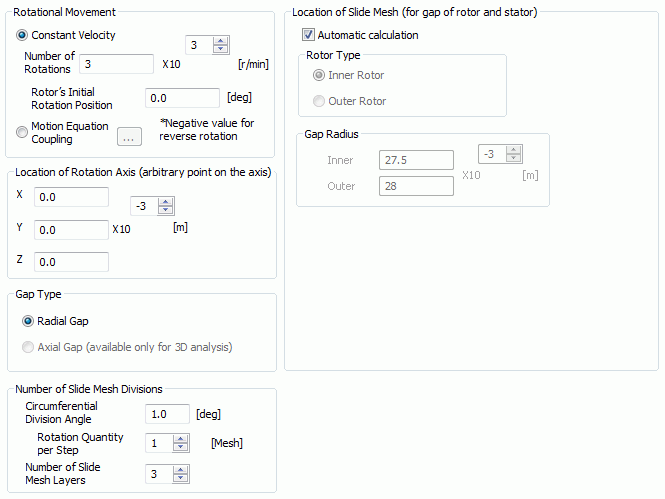
Rotational Movement |
Constant Velocity Selectable it if the number of rotations is constant.
Number of Rotations Sets the number of rotations [r/min]. If 0 is entered, the rotation is locked. Select [Rotor] on the "Stator/Rotor/Air" tab for the body attribute to create the rotor body. The rotational direction is Enter negative value for the reverse rotation.
Rotor's Initial Rotation Position Sets the rotor's initial rotation position [deg] at the initial time. The value has to be the multiple of the [Circumferential Division Angle].
Motion Equation Coupling Executes the magnetic-rotational movement coupled analysis where the rotational movement is defined by the motion equation.
See also [Setting Motion Equation Coupling] for the details.
|
|
Location of Rotation Axis (Any point on the axis) |
Defines the location of the rotation axis. Enter any given coordinates of the rotation axis. The direction of the rotation axis cannot be changed.
|
|
Gap Type |
Sets either radial gap or axial gap for the rotating machinery. Axial gap is available only for 3D analysis. It affects the sliding mesh position.
|
|
Number of Sliding Mesh Divisions |
Sets the number of sliding mesh divisions.
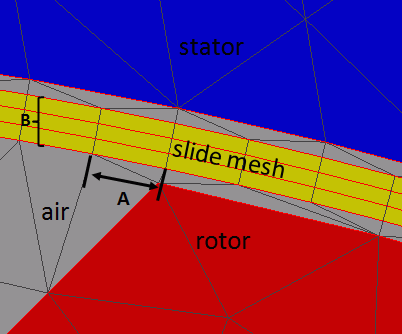
Circumferential Division Angle Specifies the circumferential division angle [deg] of the rotating machinery. (A in above diagram) If the rotational movement is [Constant Velocity], it is the minimum rotation angle per timestep. That is not always the case if the rotational movement is [Motion Equation Coupled]. If the rotation angle is not the multiple of the circumferential division angle, calculation is performed by transforming the sliding meshes to parallelogram.
Rotational Quantity per Step If the rotational movement is [Constant Velocity], set the rotational quantity per step that is set on the [Transient Analysis tab]. The unit is [Mesh]. If the value is 1, the rotor rotates at the angle set in the [Circumferential Division Angle] in a step. If the value is n, the rotation movement is at the multiple of n. No setting is required if the [Motion Equation Coupling] is selected for the rotational movement.
Number of sliding mesh layers Specifies the number of sliding mesh layers. (B in above diagram)
|
|
Location of Sliding Mesh |
Sets the location of sliding mesh (for gap of rotor and stator).
Automatic Calculation Calculates the sliding mesh location automatically. Generally this option is selected. Deselect it only when the automatic calculation does not work. Set the parameters manually as follows.
Rotor Type Sets either inner rotor or outer rotor.
Gap Radius Sets the inner and outer diameters of the gap between rotor and stator by radius.
Gap's Coordinates in Axial Direction (Z Coordinate) For the axial gap, specify the Z coordinates of the upper and lower faces of the gap in the rotation axis direction. Enter the values in the decreasing order.
|
 on the modeling window.
 Click this button. The [Setting Motion Equation Coupling] dialog box will appear.