|
Home / Technical Notes / Stress Analysis / Mechanical Damping
Mechanical Damping
How to set damping in resonant/harmonic analysis
The mechanical damping can be set in resonant/harmonic analysis as follows.
If the damping is not frequency-dependent, enter the mechanical loss tangent (tanδ) in Elasticity tab.
If the damping ratio ζ is known, convert it to the mechanical loss factor or tanδ using Equation (8) below. Result near the resonant frequency ωi will be obtained.
If the coefficients of Rayleigh damping α and β are known, convert them to the mechanical loss factor or tanδ using the Expression (10) below. Result near the resonant frequency ωi will be obtained.
To handle the frequency-dependent damping in harmonic analysis, define the frequency response of dynamic modulus on Viscoelasticity tab.
How to set damping in transient analysis
In transient analysis, you can set it on Viscoelasticity tab of the material property.
Alternatively you may set it on Coefficient of Rayleigh Damping tab of the body attribute.
See [analysis of Viscoelastic Materials] and [Stress Transient Analysis] for more details.
Equations for damped oscillation
Equation of motion in [Differential Equations Solved in the Stress Analysis] can be rewritten as follows.
The external force f includes body and surface forces. It is zero in resonant analysis.
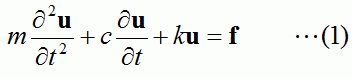
where m: mass, u: displacement, t: time, c: coefficient of damping, k: spring constant, f: external force.
By replacing the time derivative with jω in Equation (1), Equation (2) is obtained.

where ω is the angular frequency and j is the imaginary unit.
By replacing k with k* (defined in Equation (3)) in Equation (2), Equation (4) is obtained.
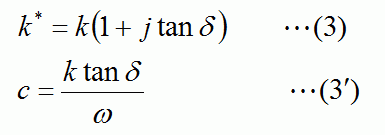
where k* is the complex spring constant and tanδ is the mechanical loss tangent.

Equation (4) is the same formula as the lossless equation. Therefore it can be solved similarly.
The spring constant is proportional to the elastic modulus, so the former can be replaced with the latter.
To study the damping characteristics of viscoelastic materials, Equation (5') is used.
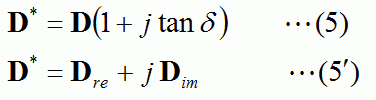
D* is the complex elastic modulus. Dre is the storage modulus. Dim is the loss modulus.
Damping parameters with damping ratio
The coefficient of damping c is given by Equation (6')
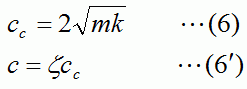
where cc is the critical coefficient of damping and ζ is the damping ratio.
If ζ > 1, the system is over-damped. It decays without oscillation.
If ζ < 1, the system is under-damped. It oscillates and the amplitude gradually decreases.
With the resonant frequency ωi defined in Equation (7), Equation (6') is expressed as Equation (7').
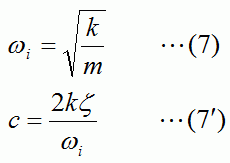
where ωi is the resonant frequency.
Assuming that the frequency of interest is resonant frequency (ω = ωi),
compare Equations (3') and (7'), and the relation between tanδ and ζ is given as follows.

If the damping ratio ζ is known, by entering the ζ multiplied by 2, simulation will be performed with damping ratio being taken into account.
Damping parameters with coefficient of Rayleigh damping
The coefficient of damping c is given as follows with coefficients of Rayleigh damping α and β

Assuming that the frequency of interest is resonant frequency (ω = ωi),
compare Equations (3') and (9), and the relation between tanδ and α and β is given as follows.
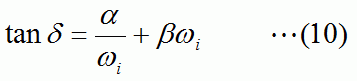
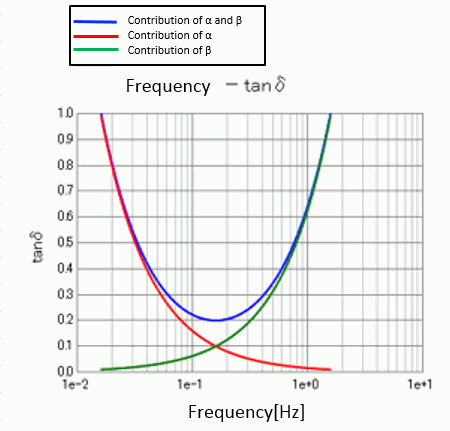
As an example, frequency dependency of tanδ is shown below with α=0.1 [/s] and β=0.1 [s]
where α is damping of low frequency vibration and β is damping of high frequency vibration.