


|
Home / Technical Notes / Stress Analysis / Differential Equations in Stress Analysis
Differential Equations Solved in the Stress Analysis
Basic Equations
(1) Equation of Balance

σ: stress, ρ: density, b: force for a unit mass
ρb is a body force.
Equation (1) is used for time-invariant system.
For time-variant system, Equation (2) is used.
(2) Equation of Motion

where ρ: density, u: displacement, t: time, σ: stress, b: force per unit mass, c: coefficient of damping per unit volume
The first-order time derivative of displacement is velocity. The second-order time derivative is acceleration.
The term of acceleration is the force of inertia. The term of velocity is the resistance due to viscosity.
When the acceleration and velocity terms are equal to 0, Equation (2) becomes Equation (1).
(3) Relation between Stress and Strain

σ: stress, ε: strain, D: elasticity (stiffness) matrix
This is a constitutive relation specific to a material.
See Anisotropic Elasticity Matrix and Analysis of Nonlinear Materials.
(4) Relation between Strain and Displacement

ε: strain, u: displacement, B: displacement gradient matrix
For small strains consisting of εxx, εyy, εzz, εyz, εzx, and εxy,
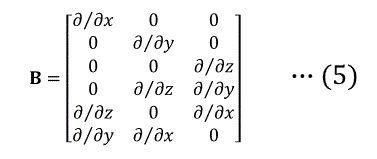
For large strains, the relation between strain and displacement is more complicated. See Analysis of Large Deformation (Geometric Nonlinearity).
Static Analysis including Buckling Analysis
Equation (6) is derived from Equations (1), (3) and (4).

D: elasticity (stiffness) matrix, B: displacement gradient matrix, u: displacement, ρ: density, b: force for a unit mass
The matrix equation for static analysis is derived from Equation (6). It is solved for displacement u.
Strain and stress are then obtained from Equations (3) and (4).
Transient Analysis
Equation (7) is derived from Equations (2), (3) and (4).

ρ: density, u: displacement, t: time, D: elasticity (stiffness) matrix, B: displacement gradient matrix, ρ: density, b: force for a unit mass
The matrix equation for the stress analysis is derived from the equation above. It is solved for displacement u. See Stress Transient Analysis for the details.
Strain and stress are then obtained from Equations (3) and (4).
Resonant/Harmonic Analysis
In resonant/harmonic analysis, D includes the damping factor. Therefore the coefficient of damping c is equal to 0.
See Mechanical Damping for more information.
The elasticity which includes the damping factor is a complex number and called dynamic modulus D*.
By replacing the time derivative with jω in Equation (7), Equation (8) is obtained.

ρ: density, ω: angular frequency, u: displacement, t: time, D*: dynamic modulus, B: displacement gradient matrix, ρ: density, b: force for a unit mass
The matrix equation for resonant/harmonic analysis is derived from Equation (8). It is solved for displacement u.
Strain and stress are then obtained from Equations (3) and (4).