


|
Home / Technical Notes / Stress Analysis / Matrix Equations for Stress Analysis
Matrix Equations for Stress Analysis
In stress analysis, the following matrix equations are solved:
Linear Static Analysis
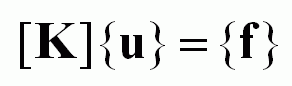
[K] is the stiffness matrix, which is related to the material's elasticity.
{f} is the load vector, which is related to the displacement boundary and the load boundary.
{u} is the displacement vector, which is the unknown.
By solving this equation, the displacement is acquired. Then the strain and the stress are solved.
Static Analysis (Nonlinear, Multi-Step)
The following are nonlinear analysis.
1) Analysis of Large Deformation (Geometric Nonlinearity).
2) Analysis of Nonlinear Materials
In the static analysis which includes one of the above three or multi-step/multi-step thermal load analysis on the Step/Thermal Load tab,
the displacement increment is calculated for each time step.
The matrix equations below are solved to obtain the displacement increment.
[K] is the stiffness matrix, which is related to the material's elasticity.
Geometric nonlinearity is included in this matrix.
{f} is the load vector, which is related to the displacement boundary and the load boundary.
{Q} is the internal force vector, which represents the strains and stresses resulting from the previous step.
{Δu} is the displacement increment vector, which is the unknown.
The stiffness matrix, the load vector and the internal vector vary before and after the increment in nonlinear analysis.
Therefore, the displacement increment vector cannot be obtained with just a single calculation.
The calculation is repeated multiple times until the reasonable incremental value is obtained.
This is called the Newton-Raphson method.
See [The Newton-Raphson Method and Convergence Judgment in Stress Analysis].
Resonant Analysis
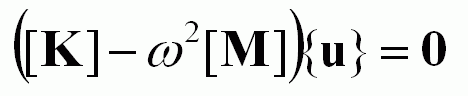
[K] is the stiffness matrix, which is related to the material's elasticity.
[M] is the mass matrix, which is related to the material's density.
{u} is the displacement vector, which is an unknown.
ω is the angular frequency, which is another unknown.
The eigenvalue of this equation is the angular frequency. The eigenvector is the displacement.
Harmonic Analysis
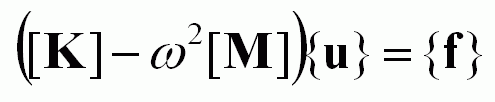
[K] is the stiffness matrix, which is related to the material's elasticity.
[M] is the mass matrix, which is related to the material's density.
{f} is the load vector, which is related to the displacement boundary and the load boundary.
ω is the angular frequency, which is given as an analysis condition of harmonic analysis.
{u} is the displacement vector, which is the unknown.
It is presumed that both the displacement and the load oscillate at the frequency of ω.
Transient Analysis

[K] is the stiffness matrix, which is related to the material's elasticity.
[M] is the mass matrix, which is related to the material's density.
[C] is the damping matrix, which is Rayleigh damping: α[M] + β[K].
{a} is the acceleration vector, {v} is the velocity vector and {u} is the displacement vector. They are all unknowns.
{f} is the load vector, which is related to the displacement boundary and the load boundary.
This equation is solved by Newmark method for each time step.
See Stress Transient Analysis for the details.
Note: Stress transient analysis is available in an optional package.
Buckling Analysis
See Buckling Analysis.