


|
Home / How to Set Analysis Condition / List of Analysis Condition Tabs / Fast Stabilizer Tab
Fast Stabilizer Tab
Conditions of the fast stabilizer in the magnetic transient analysis are set on this tab.
Correction setting is done to shorten the calculation time of the periodic steady-state field in the transient analysis.
This correction will significantly reduce the number of timesteps required until the steady state is achieved.
-
For a rotating machinery, if the power is voltage source, the coil current is in the transient state in the initial stages.
It will take much time before the coil current reaches a steady state (Many timesteps are required.)
Fast stabilizer is used to reduce the time steps.
-
If the power is current source, the coil current is in the steady state from the beginning. This function, therefore, is not necessary.
It is in the [Analysis Condition Setting] dialog box. See also [How to Set Analysis Condition].
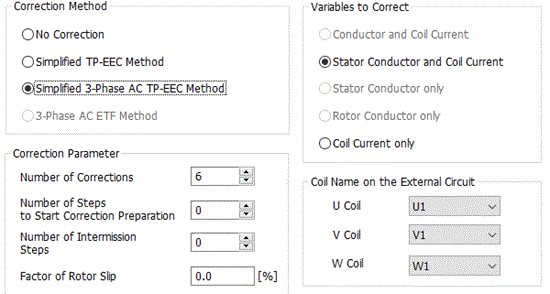
Fast Stabilizer
This correction is applied when a large number of timesteps are needed for convergence to a steady-state solution in the transient analysis concerning an eddy current field or coupling with an external circuit.
In the equation below, θ is electrical angle.
F(θ+π) = -F(θ)
Analysis model must have this half periodicity in the steady state. This function is applicable in a wide range of transient analysis of stationary device and rotating machinery.
However, this function is not effective for the induction motor having small slip (less than 3%) in general.
The unknown variables for the correction have time derivative items in the analytical equations.
The following correction methods are available.
-
Simplified TP-EEC method
-
Simplified 3-phase AC TP-EEC method that is essential to analyze inverter-driven motor
-
3-phase AC ETF method
The unknown variables tor correction in the magnetic field analysis equation are the unknowns (relating to the magnetic vector potential) in eddy current.
In the circuit coupled analysis, current of coil is the unknown variable for correction.
Conditions of applying correction
All of the conditions below must be met to apply correction.
-
Analysis object is half periodic
F(θ+π) = -F(θ) where θ is electrical angle
*) Please note that some rotating machineries are not half periodic. -
Current power and voltage power are DC (cos wave) and all frequencies are set up
-
The number of rotations is not 0 for the rotating machinery analysis
-
Time step value in the transient analysis is not too large (frequency x timestep value is 1.0 or less)
-
Timestep value in the transient analysis is constant.
TP-EEC Method
TP-EEC Method (Time-Periodic Explicit Error Correction Method) reaches the steady state fast.
This method must solve asymmetric matrix equations. The simplified TP-EEC method, on the other hand, can perform approximation calculation by the simplified operations.
Correction equations are as follows.
-
Simplified TP-EEC Method
Xnew(t) = (Xold(t) - Xold (t - T/2))/2 (T: time period) -
Simplified 3-Phase AC TP-EEC method
Unew(t) = α(⊿U+⊿V+⊿W) –⊿W (α: user to define, typical value: 1/2)
(⊿U, ⊿V, ⊿W: time-varying amount of U, V, W after 1/6 period)
Features of each method are as follows.
-
Simplified TP-EEC Method
Correction is applied only at every half period but continuous correction is possible and it is robust. -
Simplified 3-Phase AC TP-EEC Method
Correction at every 1/6 period is possible in the 3-phase AC system and continuous correction is also possible.
Please note that it is a reasonable correction for the 6n±1-order harmonics but not effective for the 6n±3-order harmonics. (n is integer.) -
3-phase AC ETF method
Correction is applied with shorter time interval than 1/6 period (user to define).
See Fast Stabilizer for the details.
|
Setting Item |
Notes |
|
Correction Method |
Conditions for applying correctionSee [Conditions of applying correction] explained in the above. Selection of correction methodsSelect simplified 3-phase AC TP-EEC method for the models where U, V, and W rotate at every electrical angle of 60 degrees. For other models which are half periodic, select simplified TP-EEC method. Details of each correction methodNo Correction Runs the solver without correction.
Simplified TP-EEC Method Applies correction at every half period.
Simplified 3-Phase AC TP-EEC Method Applies correction at every 1/6 period. It is essential for the analysis of inverter-driven motor.
3-phase AC ETF method Applies correction at interval shorter than 1/6 period (user to define). To use method, select [Motion Equation Coupling] on the [Rotating Machinery tab], and in the [Setting Motion Equation Coupling], select [Coupling with motion when coil current reaches the steady state]. |
|
Correction Parameter |
Number of Corrections Specifies the number of corrections. Enter negative value for the continuous corrections. Considering tolerance, it is around 6.
The number of steps to start correction preparation Specifies the number of steps to start the correction preparation. Usually, 0 is entered if [Motion Equation Coupling] is selected for the Rotational Movement on the [Rotating Machinery tab].
The number of intermission steps Specifies the number of intermission steps from the last correction until the next correction preparation starts. In the eddy current calculation, it is recommended to wait until the calculation stabilizes before starting the next correction preparation It is especially important for the induction machinery. Enter the positive value for the induction machinery.
Usually, 0 is entered if [Motion Equation Coupling] is selected for the Rotational Movement on the [Rotating Machinery tab].
Factor of Rotor Slip Specifies the factor of rotor slip by [%] in the rotating machinery analysis. Synchronous machinery : enter 0.0
Induction machinery: enter 3 if the factor of rotor slip is 3%. ( f - frot )/f Rotational frequency (frot) is different from the number of rotations (fr), and expressed as follows for the 2N-pole rotating machinery. frot = N×fr ( r/min = 60×fr )
|
|
Variables to Correct |
Conductor and Coil Current Corrects the variables having the time derivative items in the entire conductor domain and the variables of coil current.
Stator Conductor and Coil Current (select this for the rotating machinery) Corrects the variables having the time derivative items in the stator conductor domain and the variables of coil current.
Stator Conductor only Corrects only the variables having the time derivative items in the stator conductor domain.
Rotor Conductor only Corrects only the variables having the time derivative items in the rotor conductor domain.
Coil Current only Corrects only the variables of coil current.
|
|
Coil Name on the External Circuit |
Specifies coil names of FEM components in the external circuit for U coil, V coil, and W coil of the 3-phase AC unit.
|