


|
Home / How to Set Analysis Condition / Fluid Analysis [Bernoulli] / Diffusion Analysis Setting
Diffusion Analysis Setting
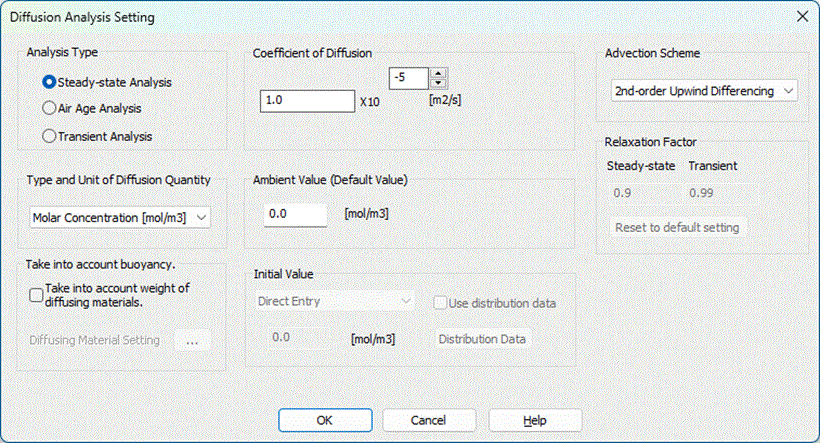
Analysis conditions for diffusion are set.
The diffusing material along the flow field obtained in the fluid solver is analyzed.
See Diffusion Analysis of technical note for more information.
|
|
Notes |
|
Analysis Type |
Steady-State Analysis There is no time dependency. Settable only if steady-state analysis is selected in the fluid solver.
Air Age Analysis Settable only if the analysis type of fluid solver is steady-state analysis. Obtains results of age, residual lifetime, and lifetime of the air. See Diffusion Analysis of technical note for more information.
Transient Analysis Transient states are analyzed. Settable both for steady-state analysis and transient analysis.
|
|
Type and Unit of Diffusion Quantity |
Selects the type and unit of diffusion quantity. Selects one from the 8 options below. ・No unit ・Molar concentration [mol/m3] ・Mass density [kg/m3] ・Mole fraction (no unit) ・Mole fraction [%] ・Mass fraction (no unit) ・Mass Fraction [%] ・Low concentration [ppm] |
|
Take Buoyancy into Account |
Select [Take into account weight of diffusing materials] Click [Diffusing Material Setting] |
|
Advection Scheme |
Sets an advection scheme for the diffusion quantity.
|
|
Coefficient of Diffusion |
Sets the coefficient of diffusion. The definition of the coefficient of diffusion is explained in Differential Equations in Fluid Analysis/Fluid-Thermal Analysis . The value of coefficient of diffusion can be any. For example, the typical value for the thermal diffusion of gas is 1.0-4 to 1.0-6[m2/s], and for fluid, 1.0-8 t o 1.0-10[m2/s], |
|
Ambient Value |
Sets the value for the diffusion quantity in the ambient which is out of analysis domain.
The ambient Value is used as follows.
・Reference value for buoyancy
If [Take into account weight of diffusing materials] is selected, buoyancy is calculated with the difference from ambient value.
・Inflow diffusion value of the boundary condition in the [Fluid Tab (Fluid-Thermal Tab] (Diffusion Analysis Setting), diffusion value on the wall face, ambient diffusion value for diffusion.
・Initial value for the transient analysis
|
|
Initial Value |
Sets the value of diffusion quantity at the initial time. Applicable if transient analysis is selected for the diffusion analysis.
If [Use Ambient Value] is selected, use the ambient value as an initial value.
If [Direct Entry] is selected, a value can be directly set.
If [Use distribution data] is selected,
Click the [Distribution Data] button to open the dialog box. |
|
Advection Scheme |
Sets an advection scheme for the diffusion quantity. |
|
Relaxation Factor |
In the fluid analysis, the calculation is iterated and gradually approaches the correct value. In the turbulent analysis, flow velocity, pressure, K_turbulent energy, and ε_engergy dissipation rate are calculated in one iteration. An additional process for calculating temperature is included in the two-way coupled analysis of the thermal-fluid solver (if the buoyancy is taken into account and the viscosity is temperature dependent). An additional process for calculating diffusion quantity is included if the weight of diffusing materials is taken into account in the diffusion analysis.
The increment of each physical quantity is solved in the individual calculation. Each physical quantity is updated by multiplying the relaxation factor to the increment. It prevents the diversion of calculation. The likelihood of diversion is smaller if the smaller relaxation factor is applied, but it will require more iterations and calculation time. Different values can be set in the steady-state analysis and the transient analysis.
The relaxation factor for diffusion quantity is set. (Alternatively, in [Detailed Settings for Fluid Analysis], velocity, pressure, K_turbulent kinetic energy, ε_energy dissipation rate, temperature, and diffusion relaxation factor can be set altogether)
Click [Reset to Default Setting] to return to the default values. |
