CAE Software【Femtet】Murata Software Co., Ltd.

- Top
- Product<
- Applications
- Analysis of Deposit Thickness in Rack Plating
Application111 Analysis of Deposit Thickness in Rack Plating
General
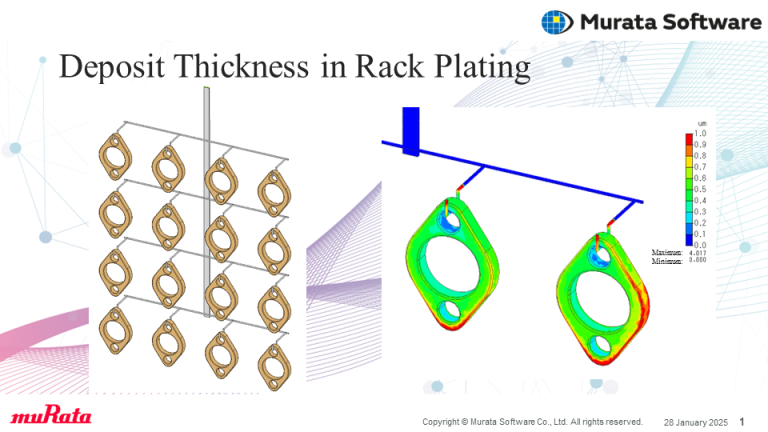
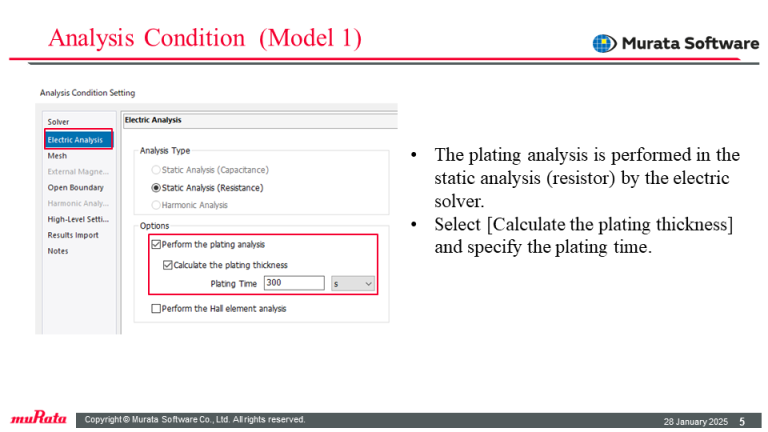
Rack plaiting is one type of electroplating process. The deposit thickness in rack plating is analyzed.
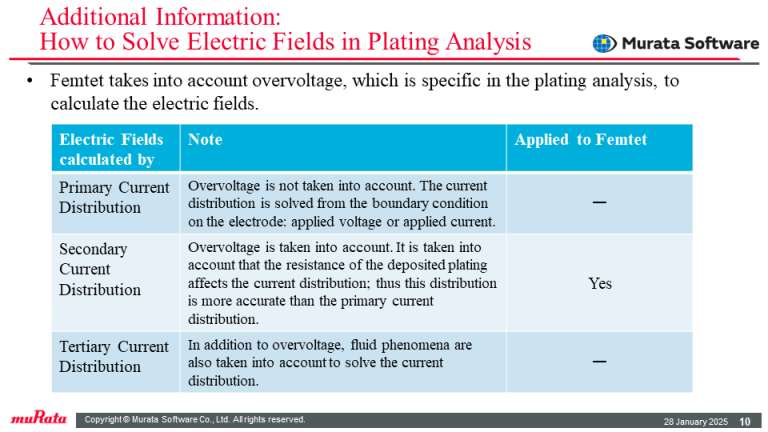
Femtet solves the current distribution (the secondary current distribution) in a plating bath, which allows you to design a current shield plate for a more uniform deposit thickness and to evaluate the operation conditions for the plating bath.
Analysis Model
-Model 1
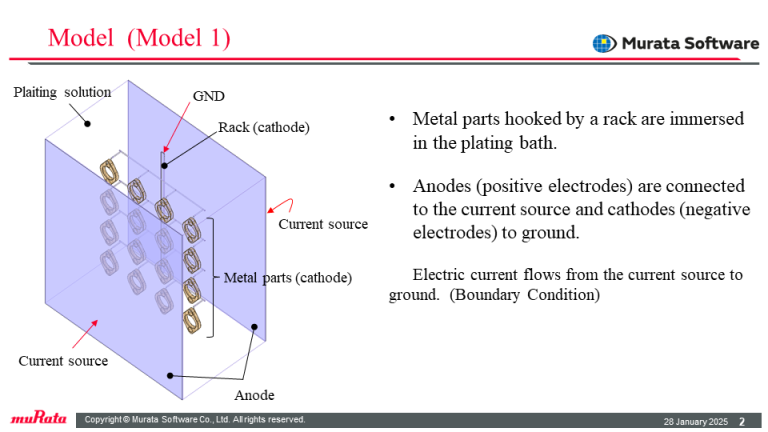
Metal parts hooked by a rack are immersed in the plating bath.
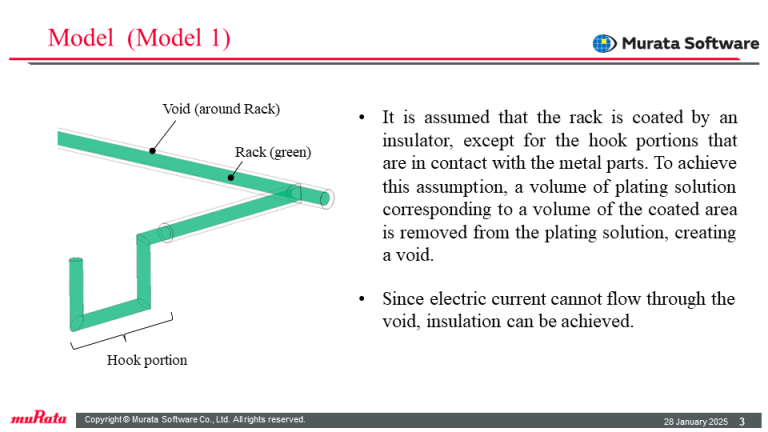
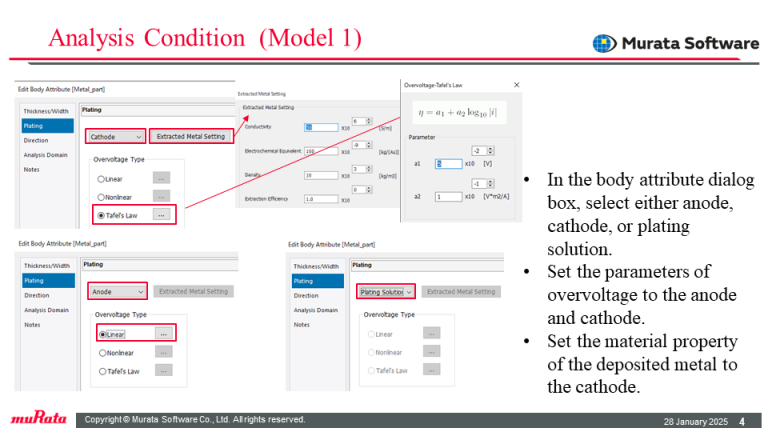
Anodes (positive electrodes) are connected to the current source and cathodes (negative electrodes) to ground. It is assumed that the rack is coated with an insulator, except for the hook portions that are in contact with the metal parts. To achieve this assumption, a volume of plating solution corresponding to the coated area is removed from the plating solution, creating a void. Since electric current cannot flow through the void, insulation can be achieved.
-Model 2
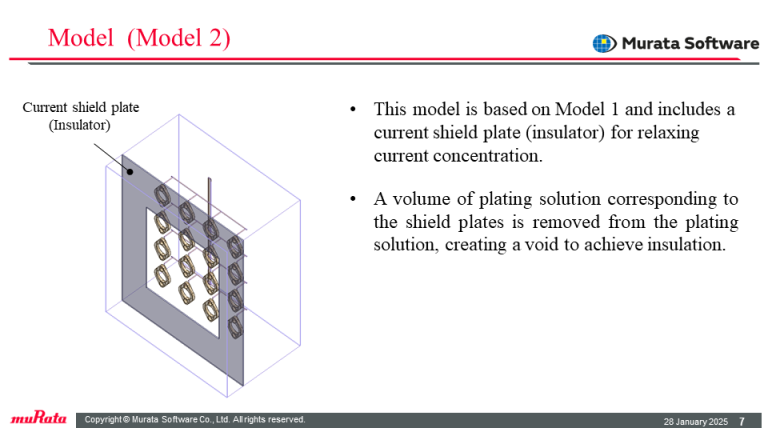
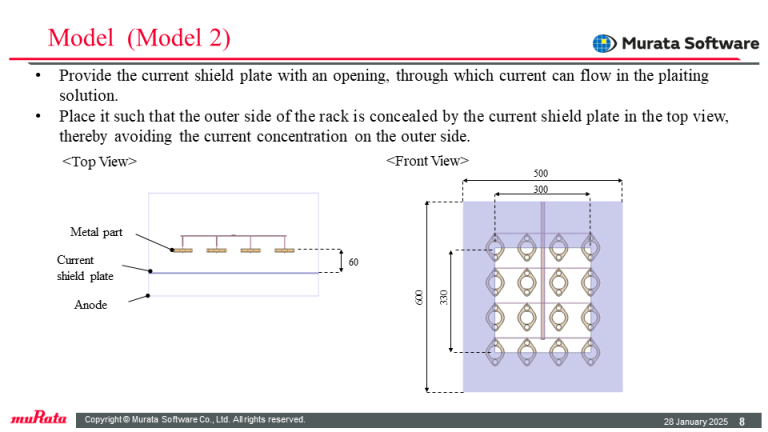
This model is based on Model 1 and includes a current shield plate (insulator). A volume of a plating solution corresponding to the shield plates is removed from the plating solution, creating a void to achieve insulation.
Result
-Model 1
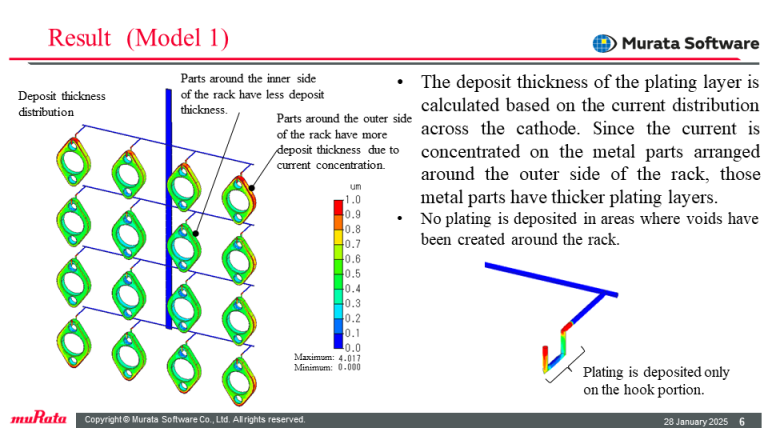
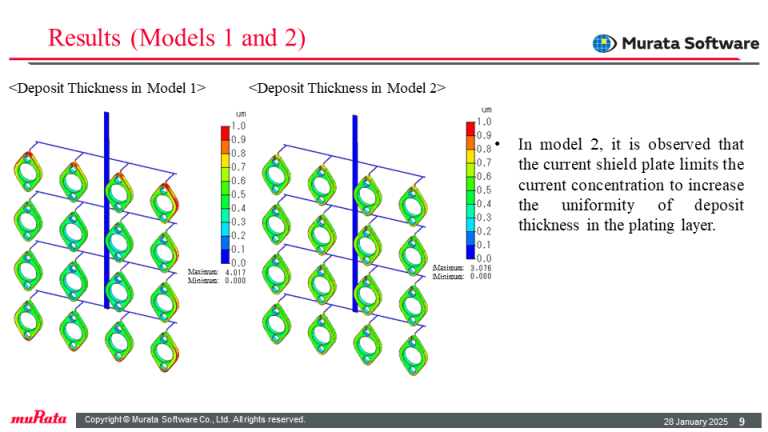
The deposit thickness of the plating layer is calculated based on the current distribution across the cathode. Since the current is concentrated on the metal parts on the outer side, those metal parts have thicker plating layers. On the surface of the rack, except for the hook portions, voids are provided around to achieve insulation, and no plaiting is deposited.
-Model 2
It is observed that the current shield plate limits current concentration to increase the uniformity of deposit thickness in the plating layer.
Key Words
Electrolytic Plating, Electroplating, Overvoltage, Secondary Current Distribution, Deposit Thickness, Rack, Hook