

Functionalities
Femtet provides all the functions required for model creation (CAD functions), mesh generation, analysis execution, and results display.
Analysis Functions


 Model Creation / Results Display
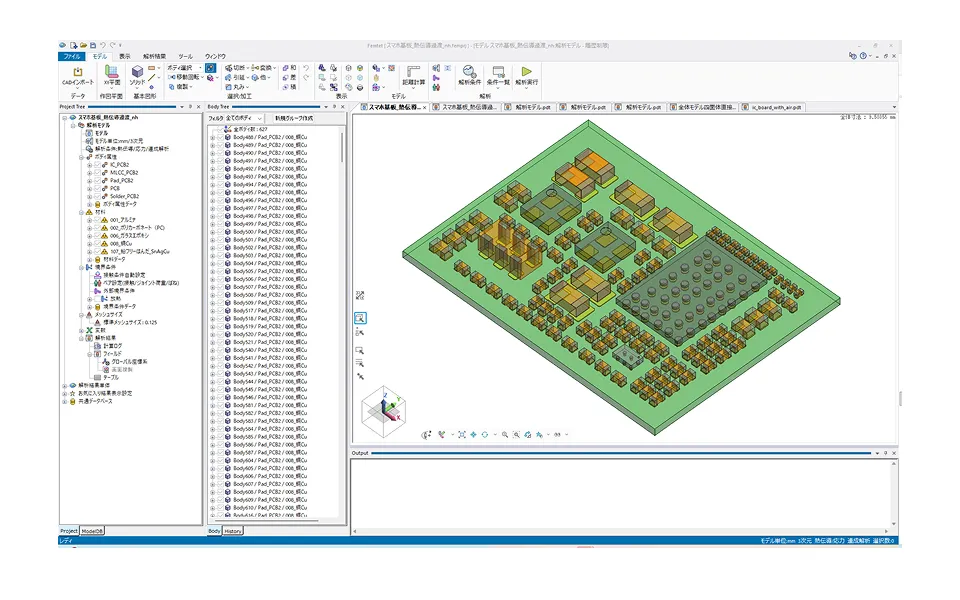
You can create geometry using the modeler included with Femtet. It also supports importing various CAD data formats.
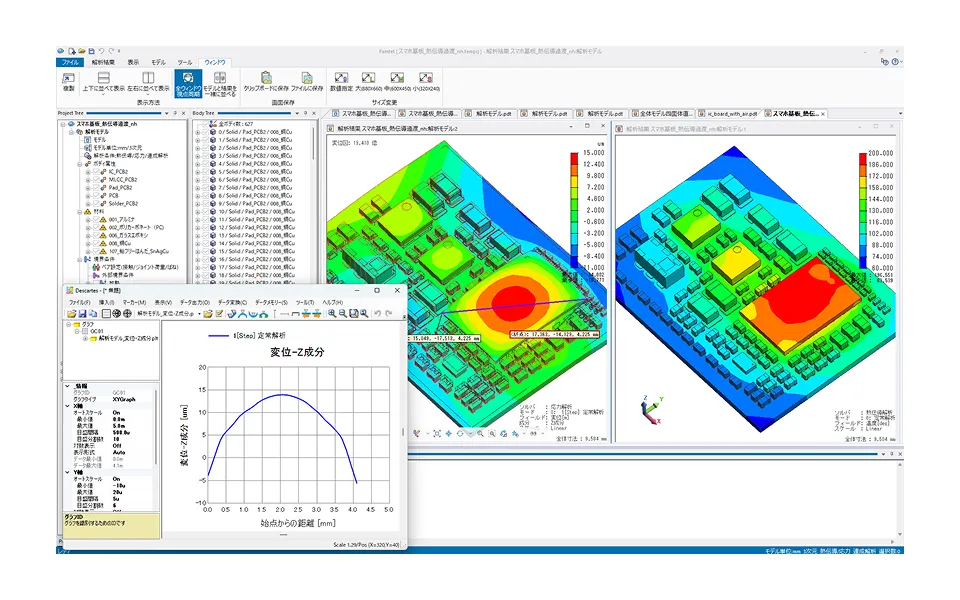
Calculation results can be displayed in 2D and 3D views. Graphs can also be created.
| Solid Modeler | Includes a wide range of functions such as sketching, Boolean operations, chamfering/rounding (C, R), sweep, spin, spline surfaces, lofting, bonding wires, distance calculation, shell processing, offset, cross-sectional display, and dimension lines. |
| Mesher | Supports element types (triangles, rectangles, tetrahedra, and hexahedra), automatic mesh generation, adaptive meshing (h-method), sweep mesh, automatic Boolean operations, automatic joint, automatic interference removal, spatial mesh, and mesh division settings in the thickness direction. |
| Results Display | Includes a wide range of visualization tools such as mesh, displacement, contour and vector plots, also streamlines/lines of force, integration, average values, animation, cross-sectional views, graph creation, CSV output, grid-format result output, tooltips, local coordinate systems, and multiple-window display. |
| Macro | Written in Excel VBA or Python (COM interface), with an automatic macro-code generation function (VBA, Python). |
| CAD Conversion Functions |
●Standard
Import Parasolid format (.x_t, .x_b), DXF format (.dxf), Gerber data (RS-274X format), and drill data (Excellon format). Export Parasolid format (.x_t, .x_b), DXF format (.dxf), and Gerber data (RS-274X format). ●Optional (CAD Translator) Import CATIA(R) V6/V5/V4, Creo(TM), Pro/ENGINEER(R), I-deas, JT, Unigraphics/NX, SolidWorks(R), Solid Edge, ACIS(R), Autodesk Inventor, IGES, STEP, STL, PRC, IFC, VRML, DWG, and DXF (3D). Solid Edge,ACIS(R),Autodesk Inventor,IGES,STEP,STL,PRC,IFC,VRML, DWG, DXF(3D) Export ACIS(R), IGES, STEP, STL, and PRC. |
| Matrix Solver | Direct method, iterative method, multigrid method, and multicore support (optional). |
| Design Efficiency Tools | Parametric analysis, batch simulation, user database, Nastran-format mesh import/export, healing, and model generation from mesh data. |
-
Model Creation Screen
-
Results Display Screen
 Electromagnetic Analysis
Electromagnetic analysis calculates S/Y/Z parameters, radiation characteristics, and electromagnetic field
distributions, which are essential for designing antennas and RF/microwave components.
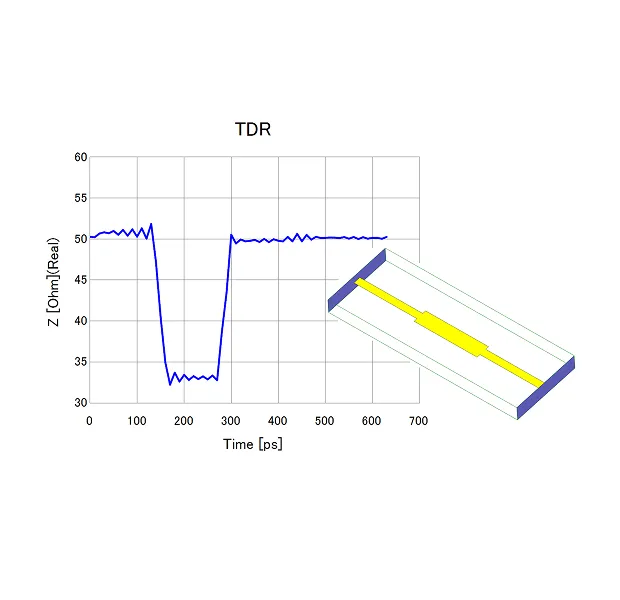
It also supports differential transmission lines and TDR.
Touchstone output enables linkage with circuit simulators.
| Analysis Functions | Harmonic analysis, resonance analysis, waveguide analysis, and transient analysis (optional). |
| Materials | Dielectrics (isotropic/anisotropic/temperature-dependent), magnetic materials (isotropic/anisotropic), conductors, and multilayer electrodes. |
| Boundary Conditions | Electric walls, magnetic walls, impedance boundaries, input/output ports, periodic boundaries, open boundaries, lumped constants (insertion of LCR and S-parameters), and multilayer electrodes. |
| Output Items | Electric field, magnetic field, S-parameters, resonance frequency, propagation constant, directivity (2D/3D), characteristic impedance, antenna gain, radiation efficiency, SAR, surrounding electromagnetic field, TDR, and Poynting vector. |
| Other | High-speed frequency sweep, thin-film electrode elements, surface roughness, differential transmission lines, incident waves, first-order/second-order edge elements, parallel sequential sweep, and interpolation sweep. |
-
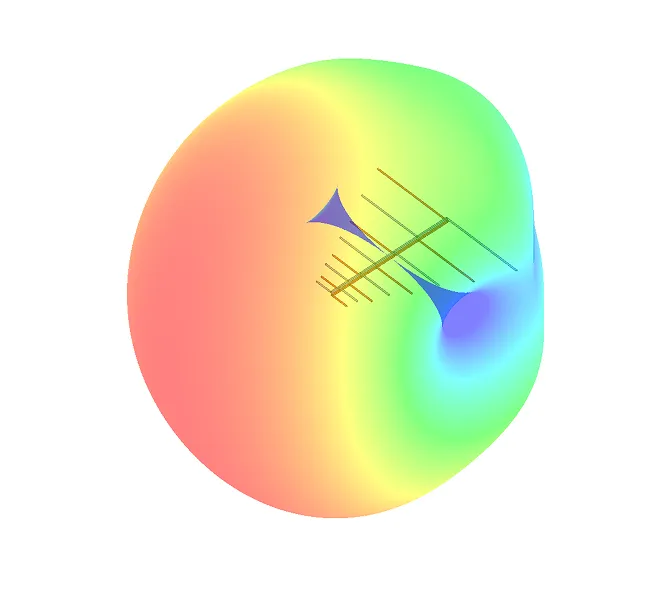
3D Directivity of an Antenna
-
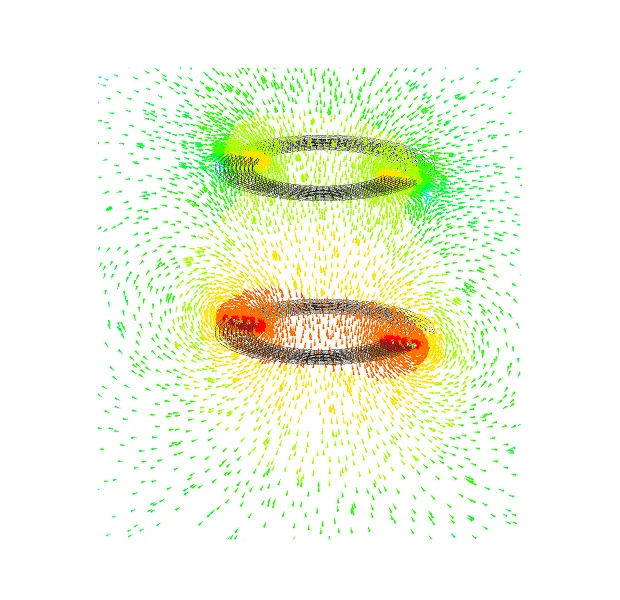
Electric Field Distribution for Wireless Power Transfer
-
TDR Analysis of Microstrip Wiring

 Magnetic Field Analysis
Magnetic field analysis calculates magnetic field distribution, magnetic flux density distribution, induced current,
and electromagnetic force in coils, magnets, and air.
It can also calculate coil characteristics (inductance and impedance), coupling coefficients, losses, and motor
characteristics (torque, T-N, and T-I).
Magnetostatic analysis handles direct current, AC magnetic field analysis handles sinusoidal current, and transient
magnetic field analysis handles arbitrary waveforms.
Materials with nonlinear B-H curves can be handled.
| Analysis Functions | Static analysis, harmonic analysis, transient analysis (optional), external circuit coupling (optional), rotating machines (optional), and linear motion machines (optional). |
| Materials | Isotropic, anisotropic, and nonlinear materials; magnetic materials, permanent magnets, conductors, temperature dependence, and irreversible demagnetization. |
| Boundary Conditions | Magnetic walls, electric walls, surface impedance boundaries, and open boundaries. |
| Output Items | Magnetic field, magnetic flux density, induced current, eddy current, inductance, coupling coefficient, electromagnetic force, impedance, torque, DC superposition characteristics, Joule loss, hysteresis loss, and Lorentz force. |
| Other | Current specification (input/output faces, current value, number of turns, and phase), bulk coils, Halbach magnetization, and linkage with MATLAB(R)/Simulink(R) motor analysis (optional). |
-
Busbar Inductance Analysis
(Current Density Distribution)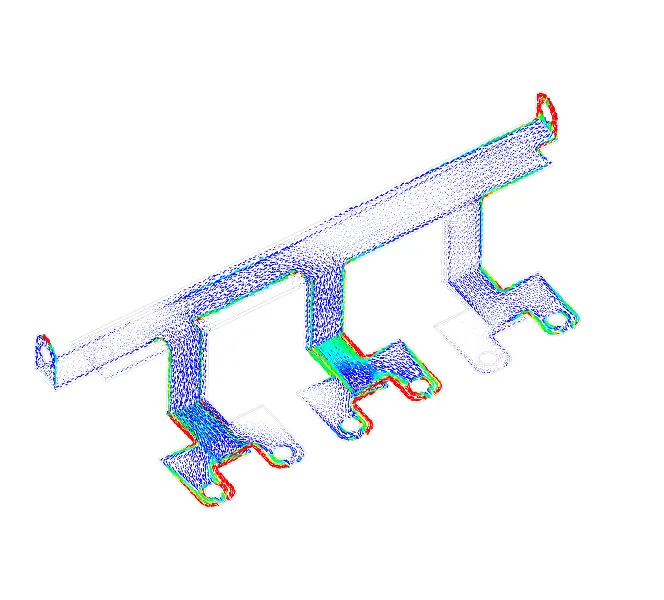
-
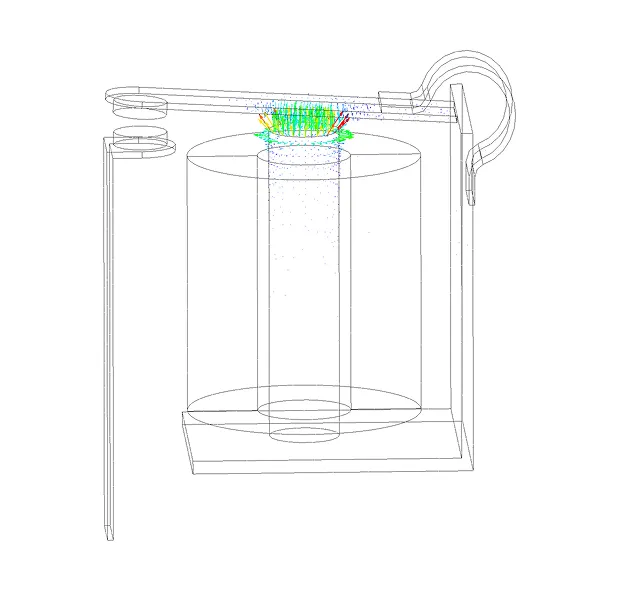
Electromagnetic Force of an Electromagnetic Relay
-
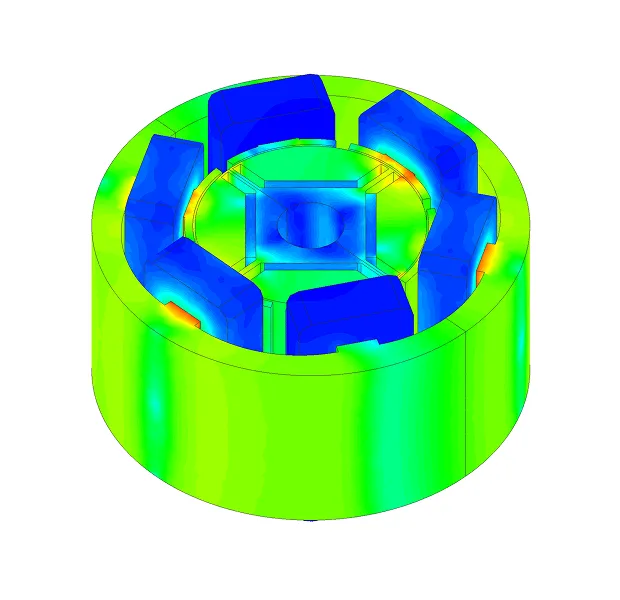
Magnetic Flux Density Distribution in a Motor
 Electric Field Analysis
Electric field analysis calculates electric field distribution and current distribution when voltage is applied to
dielectrics or conductors.
It supports electrostatic and AC electric fields, and can analyze capacitance and resistance between electrodes and
the force acting on dielectrics.
Plating analysis and Hall element analysis are also supported.
| Analysis Functions | Static analysis, harmonic analysis, plating analysis, and Hall element analysis. |
| Materials | Isotropic and anisotropic materials; dielectrics, conductors, temperature dependence, and electric-field dependence. |
| Boundary Conditions | Electric walls (voltage specification, floating electrodes), open boundaries, plating boundaries, periodic boundaries, current boundary conditions, and resistance boundaries. |
| Output Items | Electric potential, electric field, electric flux density, current, capacitance matrix, electrostatic force, and loss density. |
| Other | Space charge. |
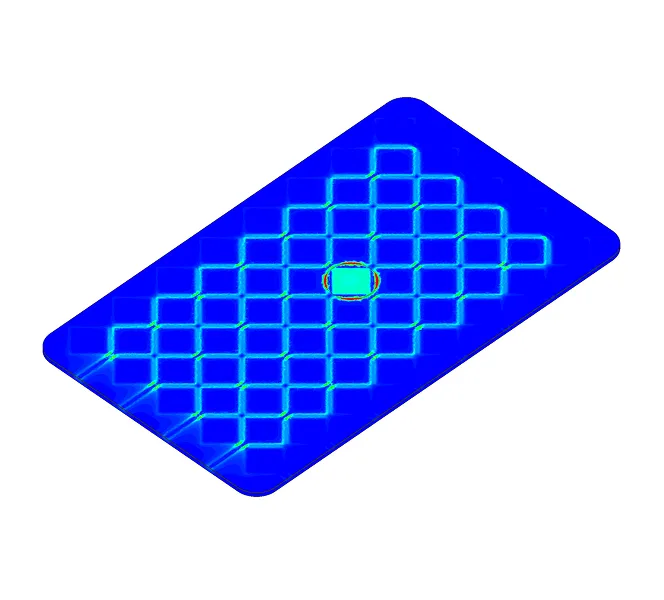
-
Electric Field Distribution in a Capacitive Touch Panel
-
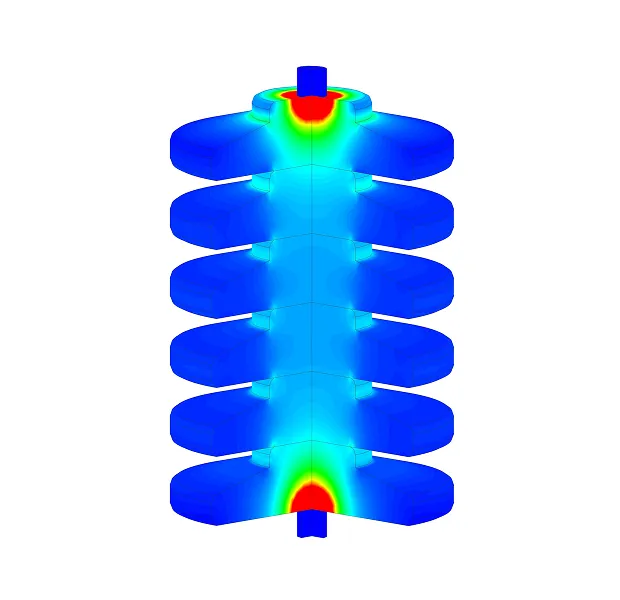
Electric Field Distribution in an Insulator
-
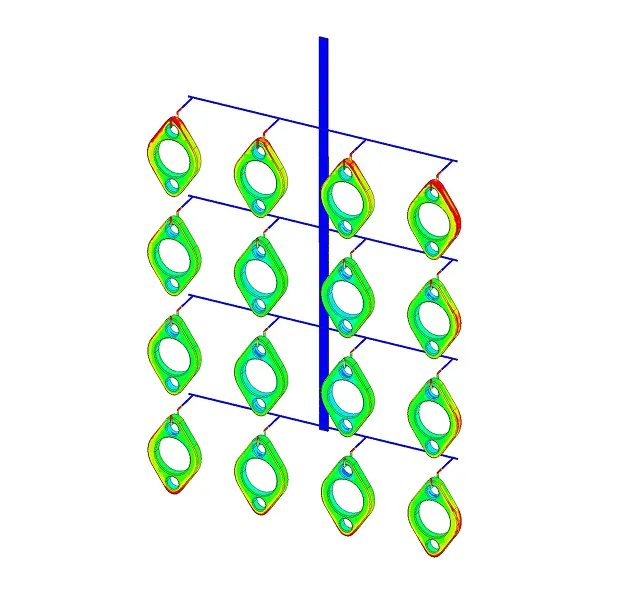
Plating Thickness Distribution
Free Trial
 Stress Analysis
Stress analysis calculates stress, displacement, strain, and other quantities in structures.
Specifically, it can analyze behavior under loads, deflection due to self-weight, verification of resonance
frequencies and modes, thermal loads, and deformation due to drop impact.
Visualizing stress and displacement makes design verification easier.
Elastic, elastoplastic, viscoelastic, and hyperelastic materials are supported.
| Analysis Functions | Static analysis, harmonic analysis, resonance analysis, transient analysis (optional), analysis considering initial stress, buckling analysis (linear), and large deformation analysis (large displacement and large strain (optional)). |
| Materials | Elasticity (isotropic/anisotropic), elastoplasticity (optional), creep (optional), viscoelasticity (optional), hyperelasticity (optional), coefficient of linear expansion (isotropic/anisotropic), and temperature dependence. |
| Boundary Conditions | Displacement, lumped vertex load, distributed load, pressure, torque load, contact (friction), arbitrary distribution boundaries, acceleration, joint load, spring connection, remote load, bond boundary, and rigid face. |
| Output Items | Displacement, stress, strain, reaction force, contact force, strain energy, J-integral, participation factor, effective mass, contact pressure, and contact area. |
| Other | Acceleration, thermal load (thermal analysis results can also be imported), initial strain, strain energy, birth/death, step analysis, centrifugal force, fatigue life (optional), rigid bodies, and shell elements (nonlinear/anisotropic). |
-
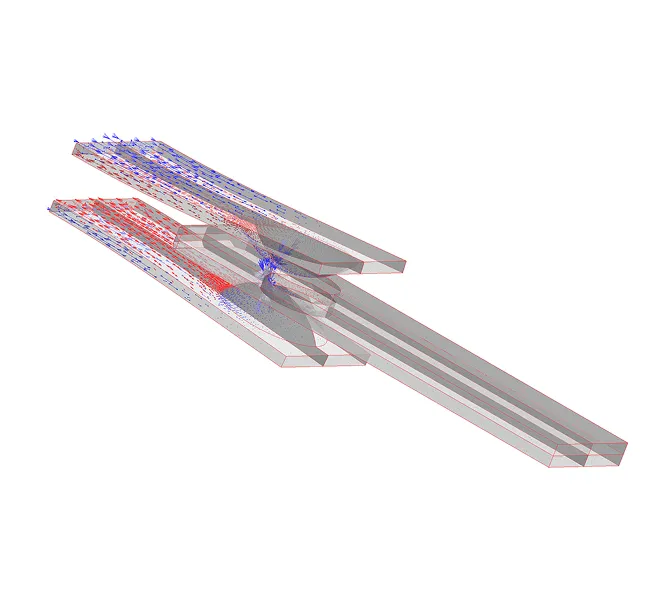
Contact Analysis of a Connector
-
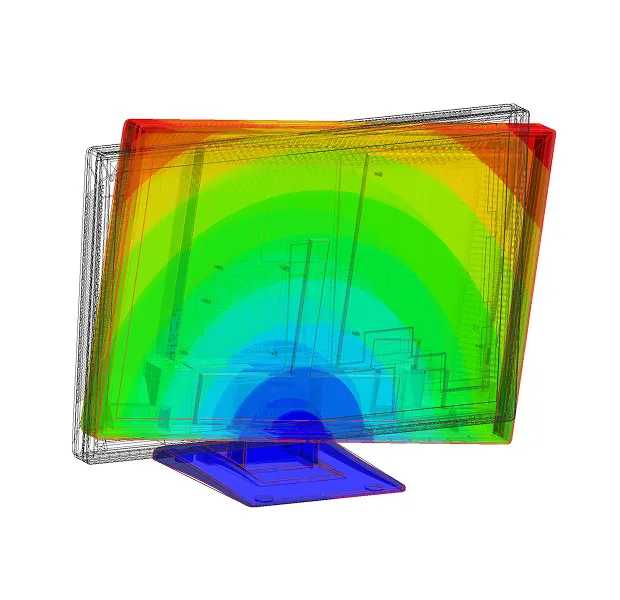
Resonance Analysis of Equipment
-
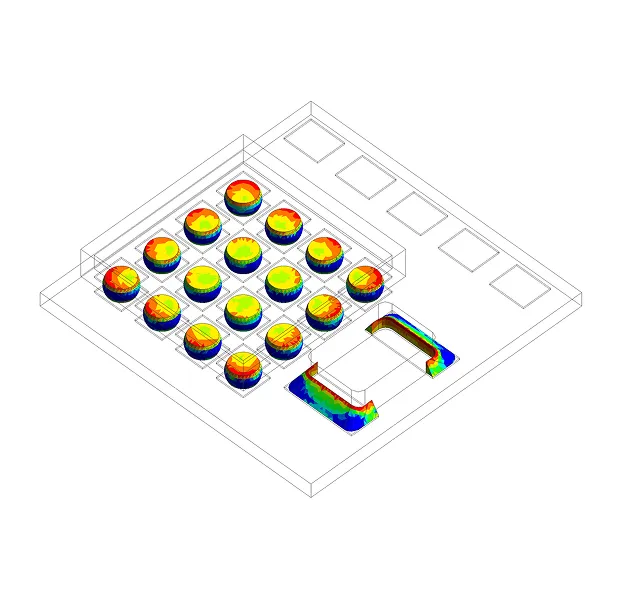
Fatigue Life Analysis of Solder
 Thermal Analysis
Thermal analysis calculates temperature and heat transfer within components (thermal conduction, heat transfer,
radiation, and heat flux).
Steady-state/transient analysis and nonlinear materials help enable appropriate thermal design.
Settings are available to automatically calculate natural convection coefficients from the model shape, and
thermal-fluid analysis is possible through coupling with fluid analysis.
| Analysis Functions | Steady-state analysis and transient analysis. |
| Materials | Isotropy, anisotropy, and nonlinearity. |
| Boundary Conditions | Temperature, heat flux, heat transfer (coefficient specification, natural convection, forced convection, and heat sinks), thermal resistance, radiation, arbitrary distribution, and bond boundaries. |
| Output Items | Temperature, heat flux, heat generation density, heat flow rate, thermal resistance, heat balance, junction resistance, and heat paths. |
| Other | Heat sources. |
-
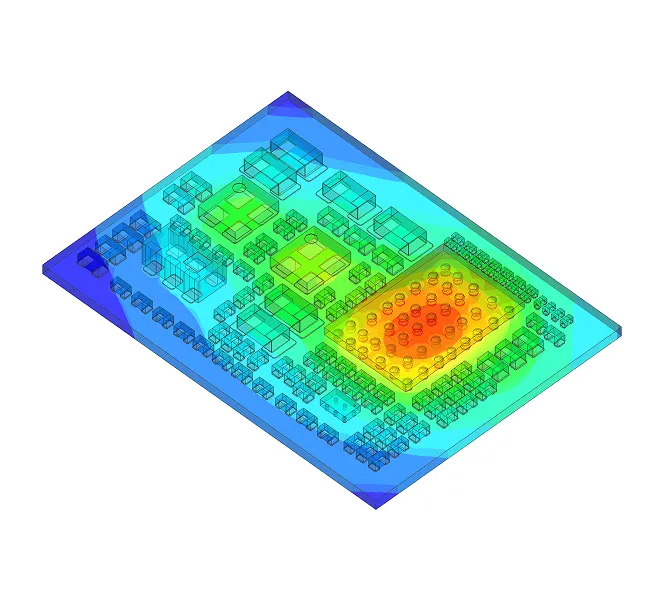
Thermal Design of a Circuit Board
-
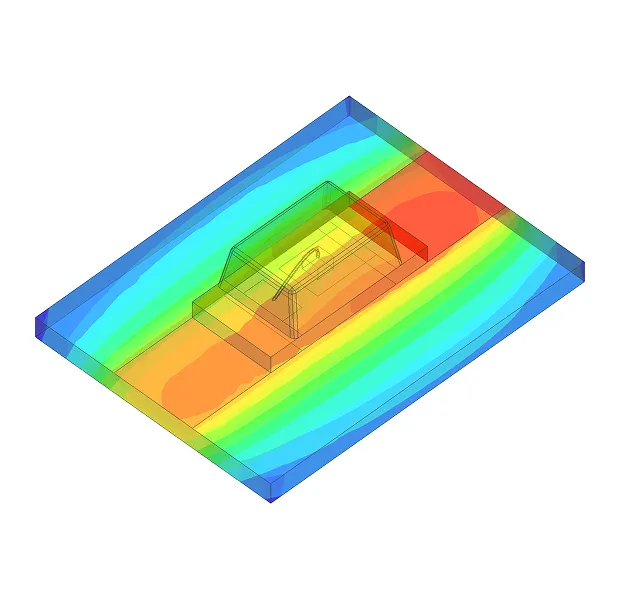
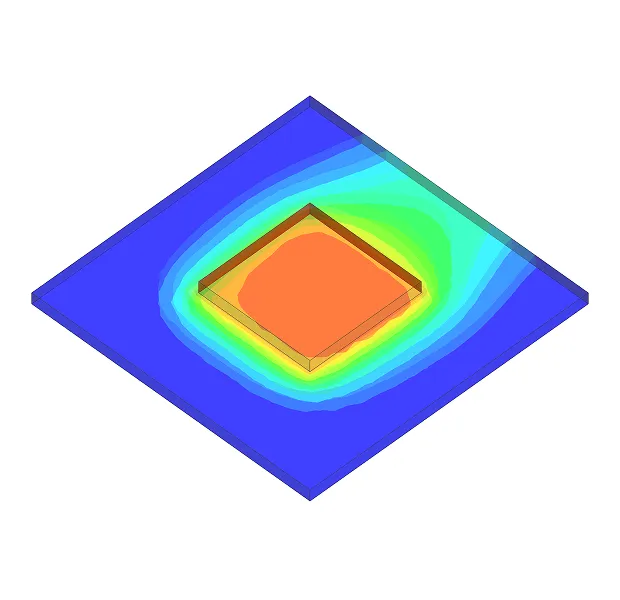
Heat Dissipation Distribution of an LED
-
IC Heat Dissipation by Forced Convection(Coupled Analysis with Fluid
Analysis)
 Fluid Analysis
Fluid analysis can analyze fluids such as water and air. It can analyze flow when obstacles exist in a flow path.
By coupling with thermal analysis, forced convection caused by flow calculated in fluid analysis can be computed.
| Analysis Functions | Steady-state analysis, transient analysis, thermal-fluid analysis (forced convection and natural convection) (optional), diffusion analysis (passive scalar), free-surface analysis (VOF method), node-centered/element-centered methods, and MRF (multiple reference frame) functionality. |
| Materials | Density, viscosity, molar weight, temperature dependence (optional), Newtonian fluids, and non-Newtonian fluids (power-law and Carreau models). |
| Boundary Conditions | Solid walls (stationary, translating, rotating), slip walls, forced inflow/outflow (velocity, flow rate, pressure, fan, direction specification, arbitrary distributed flow velocity, swirling flow), natural inflow/outflow, inflow/outflow pairs, and contact angle. |
| Output Items | Flow velocity, pressure (static pressure/total pressure), turbulent kinetic energy k, energy dissipation rate epsilon, wall force, volumetric flow rate, pressure loss, fan operating point, and heat transfer coefficient (optional). |
| Other | Laminar flow, turbulent flow (Realizable k-epsilon model and SST k-omega model), internal fluid flow specification (velocity, flow rate, pressure), porous media, and surface tension. |
-
Flow Around a Cylinder
(Karman Vortex)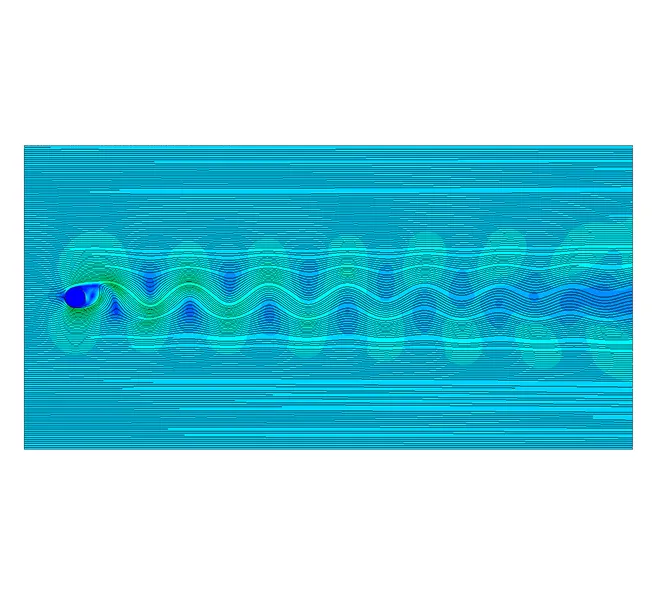
-
Swirling Flow of a Fan
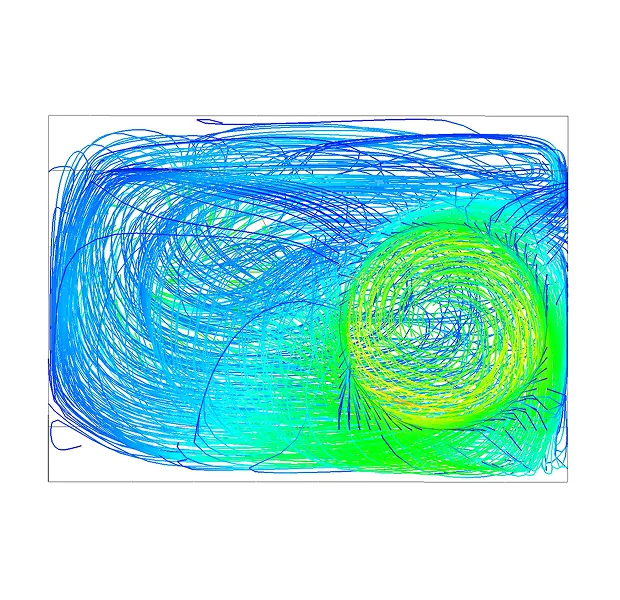
-
Thermal Design of a Circuit Board (Coupled Analysis with Thermal Conduction
Analysis)
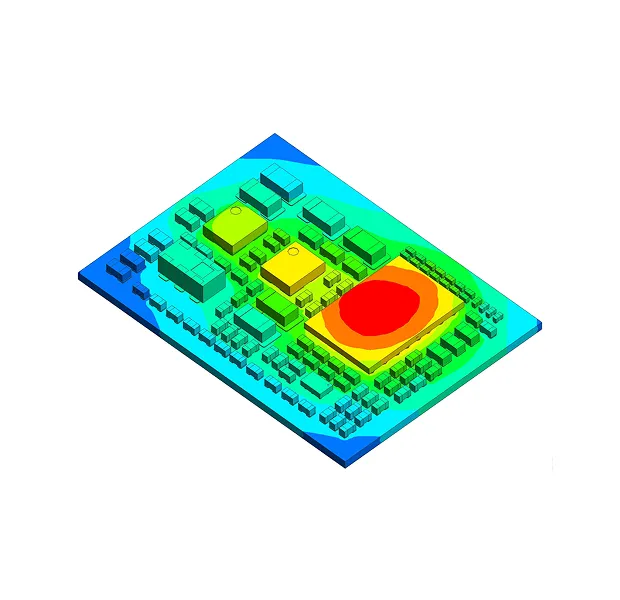
Free Trial
 Piezoelectric Analysis
Piezoelectric analysis calculates eigenvalues and frequency response for structures using piezoelectric crystals
such as quartz and piezoelectric ceramics.
It supports static analysis, eigenvalue analysis, frequency response analysis, and transient response analysis, and
can analyze vibration distribution and impedance characteristics of sensors, buzzers, actuators, and other devices.
| Analysis Functions | Static analysis, harmonic analysis, resonance analysis, analysis considering initial stress, transient analysis (optional), and large deformation (large displacement). |
| Materials | Piezoelectric materials, dielectrics (isotropic/anisotropic), perfect conductors (isotropic/anisotropic), and viscoelasticity. |
| Boundary Conditions | Electric walls (electric potential specification/floating electrodes/LCR addition), magnetic walls, displacement, concentrated load, distributed load, acceleration, pressure, torque load, remote load, contact (friction), acoustic impedance, open boundaries, periodic boundaries, and arbitrary distribution boundaries. |
| Output Items | Displacement, stress, strain, electric field, electric flux density, impedance, electric charge, electric potential, current value, resonance frequency, contact force, contact pressure, and contact area. |
| Other | High-speed frequency sweep, acceleration, angular velocity, thermal load, external resistance, centrifugal force, and Coriolis force. |
-
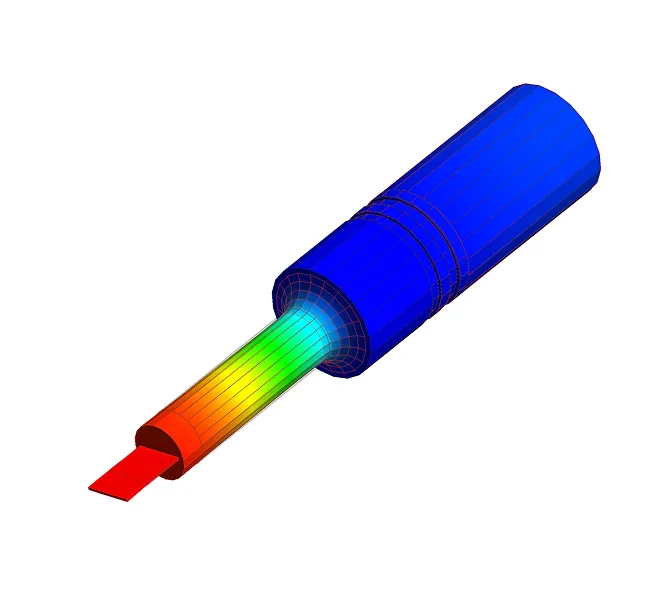
Vibration Analysis of an Ultrasonic Horn
-
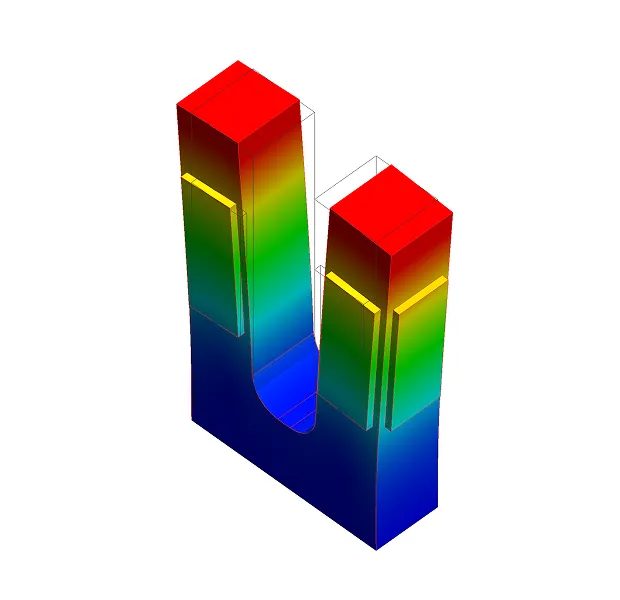
Resonance Analysis of a Piezoelectric Gyro Sensor (Displacement)
-
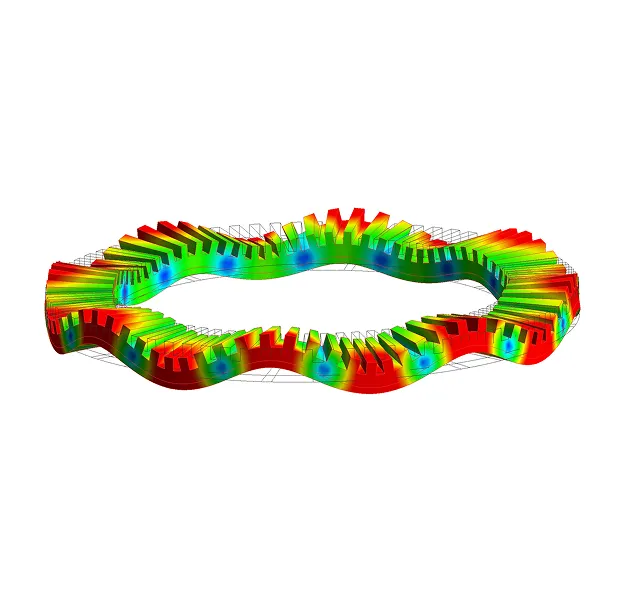
Vibration Analysis of an Ultrasonic Motor
 Acoustic Analysis
Acoustic analysis calculates sound pressure distribution and particle velocity distribution in the analysis domain
using inputs such as the location and magnitude of sound sources.
It calculates reflection/diffraction, resonance, and directivity of sound waves emitted from a sound source.
By combining it with piezoelectric analysis, you can examine the propagation of sound waves emitted from vibrating
bodies such as back sonar devices.
| Analysis Functions | Harmonic analysis and transient analysis. |
| Materials | Density, speed of sound, frequency dependence, damping media, and porous sound-absorbing materials. |
| Boundary Conditions | Displacement, pressure, velocity, sound pressure level, acceleration, rigid walls, open boundaries, and acoustic impedance. |
| Output Items | Sound pressure, sound pressure level, particle velocity, acoustic intensity, A-weighted sound pressure level, directivity, radiation impedance, loss density, and loss by body. |
| Other | High-speed frequency sweep. |
-
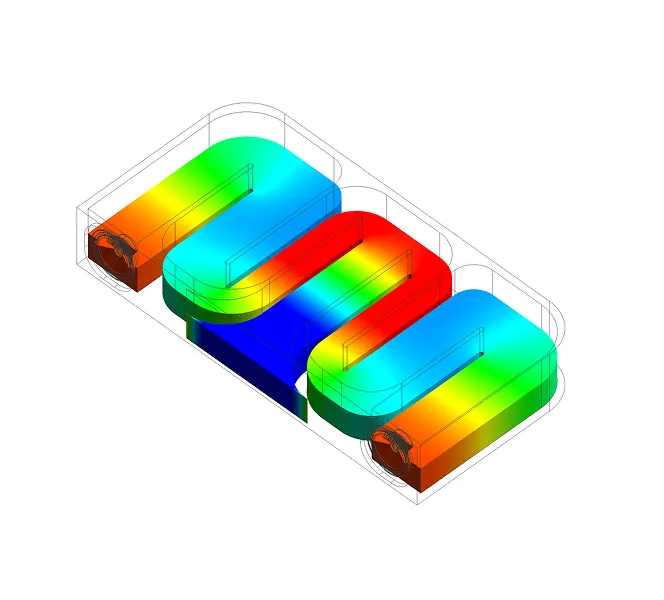
Sound Pressure Distribution Inside a Speaker Enclosure
-
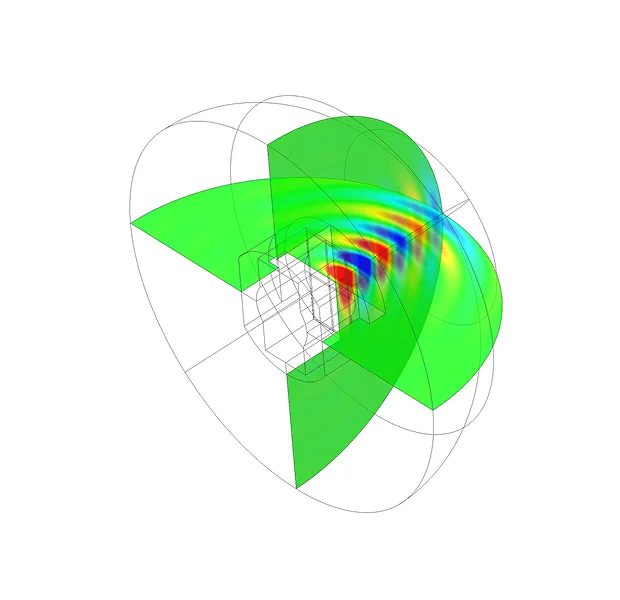
Ultrasonic Sensor
-
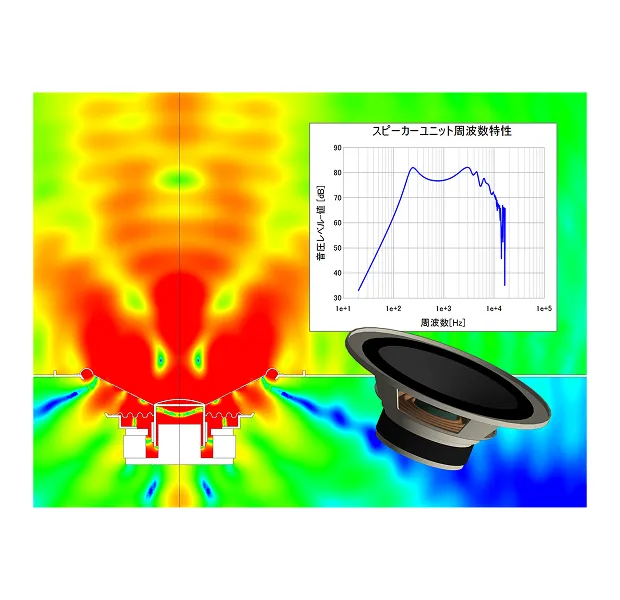
Acoustic Analysis of a Speaker (Sound Wave Reflection/Diffraction)
 Macro
Macro
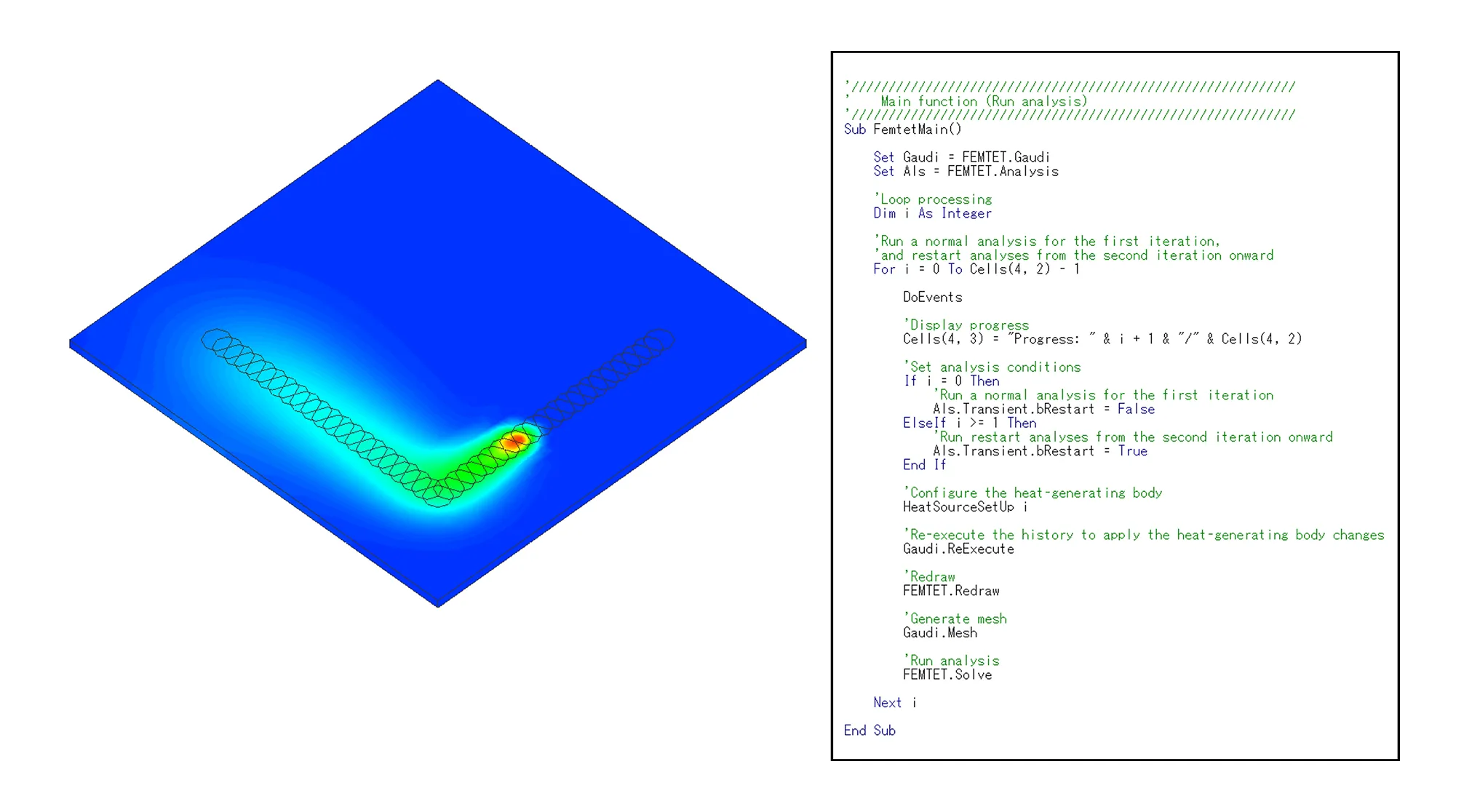
Femtet can be operated from Visual Basic and Python macros.
Macros can be used in many ways, such as automating repetitive operations, creating complex shapes, obtaining and
outputting results, and linking with business tools.
| Supported Languages | Excel VBA and Python (COM interface). |
| Automatable Processes | Dimension changes, material constant changes, switching analysis conditions, executing analysis, retrieving results, and iterative calculations. |
| Auxiliary Function | Automatic macro-code generation function (VBA and Python). |
-
Thermal Conduction Analysis with a Moving Heat Source Using a Macro
Brochure Request & Free Trial
-
Download materials that give you a quick overview of basic features, how to use Femtet, Cases, and more.

-
Apply for Seminars Here

-
Apply Here for a Free Trial
